
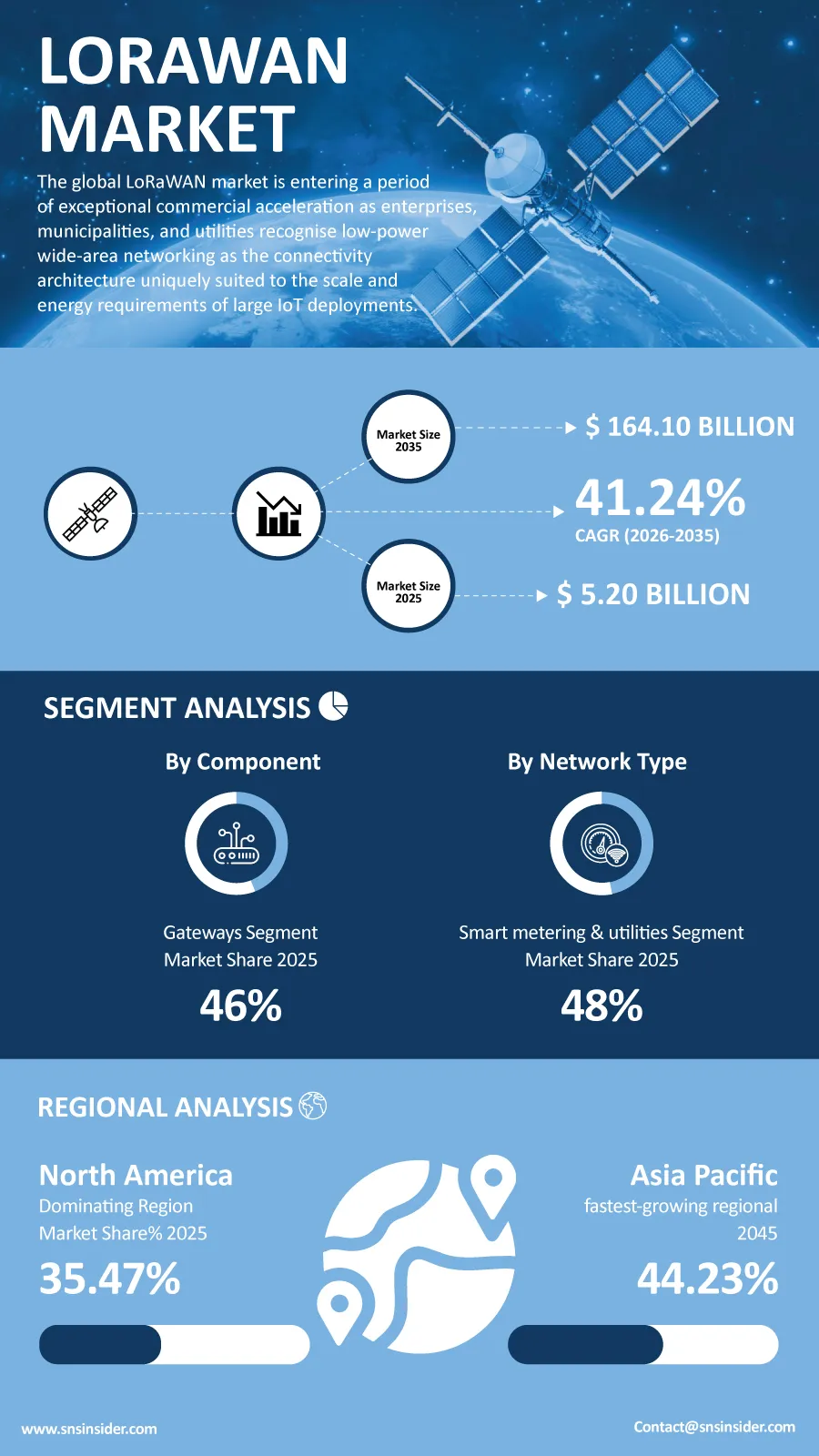
The global LoRaWAN Market is entering a period of remarkable expansion as organizations accelerate investments in Internet of Things (IoT) infrastructure, digital transformation, and intelligent monitoring systems. “According to a recent study by SNS Insider, the global LoRaWAN Market size valued at USD 5.20 billion in 2025, is anticipated to grow to USD 164.10 billion by 2035, registering a CAGR of 41.24% over the 2026–2035 forecast period.”
The increasing desire for cost-effective wireless connectivity is making more companies and local authorities look toward adopting LPWAN technology that allows the connectivity of millions of devices while using very little power. The LoRaWAN network protocol has become the communication protocol of choice for such applications that require long-range communications with low power consumption and scalability in different geographical locations.
Market dynamics are gaining momentum due to the fast-paced digital transformation in manufacturing, agriculture, logistics, energy, and smart cities. Companies are leveraging the use of connected sensors to measure their infrastructure, improve efficiencies, and collect real-time data with the reduction of maintenance expenses.
To Get Detailed Insights on the LoRaWAN Market – Request a Sample Report
Smart Infrastructure Investments Create Long-Term Growth Opportunities
Globally, governments and businesses are making considerable investments in the implementation of intelligent infrastructure projects with the aim of increasing efficiency, sustainability, and service provision. The smart metering systems, smart transportation, environmental monitoring systems, and intelligent utility networks have created considerable demand for wireless scalability platforms that can support sensors' large ecosystem.
The agricultural sector is also contributing considerably to the development of LoRaWAN technology as precision agriculture is becoming common. Applications such as soil monitoring, irrigation, animal identification, and environmental sensors help farmers to make informed decisions and increase their productivity while reducing resource utilization. With improvements in connectivity in rural areas, use of connected agricultural solutions is set to grow immensely.
Further development in the fields of semiconductor technology, IoT cloud platform technology, AI-powered network management, and satellite-based connectivity has made the commercialization of LoRaWAN technology feasible in remote industrial sites, international logistics, and infrastructure monitoring applications.
Key Market Insights Highlight Shifting Demand Patterns
Based on component, gateways are estimated to account for 46% of global market revenue in 2025 owing to their critical role in enabling reliable communication between end devices and centralized network servers. The modules segment is expected to experience the fastest growth through 2035 as organizations deploy increasing numbers of IoT-enabled sensors across industrial, agricultural, and smart city environments.
By network type, public LoRaWAN networks were dominant in 2025 in terms of market revenue due to increasing operator coverage and ease of deployment for commercial IoT applications. Private LoRaWAN networks are expected to show the highest growth in the forecast period as companies develop private network infrastructures for industrial automation, manufacturing, logistics, and precision agriculture.
In terms of application, the smart metering and utilities accounted for 48% market share in 2025 as utility companies continue developing digital meters and remote asset monitoring solutions. Smart agriculture is projected to have the fastest growth rate until 2035 with the rising usage of precision agriculture technology in developed and developing agricultural regions.
Among end users, the energy and utilities sector represented the largest share of market revenue, while the agriculture segment is expected to deliver the strongest growth throughout the forecast period.
Advanced IoT Technologies Accelerate Industry Transformation
In addition to this, the LoRaWAN platform keeps on getting better with innovations in the fields of cloud computing, AI, analytics at the edge, and satellites that can greatly improve network scalability and intelligence. AI-based platforms for the management of devices are being used to optimize networks and perform predictive maintenance and automatic fault detection.
Next-generation chipsets that support multi-band, enhanced geolocation, and satellite connectivity have also been developed by various chip manufacturers. This technology is opening up new opportunities in remote infrastructures, border crossing logistics, environmental monitoring, and asset tracking in industries.
North America Accounted for 35.47% Market Share in 2025; Asia Pacific Forecast to Register the Fastest Growth Through 2035
The North American market share is forecasted to amount to about 35.47% in 2025 owing to advanced smart city programs, massive utility modernization projects, high levels of industrial IoT penetration, and increased investment into connected infrastructures in both the U.S. and Canada. The number of public and private LoRaWAN networks continues growing in the manufacturing, logistics, and energy industries in the region.
Asia-Pacific will be one of the fastest growing regions in the market until 2035 due to the increase in governmental investments into digital infrastructures, smart cities, industrial digitalization, and precision agriculture. China, India, Japan, South Korea, and Southeast Asian countries expand their IoT ecosystems and develop their local manufacturing capacities for LoRaWAN devices and infrastructures.
Europe will also remain an important market owing to extensive deployment of smart meters, industrial digitalization, and IoT implementations in municipalities. At the same time, the Middle East, Africa, and Latin America provide many opportunities in terms of modernizing the infrastructure, implementing connected agriculture solutions, and deploying smart utilities.
Industry Participants Focus on Innovation and Intelligent IoT Connectivity
The competitive landscape remains highly dynamic as leading technology providers continue investing in next-generation wireless communication technologies, AI-enabled device management platforms, cloud-native network infrastructure, and advanced semiconductor solutions. Strategic collaborations, product innovation, and expansion of private enterprise networking capabilities remain central to strengthening competitive positioning while supporting the rapidly growing global IoT ecosystem.
Key companies operating in the global LoRaWAN Market include Semtech Corporation, Microchip Technology Inc., MultiTech Systems Inc., Murata Manufacturing Co., Ltd., STMicroelectronics N.V., Laird Connectivity (Ezurio), Actility SAS, The Things Industries B.V., Kerlink S.A., RAK Wireless, Dragino Technologies Co., Ltd., Advantech Co., Ltd., Tektelic Communications Inc., Everynet, Senet Inc., Orbiwise SA, ELSYS Electronics AB, Pycom Ltd., Ebyte Electronic Technology Co., Ltd., and HOPERF Microelectronics Co., Ltd.
An SNS Insider analyst Sakshi Kale commented, "The accelerating adoption of connected infrastructure, industrial IoT, and smart city technologies is positioning LoRaWAN as a foundational connectivity platform for next-generation digital ecosystems. Companies investing in intelligent network management, satellite-enabled connectivity, and scalable IoT solutions will be well positioned to capitalize on the rapidly expanding opportunities emerging across utilities, agriculture, logistics, manufacturing, and public infrastructure worldwide."
About the Author

Get in touch




