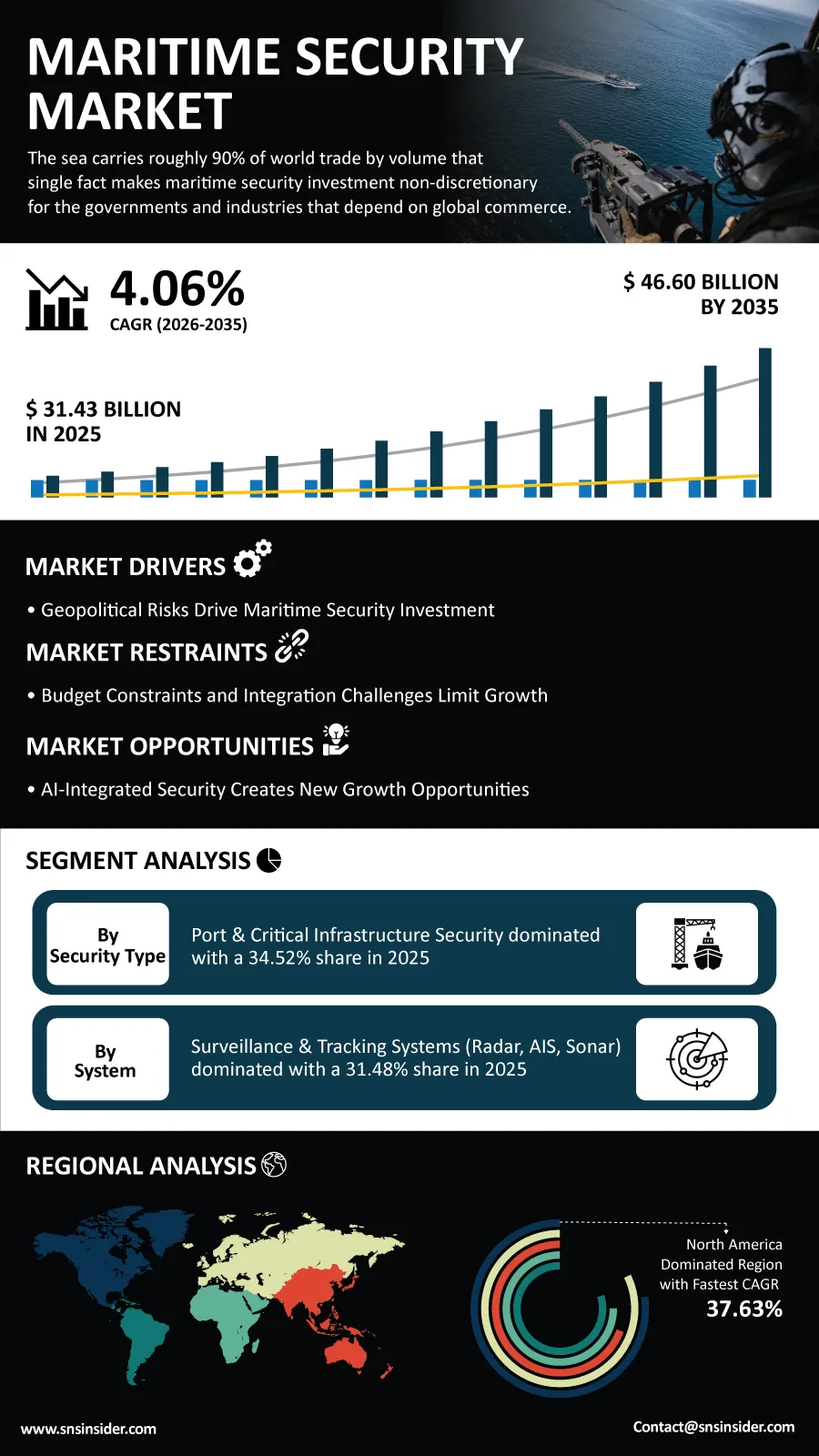
The global Maritime Security Market is expected to witness steady expansion over the coming decade as governments, port authorities, and commercial shipping operators intensify investments to protect maritime infrastructure and global trade routes. “According to a recent study by SNS Insider, the global Maritime Security Market size valued at USD 31.43 billion in 2025, is anticipated to grow to USD 46.60 billion by 2035, registering a CAGR of 4.06% over the 2026–2035 forecast period.”
Given that the majority of international goods trade is done through maritime transport, there is a need to ensure the safety of ports, routes at sea, offshore facilities, and cargo. As a result of increased geopolitical tensions and maritime business as well as advanced security threats, it is important to develop modernized means of surveillance and security.
Public agencies and private enterprises are also accelerating long-term investments in integrated security ecosystems that enhance situational awareness, improve operational resilience, and reduce risks associated with piracy, smuggling, cyberattacks, and unauthorized maritime activities.
To Get Detailed Insights on the Maritime Security Market – Request a Sample Report
Maritime Infrastructure Modernization Creates Long-Term Investment Opportunities
Maritime technology has started evolving through the processes of digitalization, automation, and networking. Contemporary ports have started to implement intelligent monitoring systems that are able to integrate surveillance, access control, vessel tracking, and cybersecurity into one operational system.
Owing to the growing implementation of artificial intelligence, unmanned surveillance technology, satellite surveillance, and predictive analytics, the maritime industry becomes able to identify potential threats and increase its response capability. The new technology makes it possible for security authorities to secure increasingly complex shipping networks without increasing operational capacity.
However, the need for monitoring large areas of sea territory arises because of offshore energy facilities, underwater infrastructure, and industrial facilities located on the coastlines. This means that there is a need to deploy advanced monitoring technologies.
Key Market Insights Reflect Evolving Security Priorities
Among security categories, Port & Critical Infrastructure Security accounted for 34.52% of global market revenue in 2025, reflecting sustained investments in terminal protection, perimeter monitoring, access control, and surveillance technologies that safeguard essential trade infrastructure.
The Cargo & Container Security segment is anticipated to record the fastest growth `through 2035, expanding at approximately 6.05% CAGR as international cargo volumes increase and logistics providers strengthen supply chain protection against theft and tampering.
By system, Surveillance & Tracking Systems generated 31.48% of market revenue during 2025 due to widespread deployment of radar, sonar, and vessel monitoring technologies. However, Access Control & Cybersecurity Solutions are projected to deliver the strongest future growth as maritime operations become increasingly digital.
Within applications, Port & Harbor Security remained the largest revenue contributor with 33.27% market share in 2025, while Commercial Shipping Security is expected to emerge as the fastest-growing application owing to heightened operational risks across international shipping lanes.
From an end-user perspective, Government & Defense Authorities represented 36.14% of global revenue, supported by sustained naval modernization and national security initiatives. Meanwhile, Oil & Gas Companies are forecast to experience the highest growth rate as offshore infrastructure protection gains greater strategic importance.
Cybersecurity and Intelligent Surveillance Reshape Maritime Operations
Maritime security solutions are increasingly moving from mere physical safety to digital security. Ports, ships, and logistics infrastructure have become increasingly dependent on technology, meaning that cybersecurity is an important aspect of maritime security.
Businesses are increasingly looking for integrated command centers that will be able to process different data sources at once in order to detect potentially suspicious movements of ships and improve cooperation of maritime agencies. Automation also makes monitoring less complicated and increases efficiency of response to threats.
Increasing cooperation of military establishments, coast guards, port operators, and companies dealing with IT also results in accelerated implementation of new solutions for maritime security.
North America Held 37.63% of the Maritime Security Market Share in 2025; Asia Pacific Projected to Register the Fastest 7.25% CAGR Through 2035
North America generated 37.63% of the global revenue in Maritime Security Market during 2025 owing to the presence of high levels of governmental spending, sophisticated naval operations, and constant improvements in port infrastructure.
The Asia Pacific region is anticipated to witness the fastest growth with an estimated 7.25% CAGR till 2035. Rising maritime trade, modernization of naval forces, territorial security issues, and the fast pace of port infrastructure development in China, India, Japan, South Korea, and Australia are some key factors fueling the growth in the region.
Europe also maintains a strong market position as governments enhance surveillance capabilities while strengthening security across major commercial ports and critical maritime infrastructure.
Industry Leaders Focus on Innovation and Integrated Security Solutions
Competition across the Maritime Security Market continues to intensify as technology providers expand portfolios spanning surveillance systems, cybersecurity platforms, unmanned monitoring solutions, artificial intelligence, and integrated command-and-control technologies.
Manufacturers are emphasizing scalable, interoperable solutions that enable governments and commercial operators to strengthen maritime domain awareness while improving operational efficiency and regulatory compliance across increasingly complex maritime environments.
Key companies operating in the global Maritime Security Market include Lockheed Martin, Raytheon Technologies, Northrop Grumman, Thales Group, BAE Systems, Harris Corporation, Elbit Systems, Leonardo S.p.A., General Dynamics, Safran Electronics & Defense, L3Harris Technologies, Boeing, DroneShield, Textron Systems, Kongsberg Gruppen, Honeywell International, Smiths Group, SAIC, OSI Maritime Systems, and Maritime Security Solutions.
An SNS Insider analyst Santosh Bhul commented, "The future of maritime security will be defined by intelligent surveillance, cyber resilience, and integrated operational awareness. Organizations investing in advanced monitoring technologies, AI-enabled analytics, and multi-domain security capabilities will be best positioned to address evolving maritime risks while supporting the uninterrupted flow of global trade."
About the Author

Get in touch