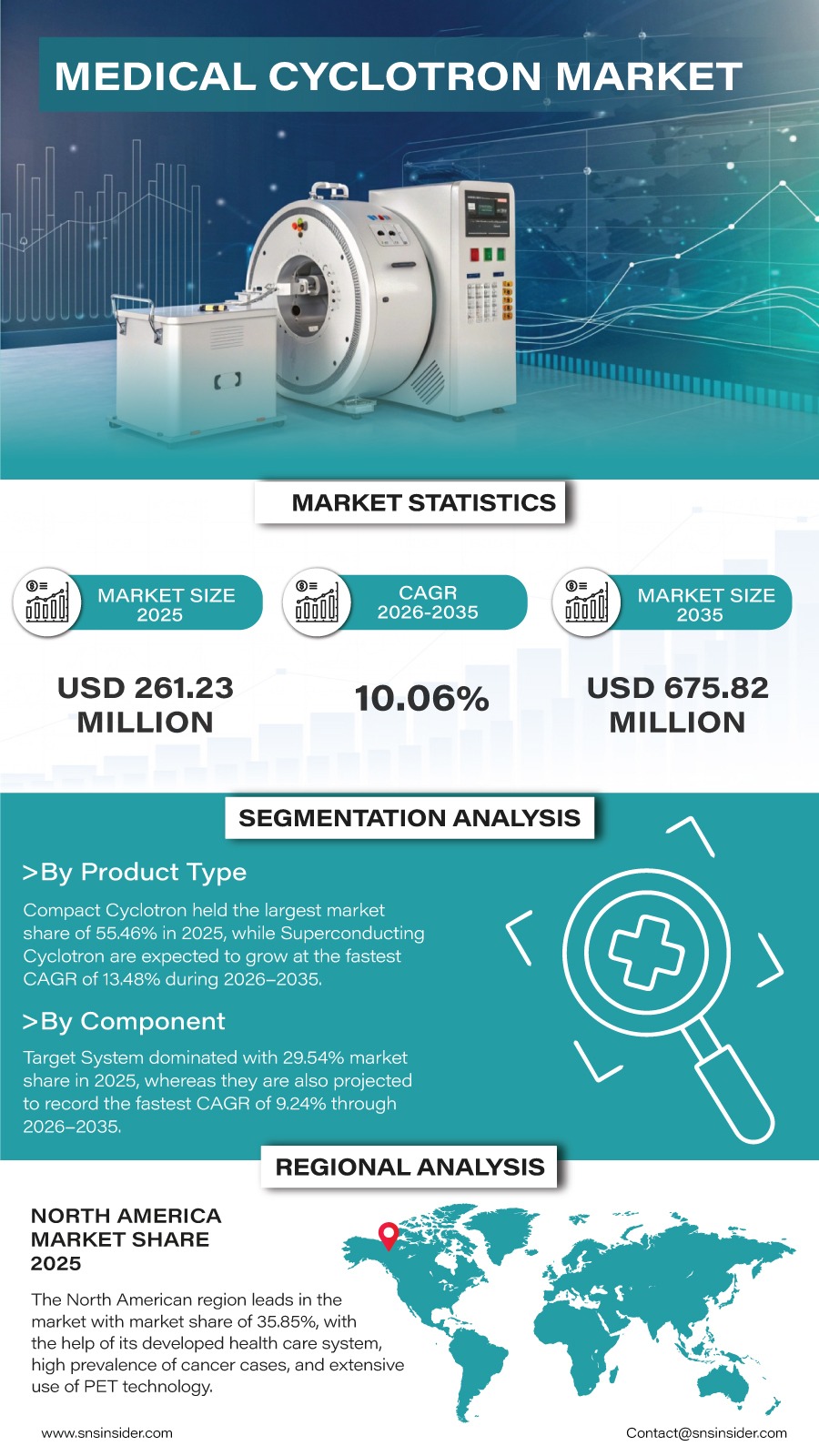
The global Medical Cyclotron Market is projected to witness substantial expansion over the coming decade as healthcare systems strengthen nuclear medicine infrastructure and broaden access to advanced diagnostic imaging technologies. “According to a recent study by SNS Insider, the global Medical Cyclotron Market size valued at USD 261.23 million in 2025, is anticipated to grow to USD 675.82 million by 2035, registering a CAGR of 10.06% over the 2026–2035 forecast period.”
Growing demands on rapid diagnosis of diseases, the increased use of positron emission tomography (PET) technology, and significant investments into the development of radiopharmaceuticals will change the face of molecular imaging. Medical facilities are progressively installing cyclotron devices to ensure better access to isotopes, cut down on dependency, and facilitate the process of diagnostics within hospitals and imaging centers.
With the continued advancements in precision medicine, the medical cyclotron device becomes an integral component of healthcare infrastructure that allows producing isotopes for different purposes.
To Get Detailed Insights on the Medical Cyclotron Market – Request a Free Sample Report
Technological Innovation Drives Next-Generation Nuclear Medicine
Continuous development in cyclotron design and automated radiochemistry is increasing efficiency levels and allowing healthcare organizations to increase their capacities for isotope production. The emergence of compact and efficient systems is facilitating the establishment of local production centers without the need to depend completely on outside suppliers.
The use of workflow management technologies, advanced imaging systems, and smart production systems is contributing to the performance improvements of contemporary nuclear medicine centers. These factors are helping to increase the efficiency levels of clinical operations and increase patient access to diagnostic tests.
Greater cooperation among healthcare organizations, research facilities, and technology developers is contributing further to innovation in the field of isotope production and molecular imaging.
Key Market Findings Highlight Emerging Opportunities
Among product categories, compact cyclotrons accounted for 55.46% of global market revenue in 2025, reflecting strong demand for space-efficient systems capable of supporting decentralized isotope production.
Meanwhile, superconducting cyclotrons are projected to register the fastest growth through 2035, expanding at a CAGR of 13.48%, driven by increasing demand for high-performance systems capable of producing multiple radioisotopes for advanced clinical and research applications.
By component, target systems represented 29.54% of total market revenue in 2025 and are also expected to remain the fastest-growing component category, advancing at a CAGR of 9.24% as healthcare facilities seek improved production efficiency and isotope yield.
From an installation perspective, hospital-based cyclotrons accounted for 48.62% of market revenue in 2025, reflecting the industry's shift toward localized radiopharmaceutical manufacturing. At the same time, centralized production facilities are expected to record the fastest growth at a CAGR of 11.21%, supported by increasing regional distribution networks and expanding nuclear medicine services.
Medium-energy cyclotrons maintained the leading position with 39.36% of global revenue in 2025, while low-energy systems are anticipated to expand at the fastest CAGR of 11.00% owing to their growing role in routine PET isotope production and cost-effective deployment.
An Infographic Representation of the Global Medical Cyclotron Market
Expanding Nuclear Medicine Infrastructure Supports Market Growth
The global healthcare sector is increasingly becoming more equipped with molecular imaging techniques, which help in disease diagnosis and development of treatment strategies. The development of cancer care centers, specialized imaging centers, and departments of nuclear medicine helps create positive prospects for the use of cyclotron technology.
Concurrently, there is an increase in the level of research being done using new radionuclides and imaging agents, which presents new avenues for hospitals, research institutions, and academic centers to develop isotope production capacities.
Localized production is increasingly helping healthcare organizations become more reliable in terms of supply while overcoming logistic obstacles of medical isotopes.
Regional Markets Continue to Expand
Market revenue in North America was 35.85% in 2025, thanks to sophisticated health care infrastructure, use of molecular imaging techniques, and substantial investments made in cancer diagnostics. Innovative developments in the production of radiopharmaceuticals and efficient clinical research abilities help in maintaining its dominance.
Meanwhile, The Asia Pacific region is poised to lead in growth with a forecasted CAGR of 11.78% till 2035. Growing investments in healthcare facilities, increasing the scope of nuclear medicine, rising cancer detection programs, and increased availability of diagnostic systems are key reasons for opportunities in nations such as China, India, Japan, and South Korea.
Leading Companies Continue to Advance Innovation
Competition within the medical cyclotron market remains dynamic as manufacturers invest in next-generation production systems, automation technologies, strategic collaborations, and expanded global service capabilities.
Key companies operating in the global medical cyclotron market include GE HealthCare, Siemens Healthineers, Philips Healthcare, Ion Beam Applications, Elekta, Sumitomo Heavy Industries, Advanced Cyclotron Systems Inc., Best Cyclotron Systems Inc., Hitachi, and Varian Medical Systems.
An SNS Insider analyst Parry Kardani commented, "The medical cyclotron market is entering a new phase of growth as healthcare providers prioritize localized isotope production, precision diagnostics, and advanced molecular imaging capabilities. Continued technological innovation and expanding investments in nuclear medicine infrastructure are expected to unlock significant opportunities across both developed and emerging healthcare markets."
About the Author

Get in touch