
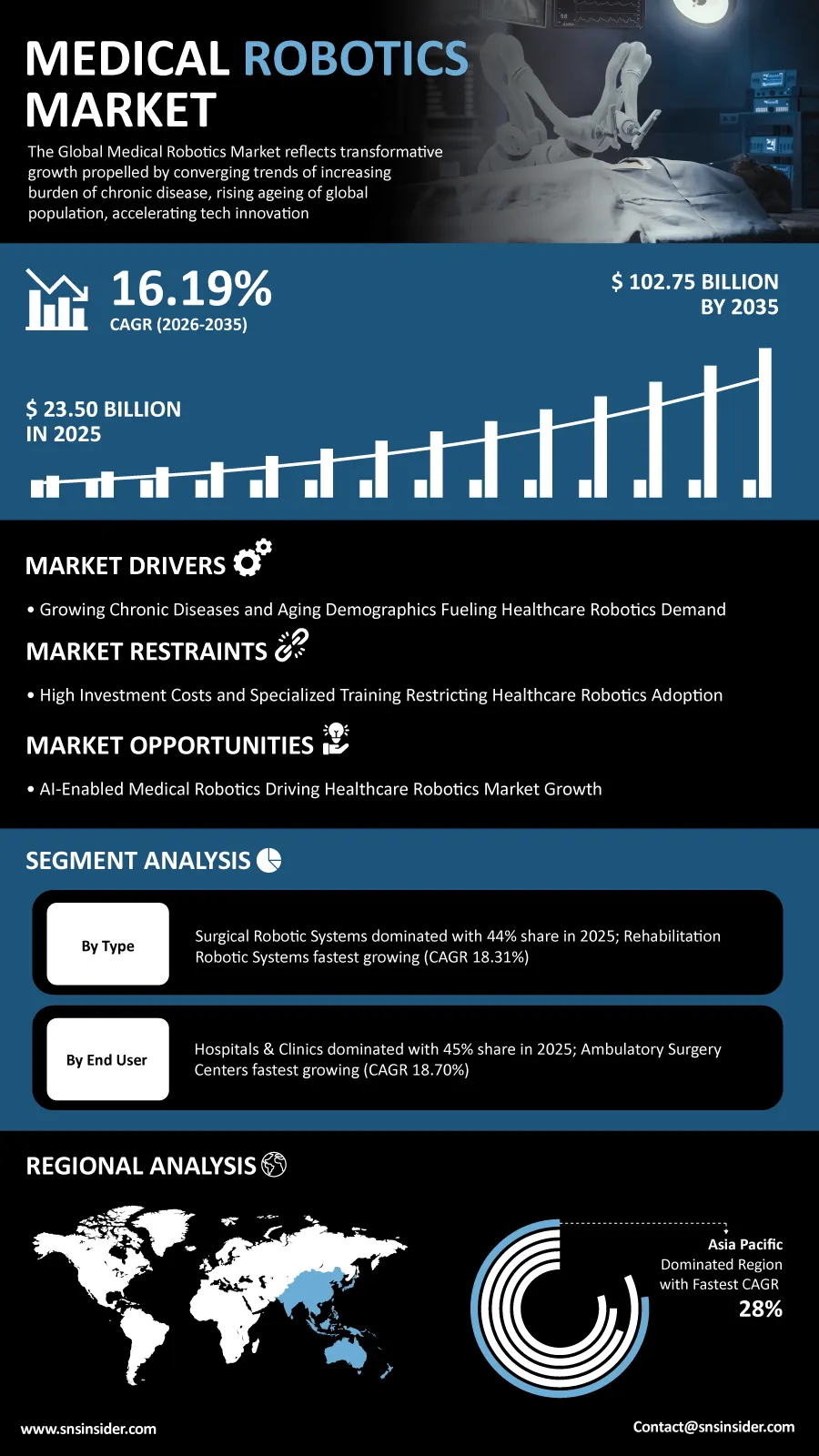
The global Medical Robotics Market is entering a high-growth phase as healthcare providers increasingly adopt robotic technologies to improve surgical precision, streamline clinical workflows, and expand access to advanced rehabilitation. According to a recent study by SNS Insider, the global Medical Robotics Market size valued at USD 23.50 billion in 2025, is anticipated to grow to USD 102.75 billion by 2035, registering a CAGR of 16.19% over the 2026–2035 forecast period.
Increased preference for minimally invasive techniques, increased prevalence of chronic conditions, and fast development of the healthcare system are promoting the use of robotics in medical facilities. Robotics is being used in hospitals and specialist practices to meet the needs that arise from the development of surgical and treatment procedures, rehabilitation processes, and logistical issues in pharmacy.
The development of artificial intelligence, imaging technologies, machine learning, and other healthcare systems is further enhancing the functionality of medical robots. In addition, regulatory clearance and reimbursement are contributing to the commercialization of robotic-assisted procedures and promoting investment in new robots.
To Get Detailed Insights on the Medical Robotics Market – Request a Sample Report
AI Integration and Healthcare Automation Create New Growth Opportunities
Another segment which is witnessing a favorable trend is that of medical robots in view of the converging nature of robotics and artificial intelligence. The capabilities of such AI-powered robots include assistance in surgery planning, real-time guidance during surgeries, imaging, and workflow optimization.
Rehabilitation robots are another promising area which can be expected to expand further in the coming years owing to the fact that there is rising demand from healthcare organizations for neurological and musculoskeletal rehabilitation. In this case, robots can assist the clinicians in providing therapeutic treatment while also keeping track of the patient's performance.
Hospital logistics robots are finding increasing application for transporting medicines and other supplies, disinfection, and other repetitive tasks within hospitals. Such robots help automate some of the tasks and allow the clinical staff to concentrate more on their duties.
Key Market Insights Highlight Shifting Demand Patterns
By type, surgical robotic systems are estimated to garner around 44% of market revenue globally by 2025, owing to growing adoption in urology, gynecology, orthopedic surgery, and general surgery. The revenue share of rehabilitation robotic systems is expected to register the highest growth rate of 18.31% CAGR during the forecast period from 2026 to 2035, attributable to the aging population and increased demand for technology-driven rehabilitation.
Based on end user, hospitals and clinics are anticipated to contribute approximately 45% of market revenue in 2025. These facilities remain major adopters because of their ability to support high-value robotic platforms, specialized personnel, and complex procedures. Ambulatory surgery centers are forecasted to experience the fastest growth, expanding at a CAGR of 18.70% as outpatient procedures increase and compact robotic systems become more accessible.
Precision Medicine and Minimally Invasive Care Remain Key Priorities
There is an increased emphasis by healthcare professionals towards optimizing treatment effectiveness while decreasing recovery time and procedural complications. Robotic assisted surgery is receiving growing interest since it can offer surgeons greater visibility, precision, and control while performing difficult surgeries.
In addition, the growing trend of outpatient healthcare is impacting the industry too. With more treatments taking place within outpatient healthcare, robotic surgical solutions are being developed in order to match the needs of facilities with smaller spaces.
Education of surgeons through investment in training, simulations, and virtual learning is also becoming a key factor driving adoption. With a growing number of surgeons being trained on how to use robotic surgical technology around the world, adoption is likely to increase.
North America Leads with 30% Revenue Share While Asia Pacific Accelerates Healthcare Modernization
North America is forecasted to be one of the key regional markets and will generate around 30% of the total revenue by 2025. Well-developed healthcare infrastructure, adoption of robotic surgery systems, reimbursement policies, and existence of big medical technology companies in the region will drive growth in the coming years.
Asia Pacific region is expected to grow at the highest rate owing to increased spending on healthcare and investments in building hospitals with cutting-edge technology. Japan, China, South Korea, and India have contributed to the growth of the Asia Pacific region through adoption of robotic surgeries, investments in medical technologies, and development of healthcare infrastructure.
As healthcare systems across emerging economies modernize, the adoption of medical robotics is expected to extend beyond major tertiary hospitals into outpatient and specialized care environments.
Industry Participants Focus on Innovation and Clinical Expansion
Competition in the medical robotics industry remains intense as manufacturers expand product portfolios, pursue regulatory approvals, and develop solutions for new clinical applications. Companies are focusing on AI integration, improved visualization, advanced surgical instrumentation, rehabilitation technologies, and more compact systems designed to reduce adoption barriers.
Key companies operating in the global Medical Robotics Market include Intuitive Surgical, Inc., Medtronic plc, Stryker Corporation, Zimmer Biomet Holdings, Inc., Johnson & Johnson (Ethicon/DePuy Synthes), Smith & Nephew plc, Globus Medical, Inc., NuVasive, Inc., Ekso Bionics Holdings, Inc., ReWalk Robotics Ltd., Asensus Surgical, Inc., Omnicell, Inc., Renishaw plc, Cyberdyne Inc., Bionik Laboratories Corp., Lifeward, Inc., Zap Surgical Systems, Inc., DIH Holdings US, Inc., Arxium, Inc., and Accuray Incorporated.
An SNS Insider analyst Sushant Kadam commented, “The medical robotics industry is moving beyond conventional surgical applications as AI, rehabilitation technologies, and healthcare automation expand the role of robotics across the care continuum. Companies that can combine clinical effectiveness, workflow integration, and cost-efficient deployment models will be well positioned to benefit from the accelerating adoption of robotic technologies worldwide.”
About the Author

Get in touch




