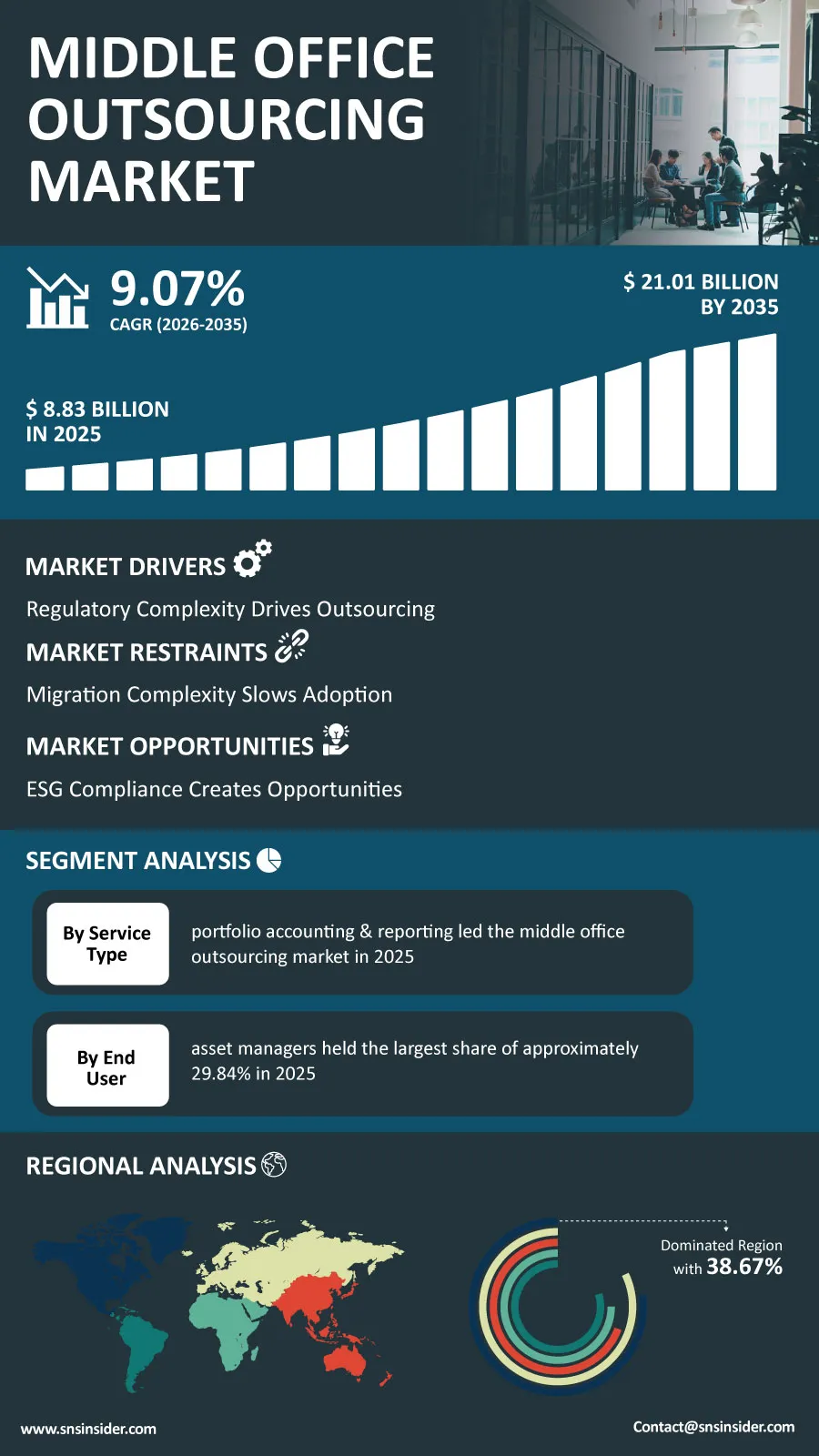
The global Middle Office Outsourcing Market is expected to witness substantial expansion as financial institutions continue modernizing operational processes while navigating increasingly complex regulatory environments. “According to a recent study by SNS Insider, the global Middle Office Outsourcing Market size valued at USD 8.83 billion in 2025, is anticipated to grow to USD 21.01 billion by 2035, registering a CAGR of 9.07% over the 2026–2035 forecast period.”
Financial firms are forming alliances with specialized outsourcers that will aid in their operational effectiveness, compliance management, and portfolio management process. The increased complexity in the investment process for a variety of asset types and the new reporting guidelines are leading many firms to look at outsourcers that leverage technology in order to increase accuracy and business continuity.
Firms are quickly adopting cloud computing and artificial intelligence and automation solutions, which are changing the landscape of middle office operations. Advanced analytics, automation, compliance monitoring, and workflow management are making it easier for outsourcers to create value for their clients.
To Get Detailed Insights on the Middle Office Outsourcing Market – Request a Sample Report
Technology-Driven Financial Operations Create Long-Term Growth Opportunities
Financial companies still persist in investing into their digital transformation efforts aimed at simplification of processes and improvement of quality of services provided. Along with increased flexibility that companies are seeking, outsourcing providers have been developing their offerings in terms of integration of operations with cloud technologies which allow handling such issues as portfolio accounting, compliance management and performance reporting within one single environment.
Increased demand for multi-asset investment approaches and international portfolio management provides more opportunities for outsourcing providers. Financial institutions, having to manage more and more diversified investment portfolios, need scalable operational capabilities for coping with more complicated reporting in different jurisdictions.
Along with that, development of artificial intelligence, predictive analysis, robotic process automation and cloud-native platforms enables providers to automate operational processes, increase the precision of processing and provide quicker insights to investment managers and institutions.
Key Market Insights Highlight Shifting Demand Patterns
Based on service type, portfolio accounting & reporting segment led the global market revenue in 2025 owing to its critical role in investment operations and regulatory reporting. The risk management segment will experience the highest growth till 2035 due to increasing complexity across global investment portfolios and rising demand for advanced analytical capabilities.
By deployment type, on-premise solutions segment accounted for 46.78% of total market revenue in 2025 because of their established adoption among large financial institutions. Cloud-based deployment is predicted to show the fastest growth over the forecast period as organizations accelerate migration toward flexible, scalable, and cost-efficient digital platforms.
In terms of enterprise size, large enterprises held 62.41% market share in 2025 owing to their extensive operational requirements and significant outsourcing investments. Small and medium enterprises will be growing at the fastest rate up until 2035 as cloud-enabled outsourcing services make sophisticated middle office capabilities more accessible.
Based on end user, asset managers represented 29.84% of market revenue in 2025 due to increasing portfolio complexity and compliance obligations. Hedge funds are projected to register the fastest expansion through 2035 as firms seek scalable operational infrastructure while maintaining lean internal investment teams.
Artificial Intelligence and Cloud Platforms Accelerate Industry Transformation
Outsourcing of middle-office functions is still developing as the companies include artificial intelligence, automation, cloud technologies, and data analytics into the essential processes. Intelligent automation is automating reconciliation procedures, compliance monitoring, portfolio management, and other areas of investment operations to decrease the need for manual activities.
At the same time, cloud-based operating models are increasing business continuity and operational resiliency and improving collaboration between the outsourcing company and the financial institution. The development allows financial organizations to become more transparent in their operations.
North America Held 38.67% of the Middle Office Outsourcing Market Share in 2025; Asia Pacific Projected to Register the Fastest CAGR Through 2035
Market share of North America is anticipated to be around 38.67% of total market revenues by 2025 due to the availability of leading asset managers, hedge funds, institutional investors, and developed financial infrastructure. Increasing regulatory obligations and constant development of financial technologies are driving adoption of outsourcing of middle office operations in this region.
The Asia-Pacific region is expected to be the fastest growing regional market up to 2035. Increasing size of capital markets, rising growth in institutional investments, increasing number of digital transformation initiatives, and growing need for efficiency are creating ample opportunities for growth in China, India, Japan, Singapore, and South Korea.
As financial institutions continue modernizing operational infrastructure while addressing evolving compliance requirements, demand for technology-enabled middle office outsourcing solutions is expected to strengthen across both developed and emerging financial markets.
Industry Participants Focus on Innovation and Technology-Enabled Operational Solutions
The competitive environment remains highly dynamic as leading service providers continue investing in cloud-based platforms, artificial intelligence, advanced analytics, and automation technologies to strengthen middle office operations. Continuous investment in digital infrastructure, regulatory technology, and integrated portfolio management solutions is enabling providers to improve operational efficiency, enhance compliance capabilities, and deliver greater analytical value to institutional clients. Strategic partnerships and platform enhancements are further helping companies expand service portfolios while addressing the evolving operational requirements of global financial institutions.
Key companies operating in the global Middle Office Outsourcing Market include State Street Corporation, BNY Mellon (Bank of New York Mellon), Northern Trust Corporation, J.P. Morgan Securities Services, Citco Group, SS&C Technologies Inc., SimCorp A/S (Deutsche Boerse), Caceis (Crédit Agricole), FIS (Fidelity National Information Services), Broadridge Financial Solutions Inc., HSBC Securities Services, Apex Group Ltd., NAV Consulting Inc., Maitland Group, IQ-EQ Group, Alter Domus, Amundi Asset Management, Kroll (formerly Duff & Phelps), SGSS (Societe Generale Securities Services), and Hazeltree LLC.
An SNS Insider analyst Sakshi Kale commented, “Financial institutions are increasingly adopting technology-enabled outsourcing strategies to improve operational resilience, regulatory compliance, and investment reporting capabilities. As cloud computing, artificial intelligence, and automation continue transforming financial operations, middle office outsourcing providers delivering scalable, data-driven, and integrated solutions will be well positioned to capture long-term market growth.”
About the Author

Get in touch