
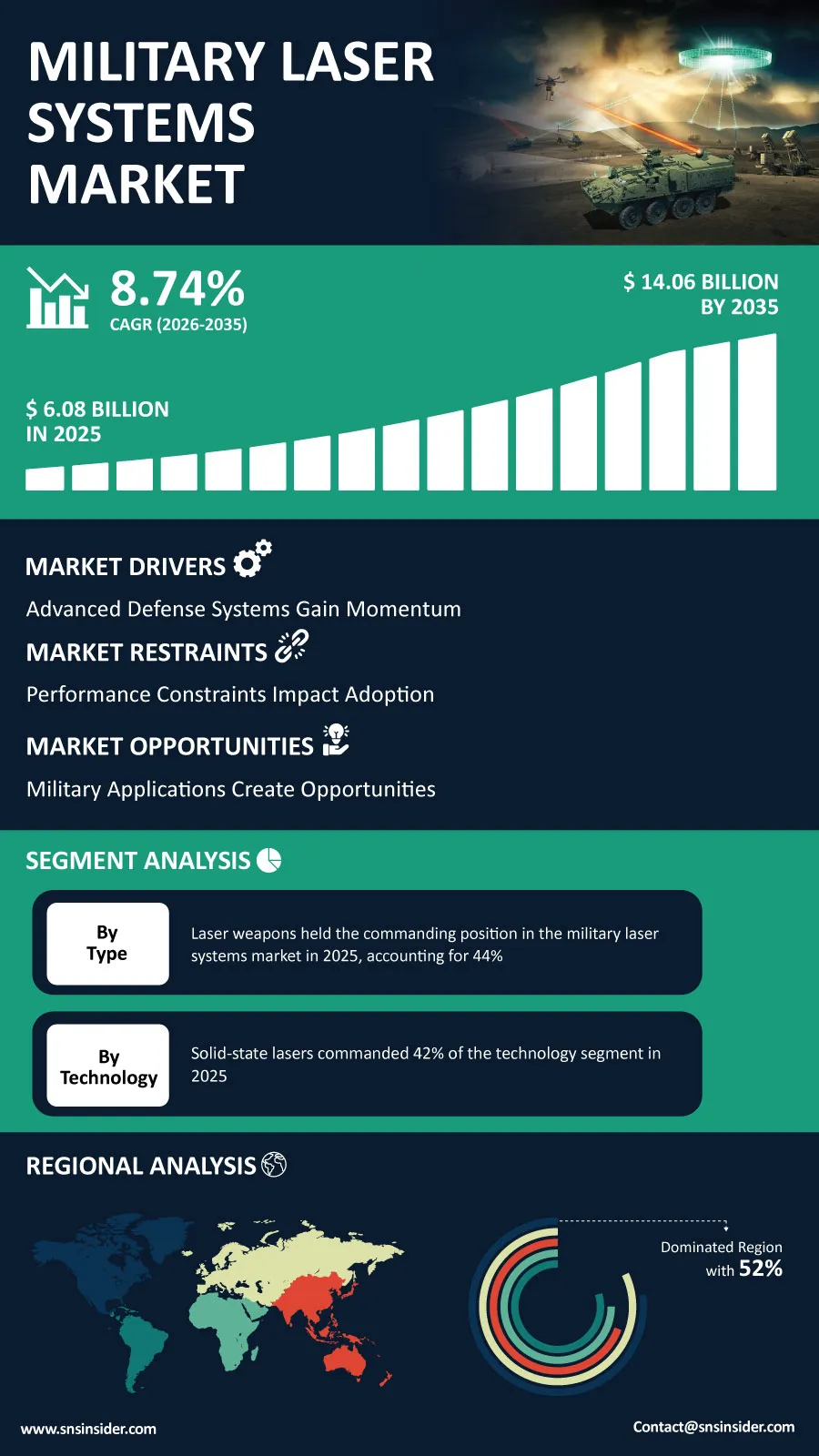
The global Military Laser System Market is gaining strong momentum as defense organizations accelerate investments in next-generation directed energy technologies to counter evolving battlefield threats. According to a recent study by SNS Insider, the global Military Laser System Market size valued at USD 6.08 billion in 2025, is anticipated to grow to USD 14.06 billion by 2035, registering a CAGR of 8.74% over the 2026–2035 forecast period.
Global military procurement trends are being shaped by intensifying geopolitical tensions, an expansion of defense modernization programs, and the rapid proliferation of unmanned aerial systems. Arguably, the armed forces are turning towards laser-based technologies to provide pinpoint engagement with less reliance on conventional munitions and costly missile interceptors.
Advances in high-energy laser development, beam control systems, and power management have brought militaries closer to moving directed energy solutions from the lab to the field. With governments bolstering their national defense capabilities, laser systems are emerging as a vital component of future warfare architectures.
To Get Detailed Insights on the Military Laser System Market – Request a Sample Report
Defense Modernization Programs Create Significant Growth Opportunities
Military planners are focusing on both developed technologies that could assist functionality in day-to-day operations, and addressing of new aerial and missile threats. Directed energy systems generally provide fast engagement rates against a range of targets, facilitate layered air defence operations and promise lower end-of-life costs through mainly electrical operation.
Continued investments in counter-drone capabilities along with the integrated air defense system (IADS) and next-generation battlefield platforms are other growth opportunities when it comes to this market. Advancements in laser technology, thermal management and system integration are simultaneously pushing performance for defense applications on land and at sea, in the air, and of future space-borne systems.
The development (and rapid commercialization) of high-energy laser systems is also being accelerated by increasingly close collaboration among governments, defense contractors, and research organizations.
Key Market Insights Highlight Shifting Demand Patterns
By type, laser weapons are expected to account for 44% of global market revenue in 2025, reflecting increasing deployment of directed energy systems for air defense and counter-UAV missions. LIDAR is projected to record the fastest growth through 2035 as military organizations expand investments in precision targeting, battlefield mapping, autonomous navigation, and surveillance technologies.
Based on technology, solid-state lasers are anticipated to contribute 42% of market revenue in 2025 due to their established operational performance and broad deployment across defense platforms. Fiber lasers are expected to emerge as the fastest-growing technology segment as improvements in beam quality, scalability, and thermal efficiency support higher-power military applications.
By platform, airborne systems are forecast to account for 38% of market revenue in 2025, driven by extensive integration of laser targeting and guidance technologies across modern aircraft. Naval platforms are projected to witness the strongest growth through 2035 as defense agencies increasingly deploy shipborne laser systems capable of countering drones, small surface threats, and future missile challenges.
Directed Energy Technologies Continue to Reshape Modern Warfare
Multi-domain defense strategies that integrate conventional weapons with radar networks, electronic warfare, cyber capabilities and military laser systems are being developed across the globe. Their capability to provide extremely accurate engagements with very limited collateral damage is reinforcing their position in the contemporary battlefield.
In addition, expanding demand for mobile, containerized and quick reaction laser systems is fueling use within expeditionary forces. It is anticipated that continued investments in advanced targeting algorithms, artificial intelligence and real-time battlefield data processing will help refine operational effectiveness during future defense missions.
Regional Markets Strengthen Defense Technology Investments
North America is expected to remain the leading regional market throughout the forecast period, driven by high levels of defense spending, large-scale directed energy investments and ongoing procurements of advanced laser systems by the U.S. military. The region's tech leadership is also being bolstered by continued investment by government agencies and major defense contractors.
Asia Pacific is estimated to be the fastest growing regional market as nations such as China, India, Japan, South Korea and Australia accelerate military modernization programs while expanding investments in advanced defense technologies. You'll learn about the latest vehicles that were announced at the 2020 Geneva Motor Show and more.
As governments worldwide continue prioritizing defense readiness and next-generation security capabilities, demand for military laser technologies is expected to remain strong over the coming decade.
Industry Participants Focus on Innovation and Strategic Defense Programs
The competitive landscape remains highly dynamic as leading defense companies continue investing in high-energy laser technologies, advanced beam control systems, integrated targeting solutions, and scalable directed energy platforms. Strategic collaborations, prototype demonstrations, and government contracts continue to accelerate commercialization across multiple military applications.
Key companies operating in the global Military Laser System Market include Lockheed Martin Corporation, Raytheon Technologies (RTX Corporation), Northrop Grumman Corporation, The Boeing Company, BAE Systems plc, Thales Group, Elbit Systems Ltd., L3Harris Technologies Inc., General Dynamics Corporation, Safran Electronics & Defense, MBDA Missile Systems, Leonardo S.p.A., Rheinmetall AG, Israel Aerospace Industries, Saab AB, Coherent Corp., II-VI Incorporated (Coherent), High Energy Laser Systems (HELS), Directed Energy Solutions United States, and Aculight Corporation (Lockheed Martin).
An SNS Insider analyst Sushant Kadam commented, “Growing investments in directed energy technologies, rising demand for cost-effective counter-drone capabilities, and continued advances in high-energy laser performance are transforming the future defense landscape. Organizations that successfully deliver scalable, reliable, and operationally proven laser systems will be well positioned to capitalize on expanding global defense modernization programs.”
About the Author

Get in touch




