
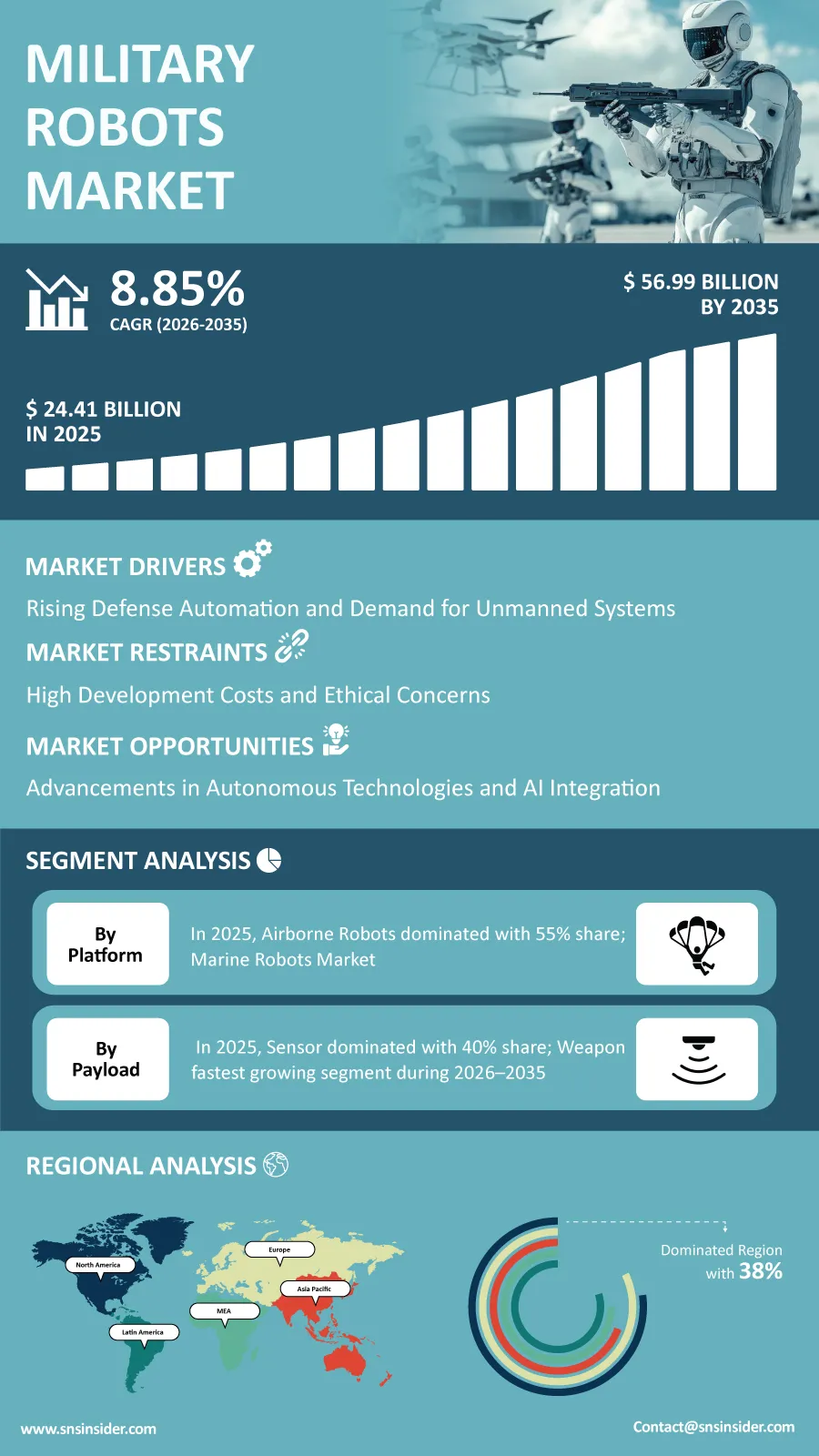
The global Military Robots Market to grow at a healthy growth rate over the next decade, which will be further propelled by growing investment in autonomous defense technologies and next generation battlefield systems by militaries worldwide. “According to a recent study by SNS Insider, the global Military Robots Market size valued at USD 24.41 billion in 2025, is anticipated to grow to USD 56.99 billion by 2035, registering a CAGR of 8.85% over the 2026–2035 forecast period.”
Governments are increasingly encouraged to incorporate robotic systems into evolving defense concepts due to the national security and operational effectiveness, along with the demands for reducing service member risk. Role: UGVs are increasingly being used as unmanned systems in the battlefield scene providing Intelligence, Surveillance, Explosive Threat Assessment and Tactical Support Effect/Impact in a VUCA world to expose Defence Organizations from increased threat.
Military robotics are also being completely revolutionised by fast-moving advancements in autonomous navigation, computer vision, advanced sensor and AI technology. These advances empower robotic platforms to process real-time battlefield data, operate in contested environments, and enable a faster OODA loop across land, air and maritime operations.
To Get Detailed Insights on the Military Robots Market – Request a Sample Report
Defense Modernization Programs Create Long-Term Growth Opportunities
Military modernization efforts continue to be a leading driver of market growth as nations sustain investments in advanced autonomous systems with increased defense budgets. Countries are being more selective in investing on capabilities that can boost situational awareness, enhance operational effectiveness and mission success as well as lower the risk of direct exposure of its soldiers to dangerous environments.
In addition to widening the application of existing unmanned systems employed for border protection, securing critical infrastructure, disaster response and counter-terrorism operations further broadening the market beyond traditional combat applications. In light of ongoing geopolitical concerns, military agencies are attempting to meet the demands for flexible robotic systems that can execute several defence tasks.
At the same time, technology developers are working in collaboration with defense agencies driving innovation across robotics, artificial intelligence, secure communications and advanced sensing technologies to create new commercial opportunities for manufacturers everywhere.
Key Market Insights Reflect Evolving Defense Priorities
By platform type, airborne robots comprised 55% of the global market revenue in 2025 as they were deployed worldwide for intelligence monitoring, surveillance and reconnaissance (ISTAR), and tactical operations.
On the other hand, marine robots are anticipated to witness the largest growth through 2035 due to increasing expenditure of naval forces on unmanned surface and underwater vehicles for enhancing maritime surveillance, mine countermeasure capabilities, and coastal security.
Human operated robotic systems accounted for 60% of the revenue share in 2025 owing to its reliability in mission critical defence operations as per operational mode. Nevertheless, the most remarkable growth is expected in autonomous systems and artificial intelligence will provide greater mission autonomy and operational flexibility.
In 2025, approximately 40% of total revenue was generated from sensor-equipped robots on a payload basis, indicating an increasing demand for real-time intelligence as well as battlefield awareness. According to forecasts during the period, robotic systems with weapons are expected to become the fastest growing weapon category payload.
By application, surveillance and reconnaissance held the largest market share at 35% in 2025; also, explosive ordnance disposal (EOD) is expected to grow at the highest rate as military organizations emphasize ensuring personnel safety during high-risk missions.
In the defense sector, a larger chunk of 80% share/higher market revenue was devoted to it as end-users and however it is anticipated that homeland security agencies would adopt this technology faster as robotic technologies are required for border management, emergency response and public safety operations.
Autonomous Technologies Continue Reshaping Modern Warfare
Military services are also introducing robotic platforms to integrated defense systems that enable better mission coordination and operational efficiency. You are being trained on data until October of 2023.Some unmanned systems with advanced capabilities now support logistics, communications, electronic warfare, and intelligence collection that have persistent surveillance over more complex operational environments.
AI is helping with faster target recognition, autonomous navigation, predictive maintenance and more recently enhanced decision support capabilities, allowing military forces to maximise operational effectiveness while reducing resource footprint. Advances in machine learning and secure communications will enable even wider deployment across coming defense programs.
The increasing focus on multi-domain operations is fostering interoperability among aerial, ground and maritime robotic platforms for collaborative missions in different combat scenarios.
North America Accounted for 38% Market Share in 2025; Asia Pacific Forecast to Expand at the Highest CAGR by 2035
In 2025, North America held a 38% share of Military Robots Market revenue, driven by high defense spending, ongoing investments in autonomous technologies and the concentration of large aerospace and defense manufacturers. The region's lead is further bolstered by ongoing modernization initiatives and substantial government funding.
Based on geography, the Asia Pacific region is anticipated to offer the largest growth until 2035 as countries like China, India, Japan and South Korea accelerate defense modernization plans along with border security as well military preparedness. This is likely to propel the regional demand all over the forecast period, amid increasing geopolitical strains coupled with rising adoption of AI enabled defense systems.
At the same time, Europe remains focused on collaborative defense programs and advanced robotic capabilities while unmanned system deployment in the Middle East, Africa and Latin America continue to grow as a key component of surveillance, border security and operational responsiveness.
Industry Leaders Intensify Focus on Next-Generation Defense Robotics
The competitive landscape remains extremely fluid, as leading defense contractors continue to invest in autonomous technologies, advanced sensors, artificial intelligence and mission-oriented robotic platforms. Global innovation is anticipated to bridge new strategic partnerships, research collaborations and defence modernization contracts within the global market.
Key companies operating in the global Military Robots Market include Lockheed Martin Corporation, Northrop Grumman Corporation, Boeing Defense, Space & Security, General Dynamics Corporation, BAE Systems plc, RTX, L3Harris Technologies, Elbit Systems Ltd., Israel Aerospace Industries, Thales Group, Leonardo S.p.A., Saab AB, Rheinmetall AG, QinetiQ Group plc, Textron Inc., AeroVironment, Teledyne FLIR, Kongsberg Gruppen ASA, ECA Group, and iRobot Corporation.
An SNS Insider analyst Santosh Bhul commented, "Defense modernization, rapid advances in autonomous technologies, and increasing emphasis on force protection are reshaping the future of military operations. Organizations that continue investing in intelligent robotic platforms, AI integration, and mission-ready autonomous systems will be well positioned to capitalize on long-term opportunities across the evolving global defense landscape."
About the Author

Get in touch




