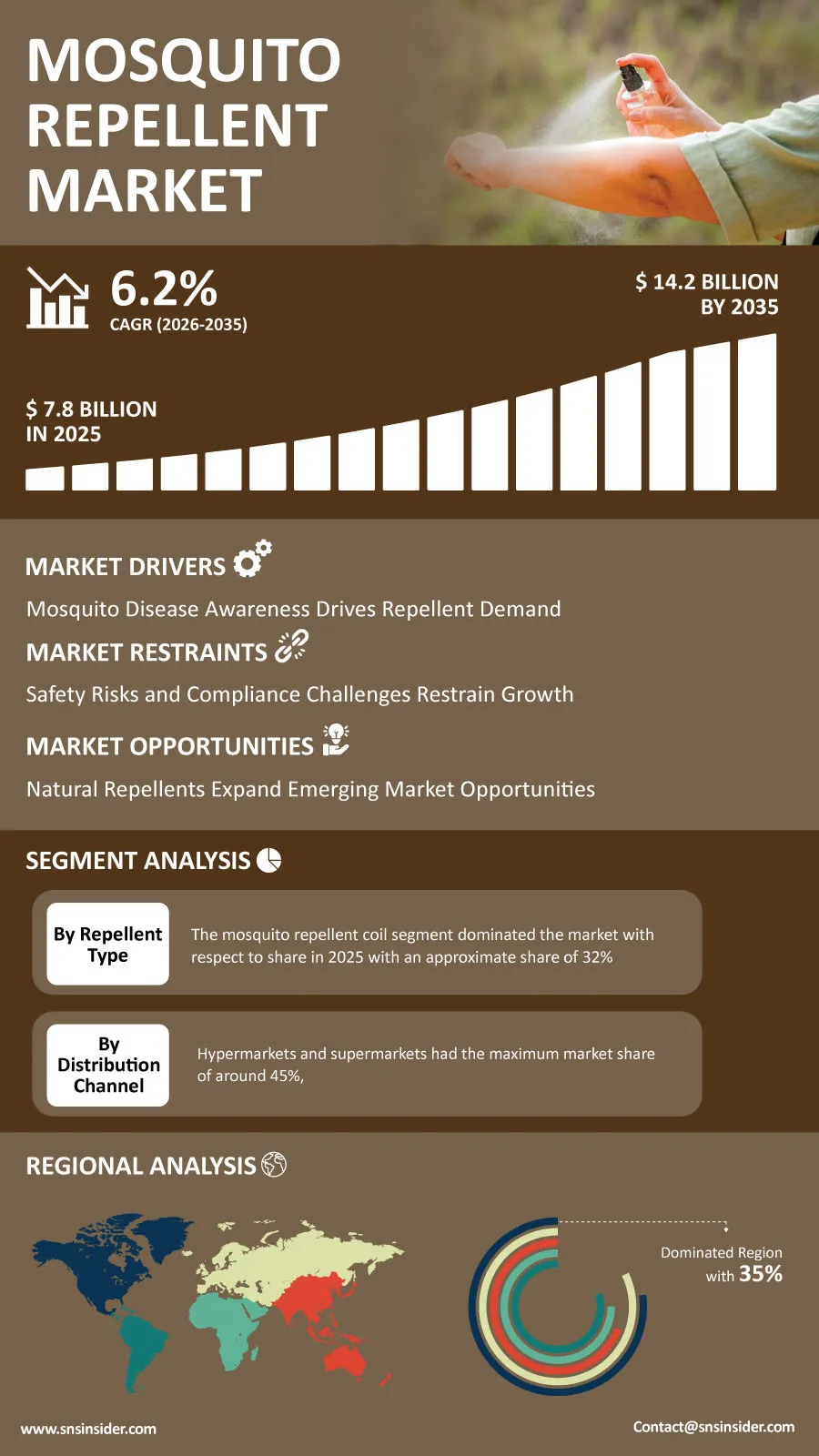
The global Mosquito Repellent Market is anticipated to grow steadily as consumers, governments, and healthcare organizations continue their efforts in preventing mosquito-borne diseases throughout the world. “According to a recent study by SNS Insider, the global Mosquito Repellent Market size valued at USD 7.8 Billion in 2025, is anticipated to grow to USD 14.2 Billion by 2035, registering a CAGR of 6.2% over the 2026–2035 forecast period.”
Growing apprehensions regarding such diseases as dengue, malaria, Zika virus, chikungunya and West Nile virus is compelling households to opt for private and household mosquito repellents across the throughout the year. Especially with the changing climatic conditions, evolving urbanization and increased mosquito habitat areas are complementing this demand equally in developed and emerging economies.
To adapt, manufacturers are creating new formulations that offer a balance of potency and safety. With this, plant-based ingredients along with herbal extracts and skin-friendly active compounds continue to become favorites in product development while technology evolution through sprays, vaporizers, wearable patches and smart outdoor protection systems widen their consumer appeal.
To Get Detailed Insights on the Mosquito Repellent Market – Request a Sample Report
Natural Formulations and Preventive Healthcare Create Long-Term Growth Opportunities
Rising inclination towards natural and herbal-based personal care products among consumers is creating highly lucrative opportunities for manufacturers engaged in developing botanical mosquito repellents. The plants used in their formulation include citronella, eucalyptus and neem among other plant-derived extracts that health-conscious consumers flock to as safer alternatives for families and children.
The expansion of markets is also supported by public health initiatives. Government-backed disease prevention campaigns, mosquito control programs and growing awareness about personal protection are still boosting product penetration throughout tropical and subtropical regions where infections transmitted by mosquitoes still thrive.
Simultaneously, the fast-growing e-commerce platforms and online sales channels allow premium mosquito repellent brands to reach beyond conventional retail channels. The ability to access unique mosquito repellents through subscription services, direct-to-consumer models, and targeted online marketing will improve accessibility of new products around the world.
Key Market Insights Highlight Evolving Consumer Preferences
According to repellent type, Coils made up 32% of the market’s revenue share in 2025 owing to their affordability, easy availability, and continued usage in developing countries. Spray and Vaporizer types will register the highest growth rates during the forecast period as they are more preferred for convenient, residue-free, and premium protection indoors.
In relation to bite protection format, Lotions made up almost 38% of the total revenue in 2025 thanks to their extended protection periods, easy applications, and suitability for all ages. Gels and Roll-Ons will register the fastest growth rates as consumers look for easy-to-carry, natural formulations for personal use.
Hypermarkets & Supermarkets were responsible for 45% of global sales in 2025 owing to wide availability of products and seasonality. E-Commerce will be responsible for the fastest growth rates until 2035 owing to increasing online shopping and subscription trends and rise of digital mosquito repellent brands.
Product Innovation Accelerates Market Transformation
As manufacturers invest in next-generation formulations that offer longer-lasting protection through improved safety and user convenience, the mosquito repellent industry continues to be defined by innovation. By tapping into plant-based active ingredients, microencapsulation technologies and the latest forms of delivery systems, it is possible to create highly performant products that also meet the needs of eco-sensitive consumers.
To this end, they are also diversifying personal protection technologies in wearables, such as bracelets, adhesive patches, treated fabrics and portable outdoor repellent devices. These innovations combine hands-free mosquito protection with the growing consumer demand for on-the-go solutions that are easy to pack, and well-suited for outdoor recreation and family use.
Asia Pacific Held 42% of the Mosquito Repellent Market in 2025, While North America and Europe Witness Strong Demand Growth
Asia Pacific held approximately 42% of global market revenue in 2025, bolstered by vast populations, mosquitoes active through the whole year, government disease control programs as well as rising awareness among consumers cover India, China, Indonesi and Southeast Asia. Strong demand for conventional and herbal mosquito repellent products prevailed across the region throughout the six months of this year.
North America kept its key role, in which the market steady growth trend is reinforced by rising outdoor recreational activities, growing awareness of mosquito-borne diseases as well as increasing preference for DEET-free products with regards to applications in the United States. Europe is also growing at a continual pace due to the longer mosquito seasons, stringent product safety regulations and increasing international traveling contribute to greater demand for advanced mosquito protection solutions.
Industry Participants Invest in Safer and Smarter Protection Solutions
The competition within the mosquito repellents market is very high since the major players are increasingly focusing on investing in botanic compounds, enhanced active ingredients, wearable technology and environment-friendly product development. Research and product diversification are key aspects in the competitive positioning of such companies within the global marketplace.
Key companies operating in the global Mosquito Repellent Market include SC Johnson & Son, Inc., Reckitt Benckiser Group plc, Godrej Consumer Products Limited, Spectrum Brands Holdings, Inc., Dabur India Limited, Perrigo Company plc, BASF SE, The Coleman Company, Inc., Quantum Health, 3M Company, Buggins Natural Insect Repellent, Ecolab Inc., Avon Products (Natura &Co), Enesis Group, Thermacell Repellents, Inc., Kincho (Earth Corporation), Insect Shield LLC, ExOfficio LLC, Mosquito Guard, and Sawyer Products.
An SNS Insider analyst Himanshu Sharma commented, "Growing awareness of mosquito-borne diseases, continuous innovation in natural repellent technologies, and expanding preventive healthcare initiatives are creating sustainable long-term growth opportunities for the mosquito repellent market. Manufacturers investing in environmentally responsible formulations, wearable protection solutions, and premium consumer products are expected to strengthen their market leadership throughout the forecast period."
About the Author

Get in touch