
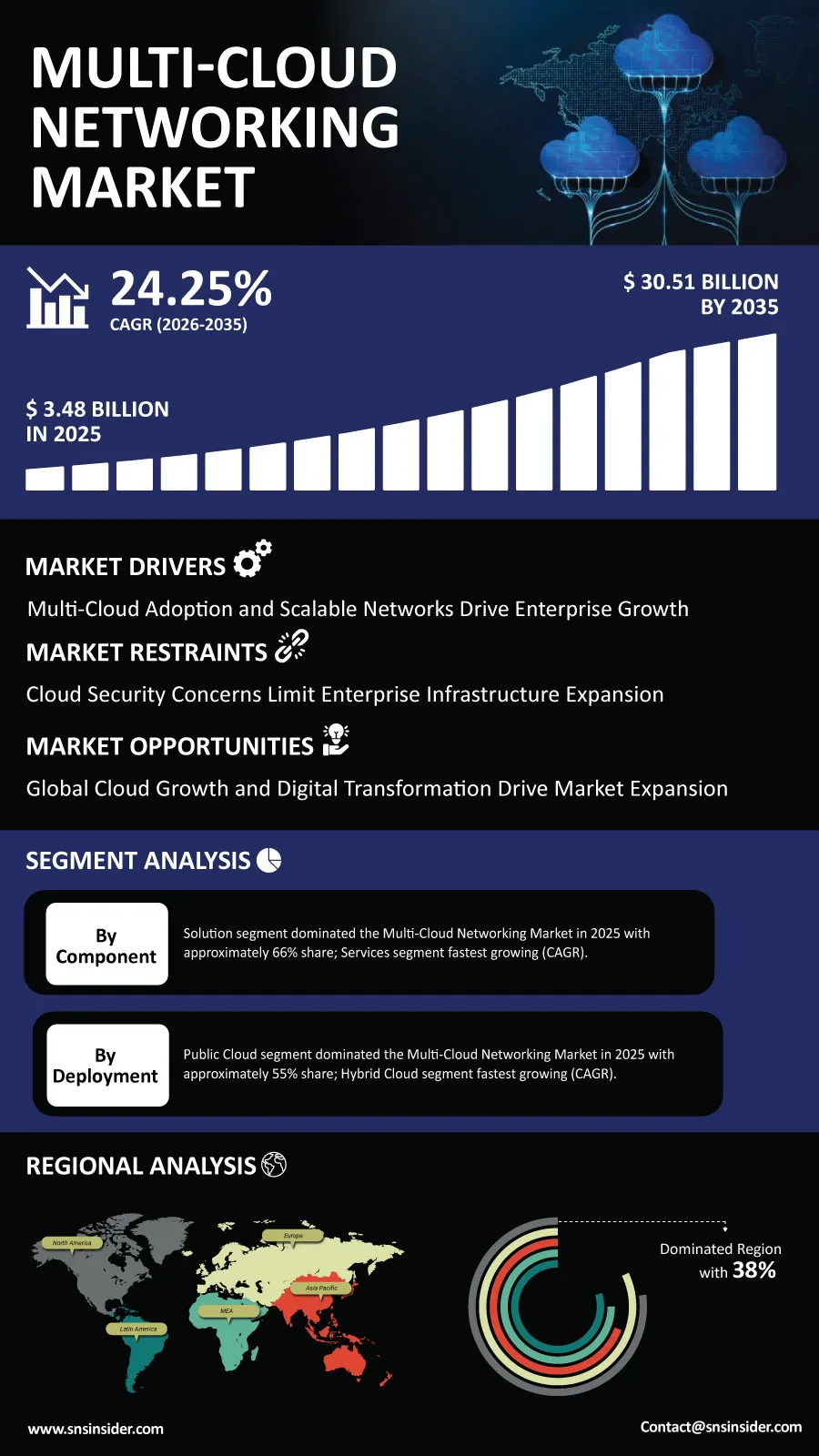
The global Multi-Cloud Networking Market is entering a new phase of expansion as organizations increasingly modernize IT environments to support distributed applications, digital services, and resilient cloud operations. “According to a recent study by SNS Insider, the global Multi-Cloud Networking Market size valued at USD 3.48 billion in 2025, is anticipated to grow to USD 30.51 billion by 2035, registering a CAGR of 24.25% over the 2026–2035 forecast period.”
The rise in cloud computing usage among enterprises is changing the landscape of networking priorities around the world. Enterprises are spending in intelligent network infrastructures that make it easier to communicate between cloud platforms and increase the efficiency of applications, performance, and continuity of business processes.
The fast growth of artificial intelligence, edge computing, Internet of Things and cloud-based applications requires more advanced networking architectures. Financial services, healthcare companies, manufacturing organizations, retailers and tech companies are developing their cloud connectivity approaches in order to make workload mobility and reduce latency.
To Get Detailed Insights on the Multi-Cloud Networking Market – Request a Sample Report
Enterprise Cloud Modernization Creates New Growth Opportunities
Organizations are moving away from using one provider cloud approach to ensure increased flexibility and lower dependence on infrastructure. This situation is bringing about numerous opportunities for networking solution providers with solutions that can centrally manage, optimize traffic, and orchestrate.
Increasing usage of hybrid working and global operation models is also driving enterprises to deploy networking solutions that provide seamless performance irrespective of the location of applications. Enterprises need reliable connectivity between their private infrastructures, public clouds, branches, and edge locations to continue with their seamless digital operations.
Emergence of software-defined networking, networking automation, observability platforms, and policy-based management solutions is enabling enterprises to simplify their cloud implementations and ensure robust network operations.
Key Market Insights Highlight Evolving Enterprise Priorities
By component, the Solution segment accounted for approximately 66% of market revenue in 2025, supported by rising demand for integrated networking platforms that simplify cloud connectivity and centralized management. Meanwhile, the Services segment is anticipated to record the fastest growth through 2035 as organizations increasingly rely on consulting, deployment, migration, and managed networking expertise.
Based on deployment, the Public Cloud segment represented nearly 55% of total market revenue in 2025 due to widespread enterprise cloud adoption and scalable infrastructure investments. The Hybrid Cloud segment is projected to witness the strongest expansion during the forecast period as organizations seek greater flexibility while balancing performance, compliance, and security requirements.
Among enterprise sizes, Large Enterprises generated approximately 61% of market revenue in 2025 because of their extensive cloud environments and large-scale digital transformation initiatives. Small and Medium Enterprises are expected to emerge as the fastest-growing customer group as cloud networking solutions become more accessible and cost-efficient.
Within end-use industries, the BFSI sector contributed nearly 28% of total revenue in 2025 owing to growing demand for secure cloud infrastructure and uninterrupted financial services. The IT & Telecommunications segment is forecast to expand at the highest rate through 2035 as cloud-native platforms, edge computing, and next-generation connectivity continue evolving.
Intelligent Network Automation Reshapes Cloud Infrastructure
The technology vendors are now deploying sophisticated networking tools that offer better visibility, automated policy enforcement, and workload balancing among the clouds. The use of artificial intelligence is becoming increasingly prevalent in network management solutions, helping them forecast performance problems, optimize routing, and provide quicker responses to incidents.
Automation is emerging as the key trend in contemporary cloud networking as companies are trying to simplify their operations and increase scalability. The constant advancements in orchestration, security, analytics, and infrastructure management technologies allow businesses to create more flexible digital infrastructures to support future expansion.
North America Held 38% of the Multi-Cloud Networking Market Share in 2025; Asia Pacific Projected to Register the Fastest Growth Through 2035
The North American region held around 38% of the total market revenue share in 2025 backed by the maturity in cloud infrastructure and massive investments in enterprise technology and digital transformation initiatives. The presence of top technology players, AI implementation, and wide adoption of hybrid working model further drives the regional demand.
The Asia-Pacific region is forecast to record the highest market growth during the period 2026-2035 due to the quick implementation of cloud technology in expanding digital economies of the region by both governments and enterprises. Increased investment in IT infrastructure, enterprise modernization initiatives, and cloud-native applications deployments drive the regional expansion.
The European region holds a significant share in the global market due to the preference of secure cloud environment and regulatory compliance among organizations. On the other hand, Latin America and the Middle East & Africa regions are making increasing investments in the cloud infrastructure and enterprise networks.
Industry Participants Focus on Unified Cloud Connectivity and Intelligent Network Management
Competition across the global Multi-Cloud Networking Market continues to intensify as technology providers expand investments in automation, cloud orchestration, network security, and AI-enabled infrastructure management. Vendors are strengthening platform interoperability while introducing solutions designed to simplify cross-cloud operations, improve workload mobility, and enhance enterprise scalability.
Key companies operating in the global Multi-Cloud Networking Market include VMware, Cisco Systems, Juniper Networks, Microsoft Corporation, IBM Corporation, Oracle Corporation, Hewlett Packard Enterprise, F5 Inc., Nutanix, Aviatrix Systems, Google LLC, Amazon Web Services, Arista Networks Inc., Alibaba Cloud, Extreme Networks Inc., Citrix Systems Inc., Dell Technologies Inc., Cloudflare Inc., Megaport Limited, and Fortinet Inc.
An SNS Insider analyst Sakshi Kale commented, "As enterprises increasingly adopt distributed cloud architectures, demand for intelligent networking solutions capable of delivering secure, scalable, and automated connectivity will continue to accelerate. Organizations investing in unified cloud management, AI-driven network operations, and resilient digital infrastructure are expected to gain significant long-term competitive advantages."
About the Author

Get in touch




