
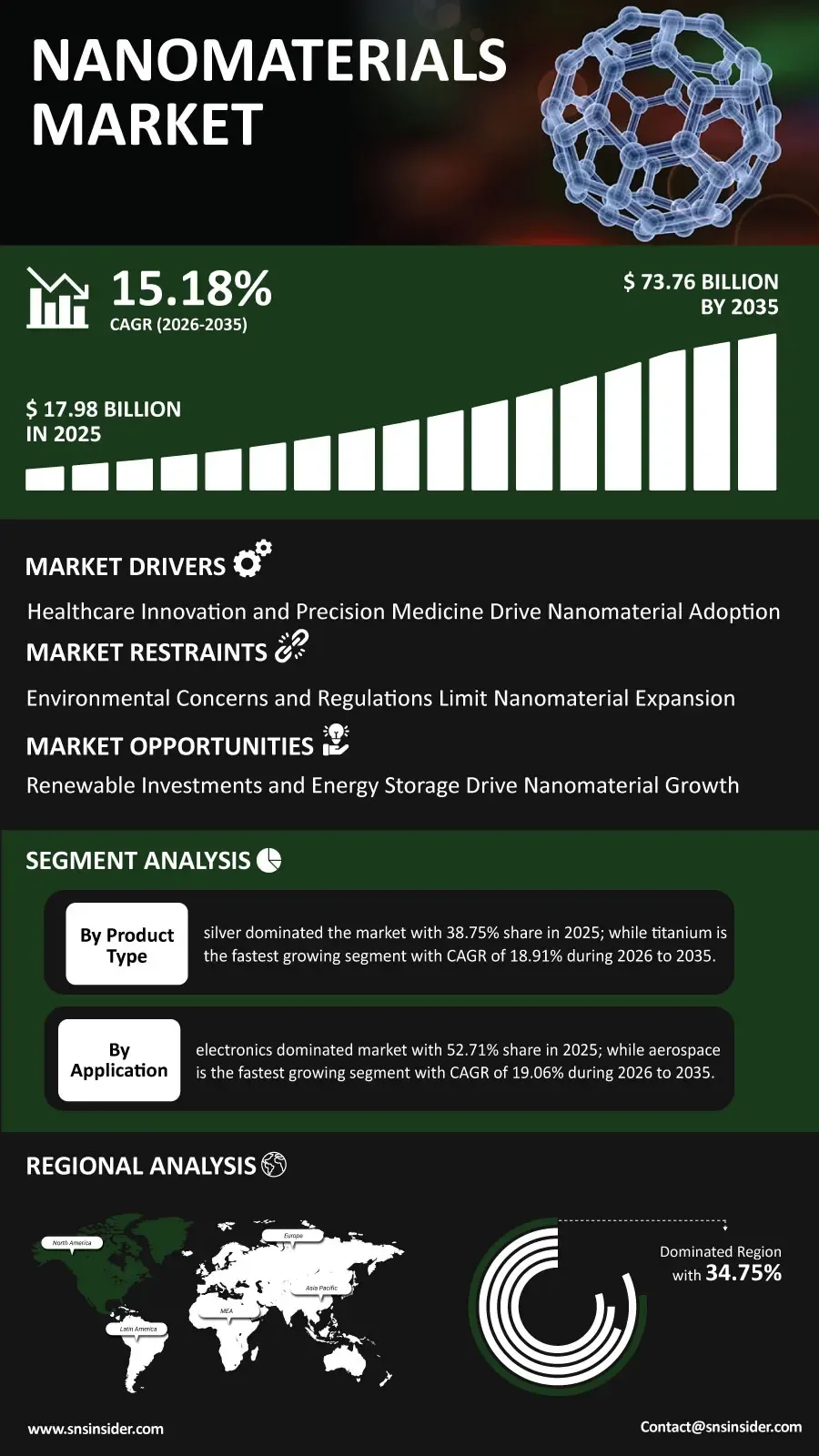
The global Nanomaterials Market is entering a high-growth phase as industries increasingly seek materials capable of delivering greater performance at smaller scales. “According to a recent study by SNS Insider, the global Nanomaterials Market size valued at 17.98 Billion in 2025, is anticipated to grow to USD 73.76 Billion by 2035, registering a CAGR of 15.18% over the 2026–2035 forecast period.”
Nanomaterials are gaining commercial importance across electronics, healthcare, aerospace, automotive, and energy because their nanoscale characteristics can improve conductivity, strength, thermal behavior, durability, and surface functionality. Investments in semiconductor manufacturing, biomedical research, lightweight components, and clean-energy technologies are accelerating the transition from laboratory-scale applications toward broader industrial deployment.
To Get Detailed Insights on the Nanomaterials Market – Request a Sample Report
Advanced Materials Create New Commercial Opportunities
Healthcare represents one of the most promising areas for nanomaterial innovation, particularly in targeted therapeutics, diagnostic technologies, imaging, and tissue regeneration. The ability to engineer materials at extremely small dimensions is enabling researchers to develop application-specific solutions for increasingly sophisticated medical technologies.
Energy applications are creating another significant avenue for expansion. Nanomaterials can enhance electrode performance, charge-transfer characteristics, and durability in batteries and solar technologies. Increasing deployment of electric vehicles, renewable power systems, and grid-scale storage is encouraging manufacturers to explore advanced material formulations that can support higher efficiency and improved energy density.
Key Market Insights Highlight Rapidly Shifting Demand
By product type, silver accounted for the largest market share of 38.75% in 2025, supported by its extensive use in conductive applications, electronics, healthcare products, and antimicrobial technologies. Titanium is projected to register the fastest growth, with a CAGR of 18.91% through 2035, driven by demand for lightweight, corrosion-resistant, and durable materials across aerospace, automotive, biomedical, and energy applications.
Based on application, electronics dominated with a 52.71% revenue share in 2025 as manufacturers increasingly integrate nanomaterials into advanced semiconductor, miniaturized, and flexible electronic technologies. Aerospace is expected to be the fastest-growing application, recording a 19.06% CAGR, as aircraft and space systems prioritize lightweight construction, thermal resistance, and improved structural performance.
By end-user industry, healthcare represented 31.75% of market revenue in 2025, reflecting expanding use in drug delivery, diagnostics, medical imaging, and regenerative applications. The energy segment is forecast to grow at the fastest pace, with a 19.77% CAGR, supported by rising investment in batteries, renewable electricity, and next-generation energy storage systems.
Nanotechnology Advances Accelerate Industrial Transformation
Research and development activities are increasingly focused on improving material consistency, scalability, surface modification, and integration into commercial manufacturing processes. These advances are helping bridge the gap between experimental nanotechnology and large-volume industrial applications.
Manufacturers are also pursuing multifunctional nanomaterials that can provide several performance benefits within a single component. Such developments are particularly relevant to electronics, aerospace composites, energy devices, and advanced coatings, where material efficiency and performance increasingly influence product design.
Regional Markets Reflect Strong Innovation and Investment
North America led the global Nanomaterials Market with approximately 34.75% of revenue in 2025, supported by extensive research infrastructure, government-backed nanotechnology programs, and strong participation from electronics, healthcare, aerospace, and energy companies. The United States remains a major contributor through investment in advanced materials, semiconductor technologies, biomedical research, and clean-energy applications.
Asia Pacific is expected to be the fastest-growing regional market, expanding at approximately 16.16% CAGR through 2035. China, Japan, India, South Korea, and Southeast Asian economies are increasing investments in semiconductor production, electric mobility, renewable energy, healthcare technologies, and advanced manufacturing, creating substantial demand for nanomaterial solutions.
Europe continues to benefit from advanced materials research and sustainability-focused industrial policies, while Middle East & Africa and Latin America are gradually expanding adoption through investments in healthcare, energy, electronics, construction, and advanced manufacturing.
Industry Participants Prioritize Scale and Application-Specific Innovation
The competitive landscape is characterized by continued investment in research, production scalability, application development, and strategic partnerships. Companies are working to commercialize nanomaterials for high-value applications while improving manufacturing efficiency and addressing regulatory and environmental requirements.
Key companies operating in the global Nanomaterials Market include BASF SE, Evonik Industries AG, Cabot Corporation, Arkema SA, LG Chem Ltd., Huntsman Corporation, DuPont de Nemours, Inc., 3M Company, Merck KGaA, Resonac Holdings Corporation, OCSiAl, NanoXplore Inc., American Elements, Nanophase Technologies Corporation, Jiangsu Cnano Technology Co., Ltd., Kuraray Co., Ltd., Haydale Graphene Industries plc, Toray Industries, Inc., Mitsubishi Chemical Group Corporation, and Nanoco Group plc.
An SNS Insider analyst Himanshu Sharma commented, “The convergence of nanotechnology with semiconductors, advanced healthcare, electric mobility, and renewable energy is opening significant opportunities for high-performance materials. Companies that can achieve reliable large-scale production while delivering application-specific functionality and meeting evolving safety requirements are likely to gain a stronger position in this rapidly expanding market.”
About the Author

Get in touch




