
Nanomaterials Market Report Scope & Overview:
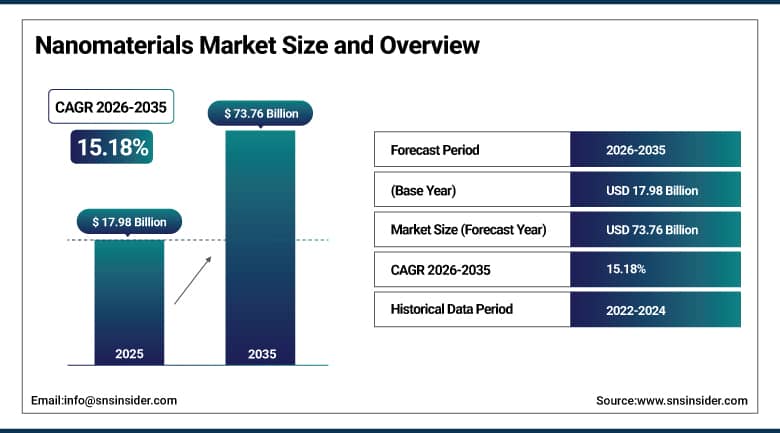
The Nanomaterials Market was valued at USD 17.98 Billion in 2025 and is expected to reach USD 73.76 Billion by 2035, growing at a CAGR of 15.18% from 2026–2035.
The global nanomaterials market is witnessing strong growth in the global market owing to increasing demand for advanced materials with enhanced mechanical, electrical, and thermal properties. Rising adoption of nanomaterials in electronics, healthcare, automotive, aerospace, and energy applications is accelerating market expansion. Manufacturers and research organizations are focusing on nanotechnology innovations, scalable production methods, surface engineering, and high-performance material development. Growing investments in semiconductor technologies, renewable energy systems, biomedical applications, and lightweight composite materials are supporting technology advancement. Increasing demand for improved material efficiency, miniaturized devices, sustainable solutions, and next-generation manufacturing processes is further driving market adoption.
According to the European Union Observatory for Nanomaterials, the expected total regional volume of the European Union market will hit 271.29 kilotons in 2025 with a compounded annual volume growth rate of 13.9%. Germany stands out as the leader in terms of regional production share with 27.2% of all registered manufacturing entities, while Spain and France hold 11% and 9.1%, respectively. Medicine and personal care products are the most prevalent applications, holding a market volume share of 20.3%.
Market Size and Forecast
-
Market Size 2026E: USD 20.68 Billion
-
Market Size 2035: USD 73.76 Billion
-
CAGR: 15.18% from 2026 to 2035
-
Fastest Growing Region: Asia Pacific
-
Largest Region: North America
To Get More Information On Nanomaterials Market - Request Free Sample Report
Nanomaterials Market Trends
-
Greater use of nanomaterials in precision medicine is leading to more efficient targeted drug delivery and diagnostics.
-
The increased use of nanomaterials in renewable energy technology is contributing to the efficiency of batteries and next-generation solar cells.
-
Increased investment in batteries for electric vehicles is stimulating the demand for high-quality nanomaterials for energy storage.
-
Ongoing advances in biotechnology are spurring developments in nanomaterial-based drugs, regenerative medicine, and personalized health care.
-
Clean energy policies in the government are aiding in commercializing nanomaterial technologies for clean energy.
-
The increased emphasis on multifunctional nanomaterials is benefiting their performance and efficiency in industry.
U.S. Nanomaterials Market Outlook
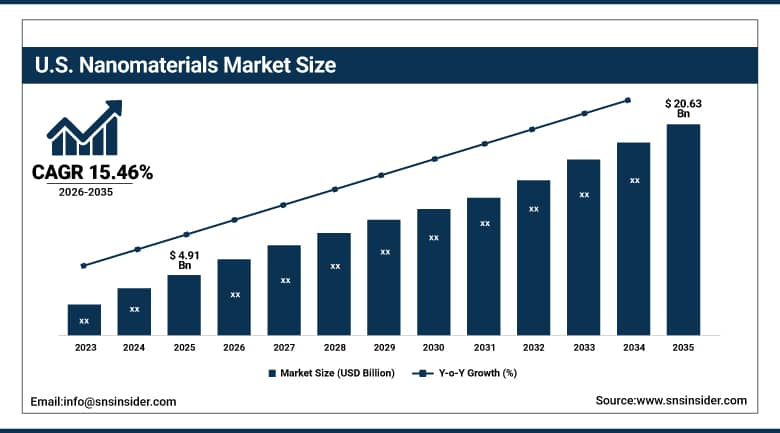
The U.S. Nanomaterials Market was valued at USD 4.91 Billion in 2025 and is expected to reach around USD 20.63 Billion by 2035, growing at a CAGR of 15.46% from 2026–2035.
The U.S. nanomaterials market is expanding rapidly owing to rising adoption of advanced materials across high-growth industries and research applications. Increasing utilization by electronics manufacturers, healthcare companies, automotive firms, aerospace organizations, and energy providers is supporting market growth nationwide. Rising investments in nanotechnology research, semiconductor manufacturing, biomedical innovations, advanced coatings, and lightweight composite materials are driving technological advancement and material performance. Growth in next-generation manufacturing and advanced material development initiatives is further accelerating nanomaterials adoption across industries. Manufacturers are focusing on scalable production, surface modification technologies, and application-specific nanomaterial solutions across diverse end-use segments. Increasing demand for high-performance materials, miniaturized electronics, sustainable technologies, and enhanced product efficiency is strengthening long-term market penetration.
As per the National Nanotechnology Initiative, intergovernmental collaboration includes 12 main federal organizations conducting public research and development management. According to USPTO statistics, nanotechnology patents account for about 0.35% of all patent applications, which highlights unique material technology processing. Additionally, NSF spends more than 60% of the NNI budget on fundamental nanotechnology research and incorporates STEM workforce training into its university user facilities network.
Nanomaterials Market Segment Analysis
-
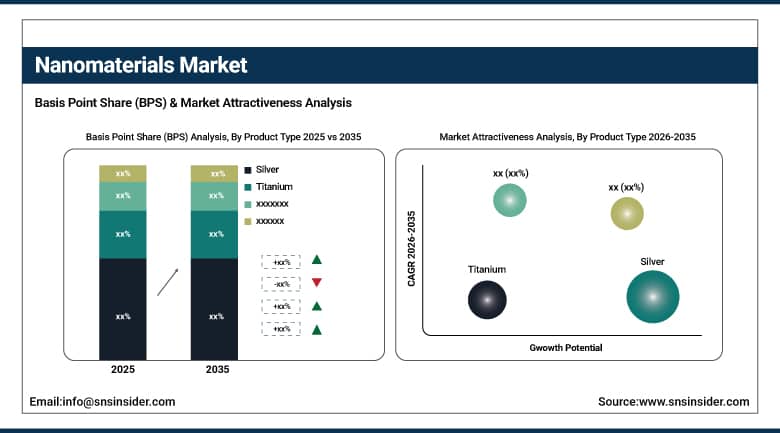
By Product Type, silver dominated the market with 38.75% share in 2025; while titanium is the fastest growing segment with CAGR of 18.91% during 2026 to 2035.
-
By Application, electronics dominated the market with 52.71% share in 2025; while aerospace is the fastest growing segment with CAGR of 19.06% during 2026 to 2035.
-
By End-User Industry, healthcare dominated the market with 31.75% share in 2025; while energy is the fastest growing segment with CAGR of 19.77% during 2026 to 2035.
By Product Type, silver dominated the nanomaterials market, while titanium is the fastest growing segment.
The silver segment held the dominated market share among all segments due to its significant use in applications such as electronics, healthcare, antimicrobial coatings, and conductive applications. Silver nanomaterials have better conductivity, higher thermal stability, and excellent antibacterial activity. Moreover, rising consumption of advanced electronic products and healthcare applications boosted the growth of the silver segment within the nanomaterials market in 2025.
The titanium segment is anticipated to have the fastest CAGR from 2026 to 2035, which can be attributed to the rising demand for titanium nanomaterials in aerospace, automotive, healthcare, and energy applications. The applications of titanium nanomaterials include excellent strength, corrosion resistance, lightweight features, and high durability. Thus, increasing investment in advanced manufacturing processes, biomedical implants, renewable energy technologies, and lightweight structural materials is propelling the demand for titanium nanomaterials.
By Application, electronics dominated the nanomaterials market, while aerospace is the fastest growing segment.
Electronics segment as the leading segment of the nanomaterials market with the dominated share in revenue in 2025, owing to increasing demand. This is attributed to the improved properties offered by nanomaterials such as their conductivity, toughness, and performance in small-sized devices and in future generation electronics applications. Higher investment in semiconductor technology and flexible electronics increases the application of nanomaterials in different industries across the globe.
The aerospace segment is estimated to exhibit the fastest CAGR between 2026 and 2035, owing to increasing demand for lightweight material. The superior properties of nanomaterials such as strength, thermal resistance, and performance make them highly suitable for aerospace applications. Investments in space exploration and fuel-efficient aircraft development will boost the usage of nanomaterials in this sector.
By End-User Industry, healthcare dominated the nanomaterials market, while energy is the fastest growing segment.
Healthcare segment was the dominant segment in the nanomaterials market in terms of revenue share in 2025 due to various applications of nanomaterials in this segment. There are numerous applications of nanomaterials in the healthcare sector, including drug delivery systems, diagnosis, imaging, and regeneration of tissues. Rapid advancements in the field of nanomedicine and investments have led to increased adoption and demand in the healthcare sector.
The energy segment will grow at a high rate during 2026-2035 due to high demands for energy storage in the form of batteries and solar panels. There are numerous uses of nanomaterials in the energy storage market as they provide better efficiency through their unique properties of conductivity and durability. Increasing investment in renewable energy sources will drive the growth of the market during the forecast period.
Regional Analysis
|
Region |
Major Country |
Share within Region, 2025(%) |
|---|---|---|
|
North America |
United States |
78.55% |
|
Europe |
Germany |
24.50% |
|
Asia Pacific |
China |
38.50% |
|
Middle East & Africa |
UAE |
14.20% |
|
Latin America |
Brazil |
42.00% |
North America Nanomaterials Market Insights
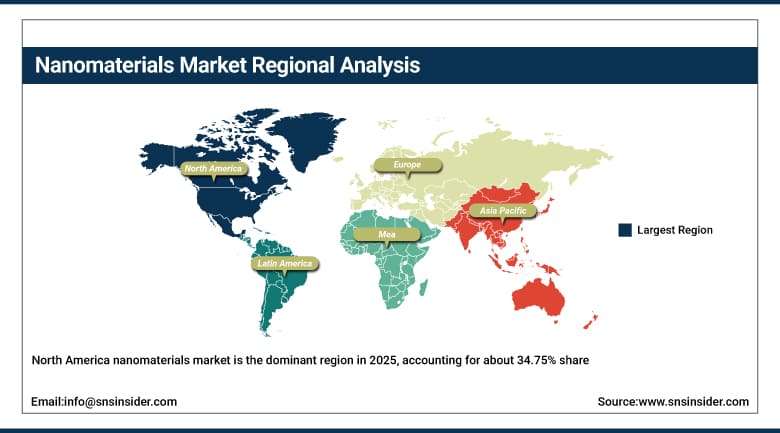
North America nanomaterials market is the dominant region in 2025, accounting for about 34.75% share, driven by increasing demand for advanced materials across electronics, healthcare, aerospace, and energy applications. The region benefits from strong research and development activities, established nanotechnology companies, and significant government funding for advanced material innovation. Increasing adoption of nanomaterials in semiconductor manufacturing, medical devices, lightweight composites, and energy storage solutions is strengthening market growth. Expansion of nanotechnology-based applications further reinforces the region’s leading position in the market.
As per the United States National Nanotechnology Coordination Office, nanoscale research and development programs in 2025 by the U.S. government include cutting-edge innovations in twelve major agencies and more than thirty federal agencies taking part in the programs. The focus areas in the program include pre-commercialization testing, standardization of performance protocols, and fast material commercialization. Collaboration between researchers, government agencies, and industries is increasing the use of nanomaterials in microelectronic, clean energy, healthcare, and advanced manufacturing fields.
Get Customized Report as Per Your Business Requirement - Enquiry Now
Europe Nanomaterials Market Insights
Europe nanomaterials market is characterized by steady growth in 2025 owing to increasing investments in advanced material research and sustainable technology development. Key countries include Germany, France, United Kingdom, Italy, and Spain. Rising adoption of nanomaterials in automotive components, healthcare solutions, electronics, and renewable energy systems is supporting market expansion. Increasing focus on lightweight materials, energy-efficient technologies, and environmentally sustainable manufacturing processes is strengthening long-term industry development. Technological advancements continue encouraging efficient material performance and innovative applications across multiple industries.
The European Chemicals Agency states that REACH evaluation figures for 2025 demonstrate that 214 compliance audits were performed concerning almost 1,200 registration applications dealing with 196 substances in order to close data gaps on the safety of chemicals. As for the result, about 70% of evaluated firms managed to provide the requested hazard information, whereas 30% of those were sent to European Union member states for enforcement proceedings. In addition, total adopted evaluation decisions came to 323.
Asia Pacific Nanomaterials Market Insights
Asia Pacific is the fastest growing region in the nanomaterials market, registering a CAGR of about 16.16% during 2026–2035. Rapid industrialization and increasing demand for advanced materials are driving strong market growth across China, Japan, India, South Korea, and Southeast Asia. Rising investments in semiconductor manufacturing, renewable energy technologies, healthcare innovation, and automotive applications are accelerating regional expansion. Growing research activities and increasing adoption of nanomaterials in electronics and energy storage applications continue supporting widespread nanotechnology development across the region.
According to World Intellectual Property Organization PCT Annual Report 2025, international patent applications totaled 275,900, which was significantly fueled by technological advancements in major Asian-Pacific regions. China retained its leadership in terms of international patent applications filed with 73,718, growing 5.3% annually, and the Republic of Korea filed 25,016 patent applications, growing at 4.9%. On the other hand, semiconductor patents showed growth of 6.1%, indicating rising usage of nanomaterials in the manufacturing of electronic devices.
Middle East & Africa and Latin America Nanomaterials Market Insights
The Middle East & Africa along with Latin America regions are witnessing gradual growth due to increasing adoption of advanced materials and expanding industrial development activities. Key contributing countries include Saudi Arabia, UAE, South Africa, Brazil, Mexico, and Argentina. Growing utilization of nanomaterials in healthcare, energy, construction, electronics, and environmental applications is supporting market expansion. Continued investments in research infrastructure and advanced manufacturing capabilities are strengthening long-term regional opportunities.
As stated by the United Nations Economic Commission for Latin America and the Caribbean, intellectual property intensive manufacturing industries, which include cutting-edge nanomaterials, contribute 13.6% to regional gross domestic product and employ 1.6 million people in Latin America. Public research institutions file 29% of the country’s patent applications, while foreigners file 85% of all patent applications. In addition, patent intensive products comprise 19% of regional imports and 9% of regional manufacturing exports.
Market Dynamics
Growth Drivers: Growing healthcare innovation and precision medicine are driving advanced nanomaterials adoption globally.
The increased application of nanomaterials in the health sector is growing very fast due to their efficiency in improving drug delivery and accuracy in diagnostics. Nanomaterials help in developing targeted treatment with minimized side effects thus making the treatment much effective for various diseases around the globe. The increased funding in the field of biotechnology research and pharmaceutical innovations is contributing in the development of various sophisticated nanomaterial-based medical products. High incidences of chronic diseases and rising demand for personalized medicines keep encouraging commercial applications on a global level.
The National Institutes of Health clinical trials registry guidelines for the year 2025 reveal that oncology made up 40.63% of all new mRNA nanoparticle therapies trials, equaling the number of infectious disease applications that made up 40.63% of all new trials for the same year. Early phase clinical trials made up 78.13% of the total 2025 trials. North America topped the global distribution of these trials with 186 total trials, with Asia following close behind with 184 total trials.
Restraints: Strict regulations and environmental concerns delay nanomaterial commercialization and global market expansion.
The process of testing that is involved when analyzing the effects of nanomaterial usage on both environmental and health aspects becomes very important. The lengthy process and changing international safety measures cause higher costs for companies trying to penetrate the regulated market in other countries. The lack of information about their long-term toxic effects and proper methods of disposal is another problem that complicates their production and commercialization. Such high costs of environmental assessment and safety analysis become necessary before selling advanced nanomaterial-based products on the international market.
Opportunities: Increasing renewable energy investments drive advanced nanomaterials adoption for efficient energy storage.
There is growing pressure on nanomaterials owing to increased demand for renewable energy on a worldwide basis. The usage of nanomaterials boosts the performance of batteries, solar cells, and hydrogen storage because of their superior material qualities. Various incentives provided by governments for clean energy development act as driving forces that urge the producers to come up with new energy solutions based on the use of nanomaterials constantly. There are ongoing investments in electric vehicles and grid energy storage, which will increase commercial potential of nanomaterials in the future.
According to IEA estimates, global battery storage capacity additions rose to 108 gigawatts in 2025, indicating a growth of 40% from 2024 figures. In terms of country-level data, China topped the charts by adding 63 gigawatts of battery storage capacity in the year, out of which utility-scale battery installations made up 55 gigawatts of national additions. Simultaneously, global renewable energy additions rose to 692 gigawatts on IRENA estimates.
Recent Developments
-
2026: OCSiAl signed a supply agreement to provide single-wall carbon nanotubes for Volkswagen Group's PowerCo Unified Cell battery manufacturing platform.
-
2025: BASF Pharma Solutions introduced digital assistant platforms and bioprocessing raw materials to enhance raw material consistency in manufacturing.
-
2025: Evonik launched PhytoSquene, a plant-derived pharmaceutical-grade squalene providing a sustainable alternative to animal-sourced lipids in vaccine delivery.
-
2024: Cabot Corporation secured a 50-million-dollar grant award from the United States Department of Energy for domestic battery supply chain capabilities.
Nanomaterials Market Key Players are:
-
BASF SE
-
Evonik Industries AG
-
Cabot Corporation
-
Arkema SA
-
LG Chem Ltd.
-
Huntsman Corporation
-
DuPont de Nemours, Inc.
-
3M Company
-
Merck KGaA
-
Resonac Holdings Corporation
-
OCSiAl
-
NanoXplore Inc.
-
American Elements
-
Nanophase Technologies Corporation
-
Jiangsu Cnano Technology Co., Ltd.
-
Kuraray Co., Ltd.
-
Haydale Graphene Industries plc
-
Toray Industries, Inc.
-
Mitsubishi Chemical Group Corporation
-
Nanoco Group plc
Nanomaterials Market Report Scope:
| Report Attributes | Details |
|---|---|
| Market Size in 2025 | USD 17.98 Billion |
| Market Size by 2035 | USD 73.76 Billion |
| CAGR | CAGR of 15.18% From 2026 to 2035 |
| Base Year | 2025 |
| Forecast Period | 2026-2035 |
| Historical Data | 2022-2024 |
| Report Scope & Coverage | Market Size, Segments Analysis, Competitive Landscape, Regional Analysis, DROC & SWOT Analysis, Forecast Outlook |
| Key Segments | • By Product Type (Gold, Silver, Platinum, Titanium, Aluminum) • By Application (Electronics, Automotive, Aerospace) • By End-User Industry (Healthcare, Energy, Construction, Rubber, Personal Care, Other End-User Industries) |
| Regional Analysis/Coverage | North America (US, Canada), Europe (Germany, UK, France, Italy, Spain, Russia, Poland, Rest of Europe), Asia Pacific (China, India, Japan, South Korea, Australia, ASEAN Countries, Rest of Asia Pacific), Middle East & Africa (UAE, Saudi Arabia, Qatar, South Africa, Rest of Middle East & Africa), Latin America (Brazil, Argentina, Mexico, Colombia, Rest of Latin America). |
| Company Profiles | BASF SE, Evonik Industries AG, Cabot Corporation, Arkema SA, LG Chem Ltd., Huntsman Corporation, DuPont de Nemours, Inc., 3M Company, Merck KGaA, Resonac Holdings Corporation, OCSiAl, NanoXplore Inc., American Elements, Nanophase Technologies Corporation, Jiangsu Cnano Technology Co., Ltd., Kuraray Co., Ltd., Haydale Graphene Industries plc, Toray Industries, Inc., Mitsubishi Chemical Group Corporation, Nanoco Group plc |

Frequently Asked Questions
The nanomaterials market was valued at USD 17.98 billion in 2025.
The major growth is driven by rising demand for advanced materials, expanding electronics and healthcare applications, renewable energy investments, semiconductor advancements, and continuous nanotechnology innovations.
The silver dominated in 2025 owing to superior conductivity, antibacterial properties, and extensive applications across electronics, healthcare, coatings, and industrial sectors.
North America dominated the nanomaterials market in 2025.
