
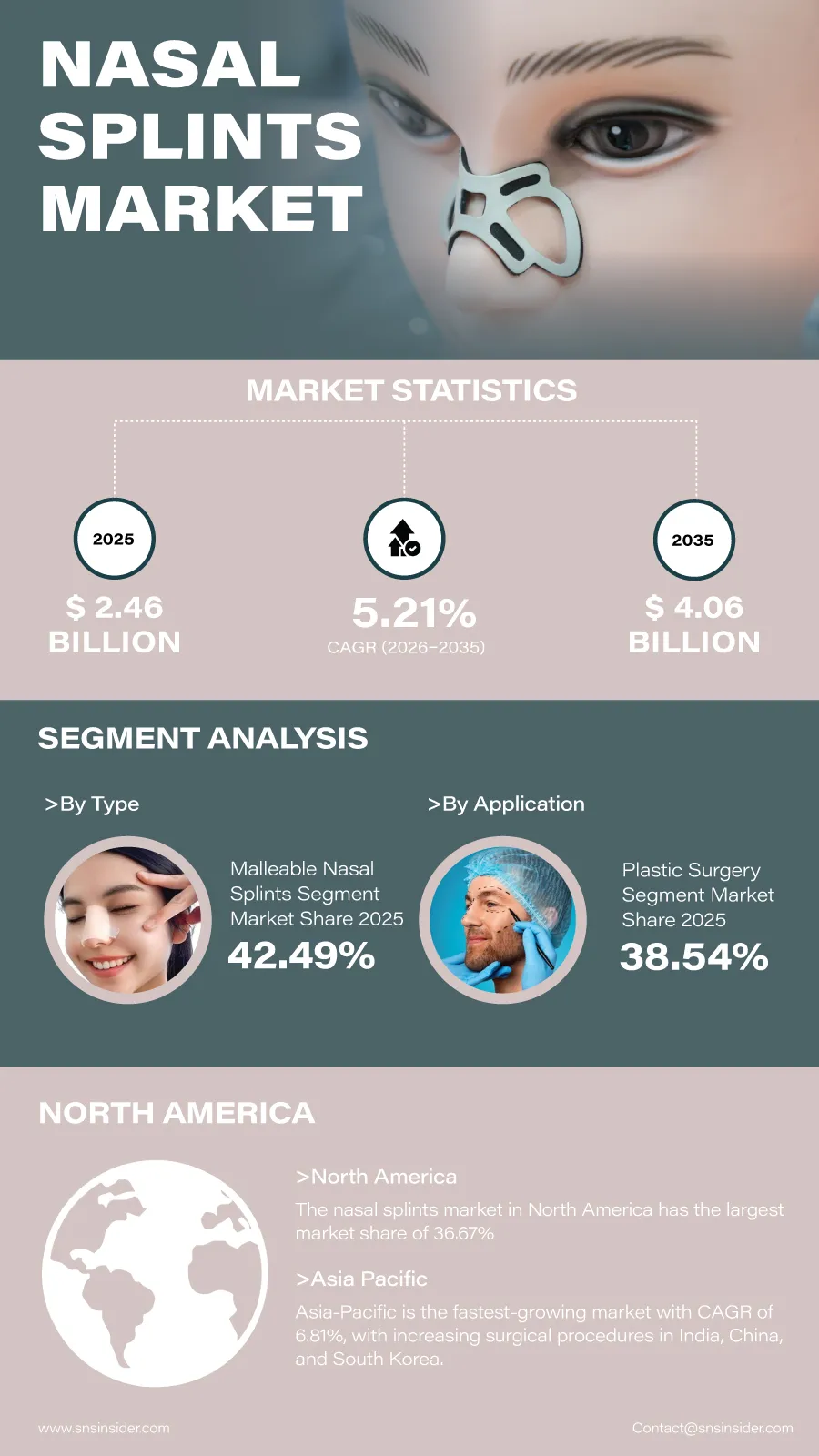
The global Nasal Splints Market is expected to register steady growth over the next decade as healthcare providers increasingly emphasize effective post-surgical recovery and improved patient outcomes following nasal procedures. “According to a recent study by SNS Insider, the global Nasal Splints Market size valued at USD 2.46 billion in 2025, is anticipated to grow to USD 4.06 billion by 2035, registering a CAGR of 5.21% over the 2026–2035 forecast period.”
The increasing number of reconstructive and cosmetic surgeries performed on noses, increased inclination toward minimally invasive surgery and wider access to post-surgery care products are creating an atmosphere conducive for market growth. Nasal stabilization products that facilitate healing and improve the comfort of patients during the recovery period are constantly being adopted by hospitals, ambulatory surgery centers, and specialized ENT clinics.
Growing investments in healthcare infrastructure and increasing access to specialized surgical services are further strengthening demand for advanced nasal care devices across developed and emerging healthcare markets.
Innovation in Surgical Recovery Solutions Shapes Market Evolution
Manufacturers are focusing on the development of next-generation nasal splints, which are more flexible and improve patient comfort and clinical management. Scientific advances in the field of material science and innovative product design are allowing healthcare providers to improve postoperative recovery while minimizing the risks associated with the procedure.
The industry is also witnessing a growing demand for patient-centric products, which include bioabsorbable nasal splints, custom splints, and technology that helps reduce pain during recovery. Such advancements allow for a wider use of these products for ENT procedures and facial cosmetic surgery.
Outpatient surgical procedures are increasingly becoming common around the world, and there is going to be sustained demand for products that help patients recover.
Key Market Findings Highlight Emerging Growth Areas
Among product categories, malleable nasal splints accounted for 42.49% of global market revenue in 2025, reflecting their versatility and widespread adoption across various nasal reconstruction and correction procedures.
Meanwhile, airway nasal splints are projected to register the fastest growth through 2035, expanding at a CAGR of 4.56%, driven by increasing demand for devices that support postoperative airflow while maintaining structural stability.
From an application perspective, plastic surgery represented 38.54% of total market revenue in 2025 and is also expected to remain the fastest-growing application segment, advancing at a CAGR of 4.98% throughout the forecast period as cosmetic procedures continue to gain popularity worldwide.
Material innovation continues to reshape product development. Silicone-based nasal splints accounted for 42.82% of market revenue in 2025, supported by their flexibility, biocompatibility, and clinical reliability. At the same time, plastic and polymer-based splints are expected to witness the fastest growth at a CAGR of 4.19%, reflecting ongoing improvements in manufacturing technologies and cost-effective production.
Distribution channels are also evolving. Hospital and clinic procurement accounted for 67.71% of total market revenue in 2025, while online platforms are anticipated to expand at the fastest CAGR of 5.56%, supported by growing digital procurement and increasing accessibility across healthcare providers.
An Infographic Representation of the Global Nasal Splints Market
Expanding Surgical Volumes Continue to Support Demand
Increased consciousness regarding facial esthetics, improvements in reconstructive surgery, and increased availability of specialized ENT treatment services remain key factors contributing to the ever-growing number of procedures performed across the globe. Advanced post-operative care strategies are becoming more common among healthcare professionals with an intent to improve outcomes.
The continuous growth of ambulatory surgery centers and clinics that offer outpatient services is equally creating fresh avenues for the companies that produce easily manageable products that help recover faster.
Regional Markets Present Significant Opportunities
North America accounted for 36.67% of the world market’s revenue in 2025, driven by its well-developed healthcare system, wide acceptance of novel surgical devices, and increased numbers of nasal surgeries done for either cosmetic or functional purposes. Investments made in specialty surgical treatments and easy availability of advanced medical devices strengthen this market position.
Meanwhile, the Asia Pacific region is forecasted to experience the fastest growth of all regional markets, as indicated by its CAGR estimated at 6.81% from 2020 to 2035. The region holds promising prospects for growth due to increased investment in the health sector, rising medical tourism, expanded surgical facilities, and awareness regarding post-surgical care.
Industry Participants Focus on Product Development
The competition within the nasal splints industry is growing more severe by the day as companies strive to innovate products, materials, and partnerships that improve surgical recovery.
Leading companies operating in the global nasal splints market include Novartis, Roche, Pfizer, AbbVie, Bristol Myers Squibb, GlaxoSmithKline, Sanofi, Johnson & Johnson, Merck & Co., and Takeda Pharmaceutical Company.
An SNS Insider analyst Parry Kardani commented, "The nasal splints market continues to evolve as healthcare providers place greater emphasis on patient recovery, procedural efficiency, and postoperative comfort. Advances in material technologies and customized surgical solutions are expected to create meaningful opportunities for manufacturers over the next decade."
About the Author

Get in touch




