
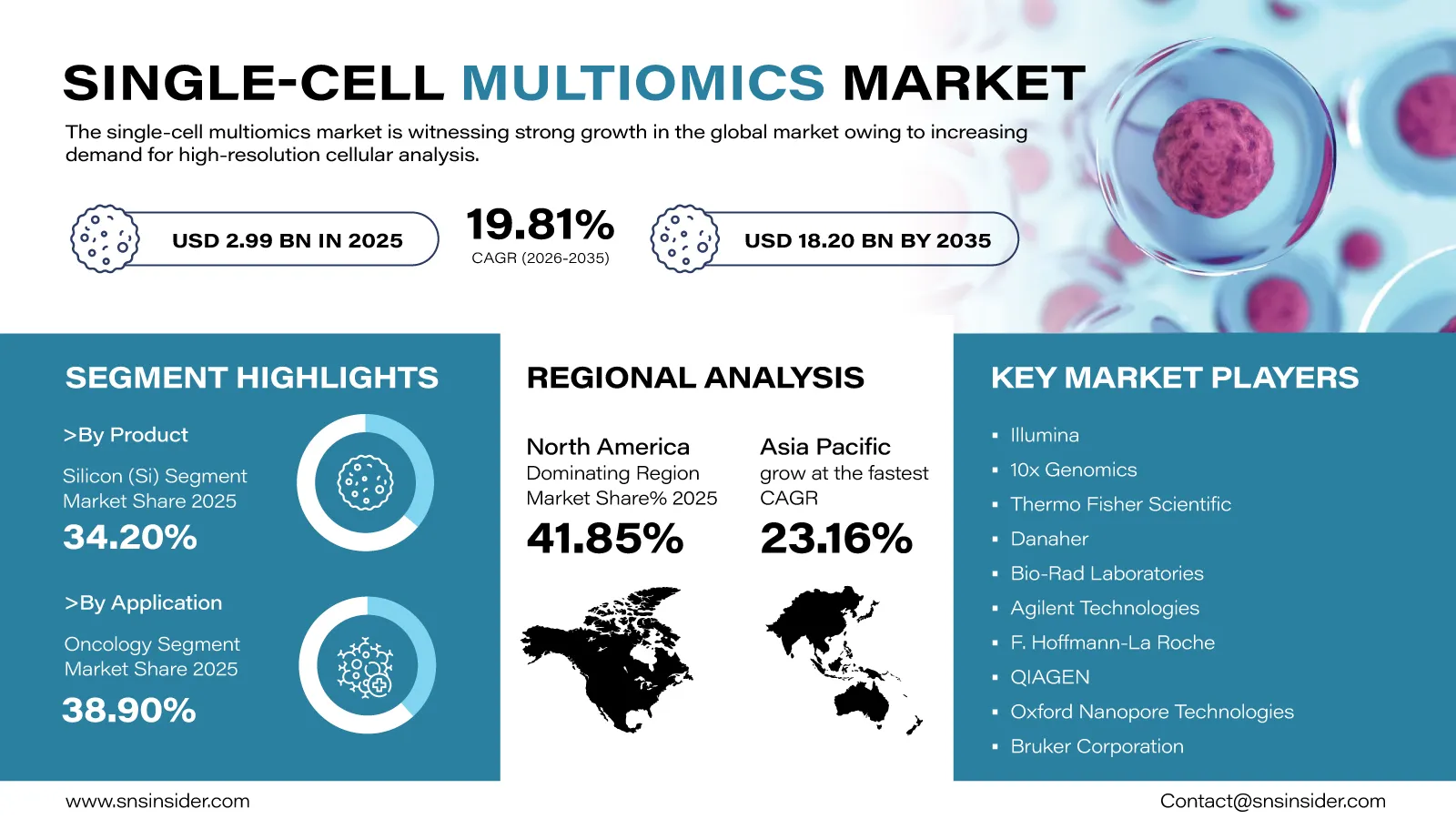
The global Single-Cell Multiomics Market will witness phenomenal growth, as the trend of implementing new technologies for cellular analysis and getting a deeper understanding of the body via this method is gaining positive ground. “According to a recent study by SNS Insider, the global Single-Cell Multiomics Market size valued at USD 2.99 billion in 2025, is anticipated to grow to USD 18.20 billion by 2035, registering a CAGR of 19.81% over the 2026–2035 forecast period.”
Increasing demand for sophisticated cell analysis is transforming biomedicine and accelerating discovery across major therapeutic areas including oncology, immunology, neurology and rare diseases through higher throughput. Curtis points out that across the world, organizations are starting to leverage sophisticated multiomics platforms to enable their scientists better insight into complex biological processes and translate this knowledge into effective personalized treatment.
Precision medicine programs and translational research programs by the pharmaceutical industry necessitate single-cell multiomics.
To Get Detailed Insights on the Single-Cell Multiomics Market – Request a Free Sample Report
Next-Generation Cellular Analysis Reshapes Biomedical Research
Technology advancements at a fast pace are giving an added momentum to capabilities of single cell analysis platforms. Rapid developments in various sequencing techniques, spatial biology, data analytics and bioinformatics are enabling researchers to generate more scientific insights while improving the efficiency of processes.
The growing implementation of artificial intelligence, cloud computing and next generation sequencing is propelling the analysis of complex biological data sets at an even faster rate. This trend is supporting research organizations to accelerate the time for discovery, with biomarkers identification A precise medicine application in various treatment areas.
More academia-biotech-pharma partnership is critical for the commercial success of multi-omics solutions.
Key Market Findings Highlight Emerging Opportunities
Depending on product type, single-cell genomics was accountable for 34.20% sales generated globally by the market in 2025 due to extensive acceptance of single cell technologies across genomic research, disease profiling and precision medicine.
Conversely, single-cell proteomics will witness the most rapid growth over the period of this forecast up to 2035 at a CAGR of 23.16%, due to growing demand for protein analysis and biomarkers for research applications.
On the basis of application, oncology accounted for 38.90% revenue share in 2025 attributed to growing number of ongoing cancer research projects and increasing demand for precision oncology. The immunology segment is anticipated to grow at the fastest CAGR of 22.16% during the forecast period.
On the subject of technology adoption, droplet-based microfluidics represented 56.30% of revenue generated from market in 2025 growing at a fast rate owing to scalability and ability to conduct high through put single cell analysis. However, spatial-omics based platforms are expected to show the highest CAGR of 24.50% over the forecast period owing to increasing use of tissue-level analysis and spatial biology.
By end-user, pharmaceutical and biotechnology companies accounted for 39.10% of global revenue in the market in 2025. Conversely Academic/research institutions segments are expected to show the highest CAGR of 21.29%.
Precision Medicine and AI Continue to Drive Market Expansion
Recently, healthcare institutions, as well as biotech firms, have been encouraged to implement the multiomics approaches to gain a deeper comprehension of disease mechanisms and therapeutic development, resulting in personalized patient treatment. As the processing of biological information has become a critical step in the characterization of any system, as computational approaches and AI availability en passant made it easier that led to biomarker discovery and facilitated data analysis.
The growth of single-cell multiomics is likely to be accelerated by the widespread adoption of automation, cloud computing, and bioinformatics in future years.
Regional Markets Continue to Expand
In 2025, North America accounted for 41.85% of total market revenue, supported by active research facilities, availability of quality and advanced sequencing technologies and increased spending on precision medicine in the region. The continued benefits Retrieved Derived from Research Institute — Biotech Company — Healthcare Partnerships In The Region
Asia Pacific region is projected to witness the maximum growth among the regional markets over the forecast period till 2035 because of a booming biotechnology market, increasing research investment, various genomics initiatives and advancements in life sciences technologies developed in countries such as China, Japan, South Korea and India.
Industry Leaders Accelerate Innovation
The growing demand for next-generation sequencing technologies in various applications coupled withspatial biology, software development, and analysis solutions is changing the scenario of single-cellmultiomics market as it has technically become competitive now with many big players in the lifesciences sector investing huge amounts into it.
Key companies operating in the global single-cell multiomics market include Illumina, 10x Genomics, Thermo Fisher Scientific, Danaher Corporation, Bio-Rad Laboratories, Agilent Technologies, Roche, QIAGEN, Oxford Nanopore Technologies, and Bruker Corporation.
An SNS Insider analyst Parry Kardani commented, "Single-cell multiomics is transforming biomedical research by enabling scientists to examine cellular complexity with unprecedented precision. Continued advances in sequencing technologies, spatial biology, and AI-enabled analytics are expected to unlock significant opportunities for precision medicine and next-generation therapeutic development over the coming decade."
About the Author

Get in touch




