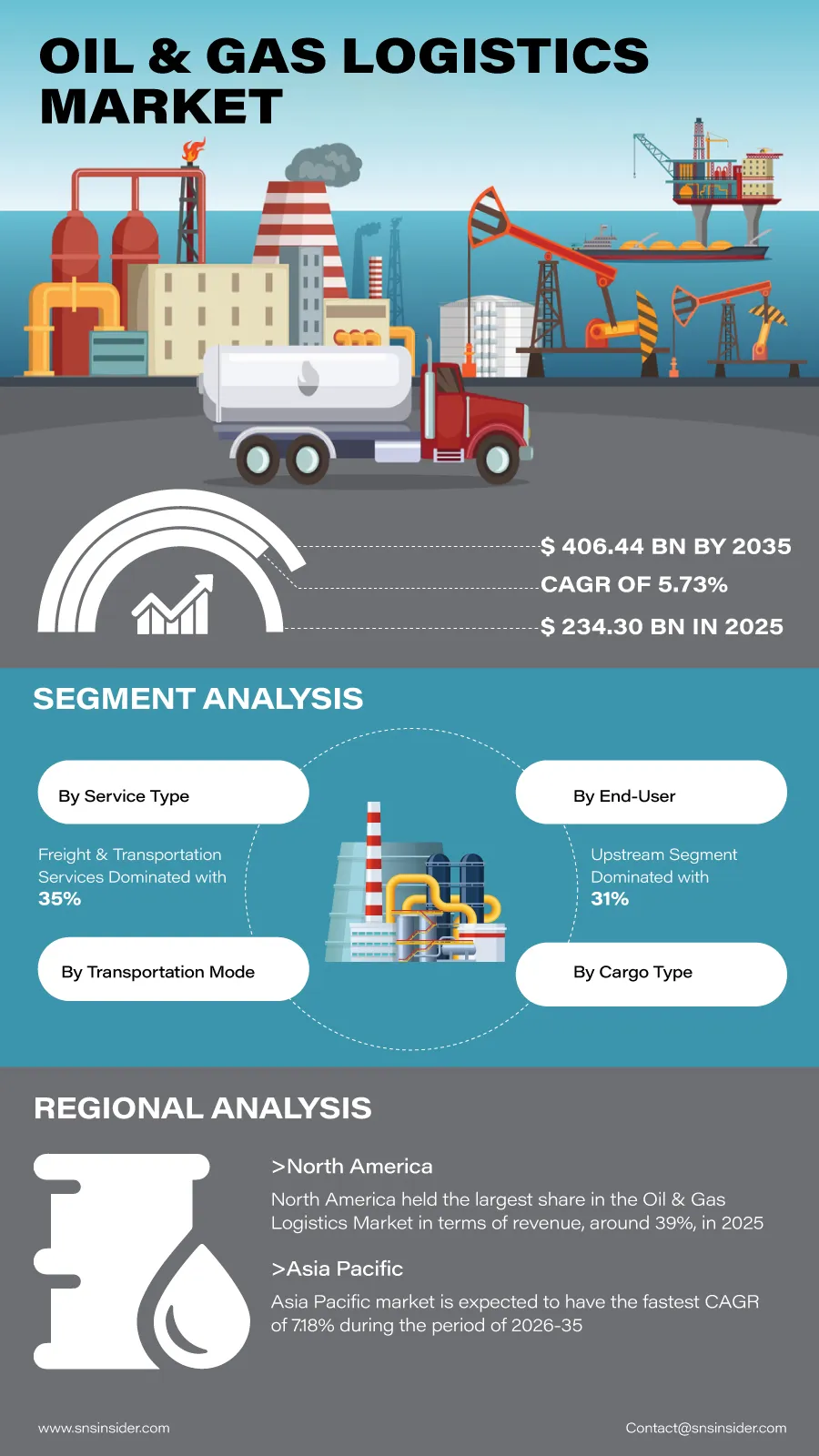
The global Oil And Gas Logistics Market is poised for sustained growth over the coming decade as energy producers, logistics providers, and infrastructure developers strengthen supply chain capabilities to support rising global demand for crude oil, liquefied natural gas (LNG), and refined petroleum products. According to a recent study by SNS Insider, the global Oil And Gas Logistics Market size valued at USD 234.30 billion in 2025, is anticipated to grow to USD 406.44 billion by 2035, registering a CAGR of 5.73% over the 2026–2035 forecast period.
Upstream, midstream, and downstream energy operations are becoming more reliant on effective transport and distribution systems to safely and effectively manage hydrocarbons. With the increase in energy operations in challenging terrain and areas, there has been an increase in investment in specialized transport systems, advanced tracking technologies, and supply chain systems to improve the effectiveness of operations.
In addition, increasing global energy trade is affecting the way energy logistics is done. With investments in pipelines, ports, storage systems, marine transport, and multimodal logistics networks, energy logistics is being performed in a faster manner while helping to build robust logistics chains for the energy companies.
Digital Supply Chains and Infrastructure Investments Create New Growth Opportunities
More energy companies are adopting intelligent logistics solutions that are incorporating artificial intelligence, predictive analytics, IoT connections, and digital twins technology. Intelligent logistics increase shipment visibility, minimize delays, and ensure better decision-making within the complicated supply chain.
At the same time, government agencies and private organizations have been continuing investments in infrastructure development in order to guarantee supply security and increase cross-border energy transport. Various projects including new pipelines, LNG export terminals, storage facilities, and ports are offering many opportunities for logistics providers dealing with energy cargo.
Along with sustainability and efficiency becoming increasingly important, the transportation firms are utilizing automated fleet management systems and high-end safety systems that improve handling of hazardous materials and lower expenses.
Key Market Insights Highlight Shifting Demand Patterns
Based on transportation mode, marine and sea transportation segment held approximately 42% of global market revenue share in 2025 due to their cost-effectiveness in moving large volumes of crude oil, refined products, and liquefied gases across international markets. Pipeline transportation is projected to register the fastest growth through 2035 caused by the investments in new transmission networks and infrastructure upgrades continue globally.
By end user, the upstream segment is expected to make up close to 31% of the total revenues in the industry in 2025 due to continuous exploration, drilling, and production processes that necessitate special logistical assistance. The midstream segment will be the fastest-growing segment of the industry in the coming years as investments in storage, transportation, and distribution infrastructure accelerate globally.
In terms of service type, freight and transportation services held around 35% market share in 2025 due to their crucial importance in the transportation of drilling equipment, oil and gas products, and industrial equipment. Logistics of project operations and oilfield services will show the highest rate of growth as offshore developments and large-scale energy projects increase demand for specialized logistics capabilities.
By cargo type, crude oil segment held around 45% of market revenue in 2025 owing to its dominant role in global energy consumption and international trade. LNG is projected to emerge as the fastest-growing cargo segment through 2035, owing to the expanding liquefaction capacity, growing natural gas demand, and continued investments in cleaner energy infrastructure.
Smart Logistics Technologies Enhance Operational Efficiency
As technology advances into intelligent devices, digital transformation has become the most prominent trend in the oil and gas logistics industry through improved efficiency and effectiveness, including safety and optimization of resources. The use of real-time cargo tracking, predictive maintenance, artificial intelligence-based route optimization, and fleet management systems allows for reduction in downtime and increased visibility within the supply chain.
Automation is also proving useful in addressing changes in demands and operational interruptions through the implementation of integrated digital systems. Through these systems, energy companies can integrate and coordinate the transportation system on water, pipelines, railroads, and roads effectively and efficiently.
These technological advancements are expected to play a central role in supporting future logistics operations as global energy markets become increasingly interconnected.
Regional Markets Demonstrate Strong Growth Potential
North America contributed about 39% of market revenues globally in 2025 due to shale oil and natural gas resources, strong pipeline network, efficient ports and logistics system. Investments in energy export and digital logistics services ensure North America's leading status.
The Asia Pacific region is forecasted to be the highest growing market at a CAGR of 7.18% till 2035. This growth is driven by fast industrialization and rising energy consumption, development of LNG networks and investments in ports, pipelines and storage facilities in China and India.
As global energy demand continues to rise, regional investments in transportation infrastructure and supply chain modernization are expected to sustain long-term market expansion.
Industry Participants Focus on Digital Innovation and Supply Chain Excellence
Competitive environment keeps changing due to increasing digitalization of logistic companies, development of multimodal transportation, and use of modern supply chain management software. Predictive analytics, automation of logistics processes, and integration of project management are becoming essential for more efficient work and handling of complicated energy-related tasks.
Key companies operating in the global Oil And Gas Logistics Market include Schlumberger Limited, Halliburton Company, Baker Hughes Company, DHL Global Forwarding, Kuehne + Nagel Management AG, DB Schenker, Agility Public Warehousing Co. K.S.C.P., C.H. Robinson Worldwide Inc., CEVA Logistics, Expeditors International of Washington, ACI Cargo, Aramex International LLC, Gulf Agency Co. (GAC), Berrio Logistics India Pvt. Ltd., Noatum Holdings S.L.U., Riada Shipping and Logistics, Halcon Primo Logistics Pte Ltd., J.B. Hunt Transport Services, XPO Logistics, and Mitsubishi Logistics Corporation.
An SNS Insider analyst Santosh Bhul commented, “The future of oil and gas logistics will be shaped by digital supply chain transformation, infrastructure modernization, and increasing global energy trade. Companies that invest in intelligent logistics technologies, operational resilience, and integrated transportation solutions will be well positioned to capitalize on evolving market opportunities over the next decade.”
An Infographic Representation of the Global Oil And Gas Logistics Market
About the Author

Get in touch