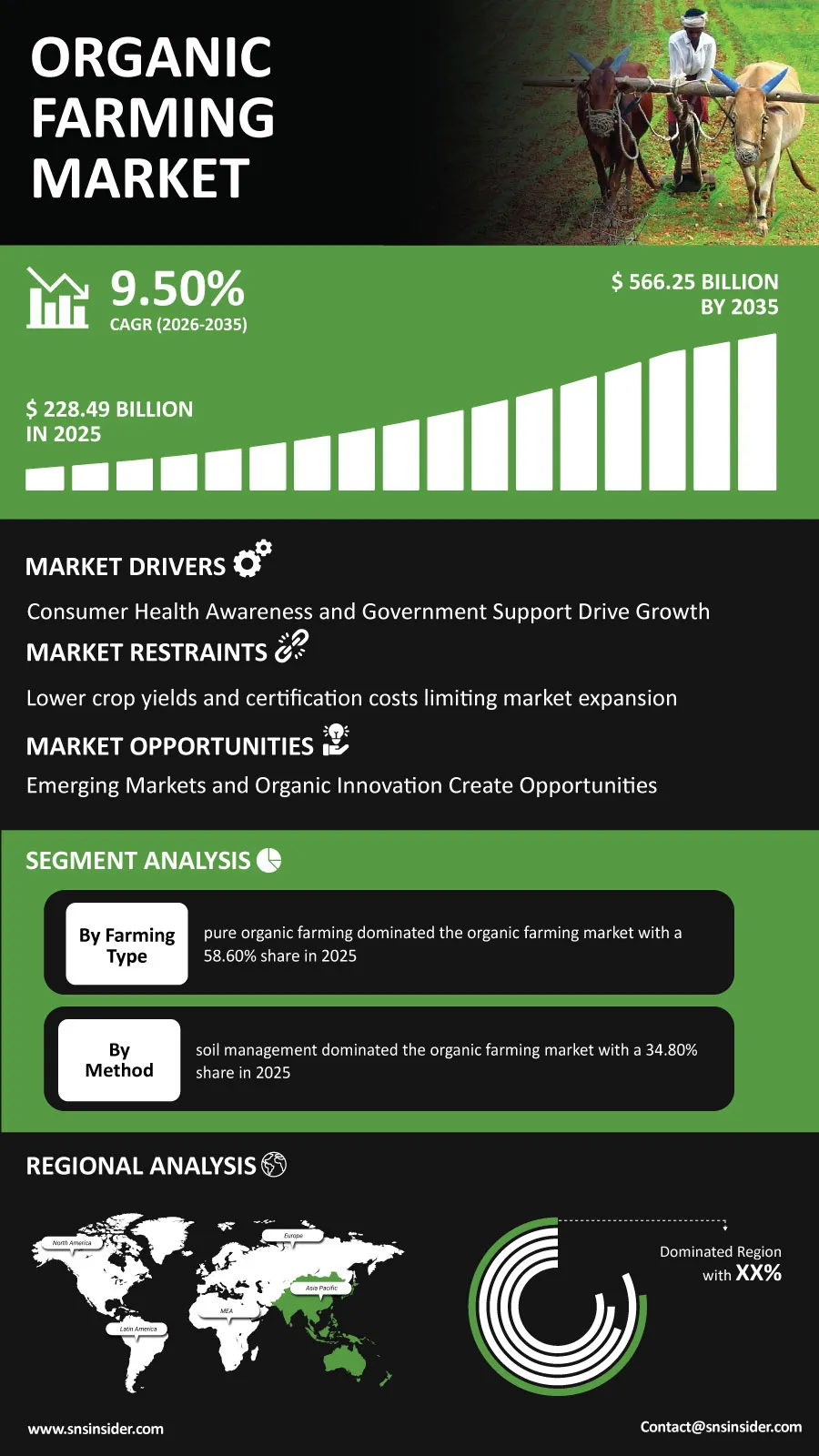
The global Organic Farming Market is set for significant expansion as consumer health consciousness and government sustainability initiatives continue to reshape agricultural production worldwide. “According to a recent study by SNS Insider, the global Organic Farming Market size valued at USD 228.49 billion in 2025, is anticipated to grow to USD 566.25 billion by 2035, registering a CAGR of 9.50% over the 2026–2035 forecast period.”
There have been tremendous changes within sustainable agriculture practices over time, due to which many farmers who aim at improving the environmental and economic sustainability of their operations can take advantage of this trend. This includes the need for more effective soil management and crop diversity techniques that will provide producers with the ability to maintain productivity while meeting certified organic standards. This applies in situations where organic farming supports fresh produce cultivation, grain production, and diverse agricultural commercialization networks. Farmers are constantly working hard to ensure that their organic operations perform better than before in order to meet various market and certification requirements.
To Get Detailed Insights on the Organic Farming Market – Request a Sample Report
Consumer Health Consciousness Creates New Demand
Organic farming has developed from a relatively unknown agricultural practice into a much more widespread commercial agricultural method. As a result of increased efforts in soil health management, use of biopesticides, and organic certification among other activities within farms of varying sizes, there has been a need for efficient organic farming practices.
New farming techniques can increase soil fertility, improve pest resistance, and allow for expansion into increasingly diverse organic product categories beyond traditional fresh produce. This gives farmers the possibility to capture premium pricing and build more resilient, sustainable agricultural operations while meeting growing consumer demand for certified organic food.
Organic input suppliers, farmer cooperatives, and food and beverage brands are increasingly cooperating thanks to the growing interest in developing future solutions for scalable, certified organic agricultural production.
Key Market Findings Highlight High-Growth Segments
The pure organic farming segment dominated all categories in the organic farming market share with a market revenue share of 58.60% in 2025 due to its complete avoidance of synthetic inputs and strict certification adherence. The fastest growing category is expected to be integrated organic farming which will grow at a CAGR of 10.40% through 2035, owing to growing farmer interest in soil health management during transition periods.
By method, soil management held the largest share of total market revenue at 34.80% in 2025 due to its foundational role in organic farming success. Crop diversity will see the fastest growth in revenue generation at a CAGR of 10.80%, driven by growing recognition of diversified cropping systems improving farm resilience.
Based on crop type, fruits and vegetables generated a share of 42.60% of market revenue in 2025 thanks to strong consumer demand for organic fresh produce. On the other hand, cereals and grains will be the segment recording the fastest revenue growth at a CAGR of 9.90%, supported by growing demand for organic grain-based products and plant-based milk innovation.
Distributive end-user trends are changing as well. Organic farms accounted for a 61.40% revenue share in 2025 owing to their direct role in primary organic cultivation. But agricultural companies will turn out to be the fastest-growing end-user category through 2035, on the back of growing corporate and cooperative investment in scaled organic production.
Soil Health, Certification, and Market Access Gain Importance
In this regard, farmers have been looking at organic practices that would deliver more consistent productivity while requiring less reliance on synthetic inputs and offering stronger market access support.
Innovation in biopesticide and biostimulant adoption, soil management techniques, and certification support programs has been making it possible for producers to come up with operations that can compete effectively while meeting increasingly stringent organic standards. In addition to that, increasing emphasis on farmer transition support and market access is also making it possible for cooperatives and companies to find solutions that meet evolving supply chain and consumer expectations. Such trends are likely to become even more prominent in the future.
Asia Pacific Emerges as the Largest Market with 44.80% Regional Revenue Share Amid Rising Agricultural Production
The Asia Pacific region represented the largest share of regional market revenue in 2025, owing to the region's massive agricultural production base, growing government support for organic farming adoption, and rising consumer health consciousness. On the other hand, North America is expected to be the fastest-growing market during the forecast period through 2035, propelled by rising sustainable agriculture initiatives and substantial government-backed investment supporting farmer transition to organic practices.
Leading Companies Drive Innovation and Competition
The environment continues to stay very dynamic since players continue innovating on organic inputs and market access support as well as forming partnerships in order to enhance their position in the industry. Some of the major companies that operate in the global organic farming market are Bayer, Organic Valley, Eden Foods, Nature's Path Foods, SunOpta, The Hain Celestial Group, Amy's Kitchen, General Mills, Danone, and Nestlé.
An SNS Insider analyst Santosh Bhul commented, "The growing consumer demand for chemical-free, sustainably produced food is creating unprecedented opportunities for farmers transitioning to certified organic practices. Companies and cooperatives that successfully combine farmer support, certification infrastructure, and market access will be best positioned to capitalize on emerging opportunities across fresh produce, grain, and diversified organic product segments."
About the Author

Get in touch