
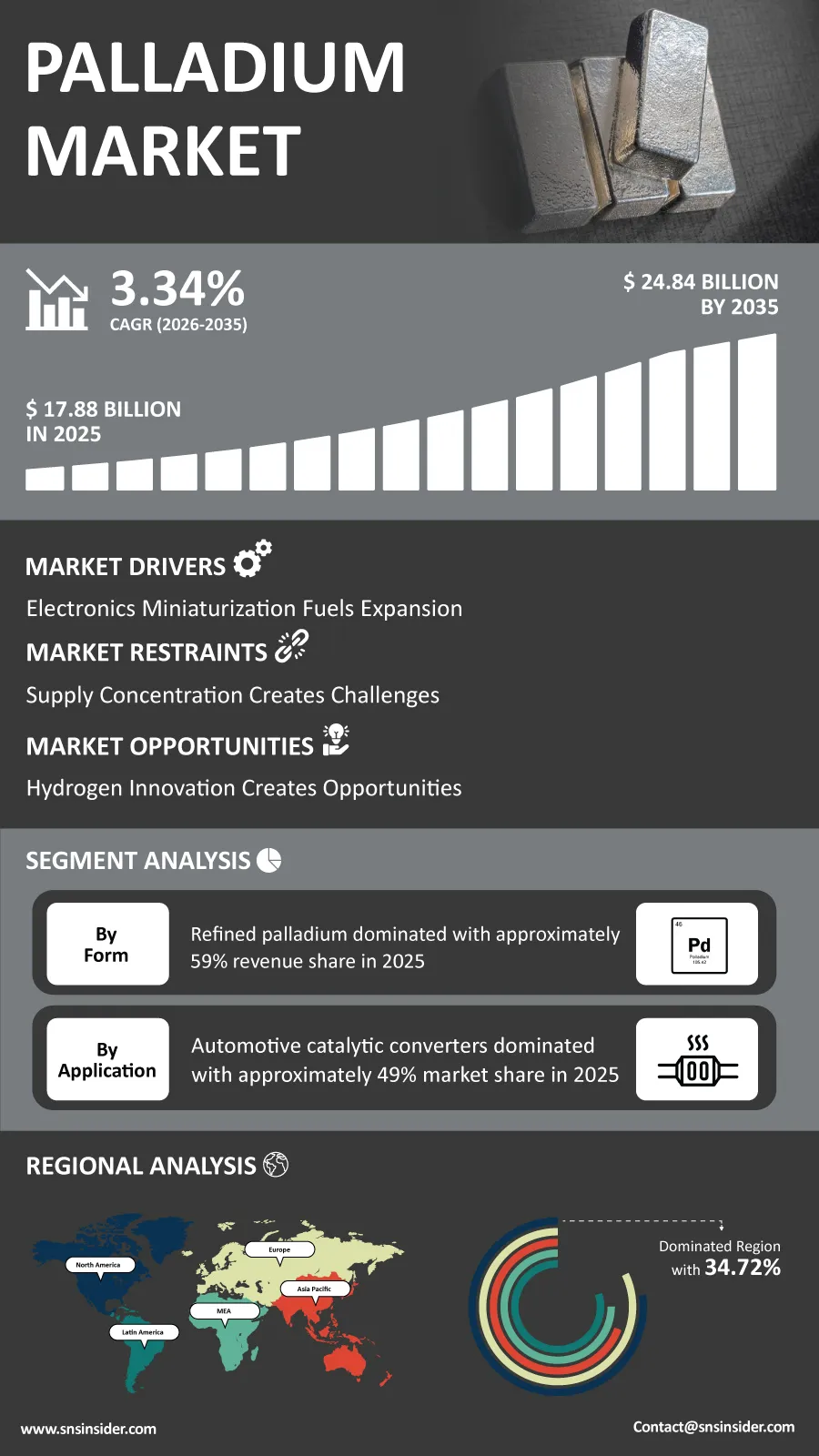
The global Palladium Market is expected to grow moderately due to reliance of various industries on high-performance precious metals for emission control & treatment, advanced electronics, chemical processing and new clean energy technologies. “According to a recent study by SNS Insider, the global Palladium Market size valued at USD 17.88 Billion in 2025, is anticipated to grow to USD 24.84 Billion by 2035, registering a CAGR of 3.34% over the 2026–2035 forecast period.”
The global demand for palladium-based catalytic materials, which helps protect the environment from harmful vehicle emissions, always continues due to tightening environmental regulations around the world. The growing production of electronic components and the increasing use of specialty catalysts across industrial manufacturing are supporting long-term market demand, alongside widespread automotive applications.
Now, industry players are also investing heavily in new refining and recycling capabilities which will improve material recovery, diversify supply sources and decrease reliance on primary mining. With sustainability becoming more of a strategic priority, recycled palladium should seek to fulfil an increasingly important function in matching future supply needs.
To Get Detailed Insights on the Palladium Market – Request a Sample Report
Recycling Expansion and Clean Energy Applications Open New Growth Opportunities
Circular economy investment projects have opened new possibilities for palladium usage in its value chain. The efficiency of recycling techniques, which allow for extraction of valuable metals from end-of-life automobiles and electronic devices, becomes higher, thus increasing the resource supply and reducing the environmental footprint.
The hydrogen technologies also offer some interesting areas of use for palladium. Due to the distinctive physical properties of palladium, this metal can be used in the hydrogen purification systems, specific membranes and industrial equipment. Thus, new commercial prospects for palladium appear outside of its conventional uses.
Furthermore, innovations in the area of industrial catalysts development, pharmaceuticals and fine chemicals manufacturing provide new opportunities for palladium in high-end manufacturing industries.
Key Market Insights Highlight Changing Industry Demand
Based on the form, refined palladium accounted for roughly 59% of global revenue in 2025 thanks to continuous demand from automobile catalyst production and other premium industrial uses. Palladium alloys will represent an greater share by 2035 in terms of landing rate as producers boost use across high-tech electronics, items and engineering.
Based on application, automotive catalytic converters accounted for over 49% share of global market revenue in 2025 owing to regulations for cleaner gasoline and hybrid vehicle emissions. The electronics and electrical segment is projected to be the fastest-growing market during the precedent time as use for high performance connectors, multilayer ceramic capacitors, and latest electronic assemblies increase.
Based on end users, the automotive industry was the largest consumer in 2025 with a significant use of palladium for emission control technologies. Catalytic Applications Will Continue to Grow Across Pharmaceuticals, Specialty Chemicals and Industrial Processing: The market is projected to grow the most within the chemical industry through 2035 as applications for catalysts expand across Dev & Manufacturing of Pharmaceuticals, Specialty chemicals and processing of various institutions.
Technology Innovation Improves Efficiency Across the Value Chain
Manufacturers keep releasing cutting-edge refining technologies, automated recycling systems, and enhanced recovery systems during which they maximize the communication with materials while minimizing production expenses. These technological advancements are building resilience in the supply chain and aiding manufacturers to adopt more sustainable sourcing strategies across global markets.
Catalyst optimization research is delivering enhanced performance with lower precious metal loadings in targeted industrial processes as well. In parallel, testing of new hydrogen-based technologies is opening up even more commercial value for the metal in future energy infrastructure.
Increasing spending on digital process controls and innovative metallurgy and material recovery technologies are anticipated to bolster down the line operational efficiency across mining, refining as well as downstream manufacturing activities.
Asia Pacific Dominated 39% of the Palladium Market in 2025; North America Set for Highest CAGR by 2035
Due to the support of leading automotive production, industrial processing and electronics manufacturing, Asia Pacific collectively represented nearly 39% of total market revenue in 2025. China has been the main engine of growth in the region driven by booming car manufacturing, mass electronics production and greater investments in advanced industrial technologies.
North America is expected to grow rapidly in its regional market by 2035. Regions Strengthened by Rising Investment in Clean Energy Technologies, Domestic Automotive Manufacturing, Hydrogen Infrastructure and Precious Metal Recycling Capacity Capacity for domestic sourcing and resilient supply chains will continue to drive a more sustainable market growth trend across North America as well.
Driven by government support for cleaner transport technologies, industrial modernization and resource security, overall demand for palladium is forecast to remain relatively stable over the rest of the period across both established and developing applications.
Leading Companies Focus on Recycling, Supply Security, and Advanced Materials
Competitive dynamics for the global palladium market consistently revolve around increasing refining capacity, stimulating recycling efficiency and bolstering supply chain resilience. Top producers are pouring money into advanced processing technology, either while downstream manufacturers are concentrating on boosting catalyst performance, curtailing material intensity, and backing sustainable emitters.
Key companies operating in the global Palladium Market include PJSC MMC Norilsk Nickel, Anglo American Platinum Ltd., Impala Platinum Holdings Ltd. (Implats), Sibanye Stillwater Ltd., Northam Platinum Holdings Ltd., Heraeus Holding GmbH, BASF SE, Umicore SA, Johnson Matthey plc, Vale SA, Vedanta Resources Ltd., Russian Platinum, Stillwater Mining Company, Ivanhoe Mines Ltd., Palladium One Mining Inc., Platinum Group Metals Ltd., Sprott Physical Platinum and Palladium Trust, Royal Bafokeng Platinum Ltd., Sylvania Platinum Ltd., and Excello Technology.
An SNS Insider analyst Himanshu Sharma commented, "The evolution of cleaner mobility, expanding electronics manufacturing, and growing investment in advanced recycling infrastructure are reshaping the global palladium industry. Companies strengthening supply resilience while investing in sustainable refining technologies and high-value industrial applications will be best positioned to capitalize on long-term market opportunities."
About the Author

Get in touch




