
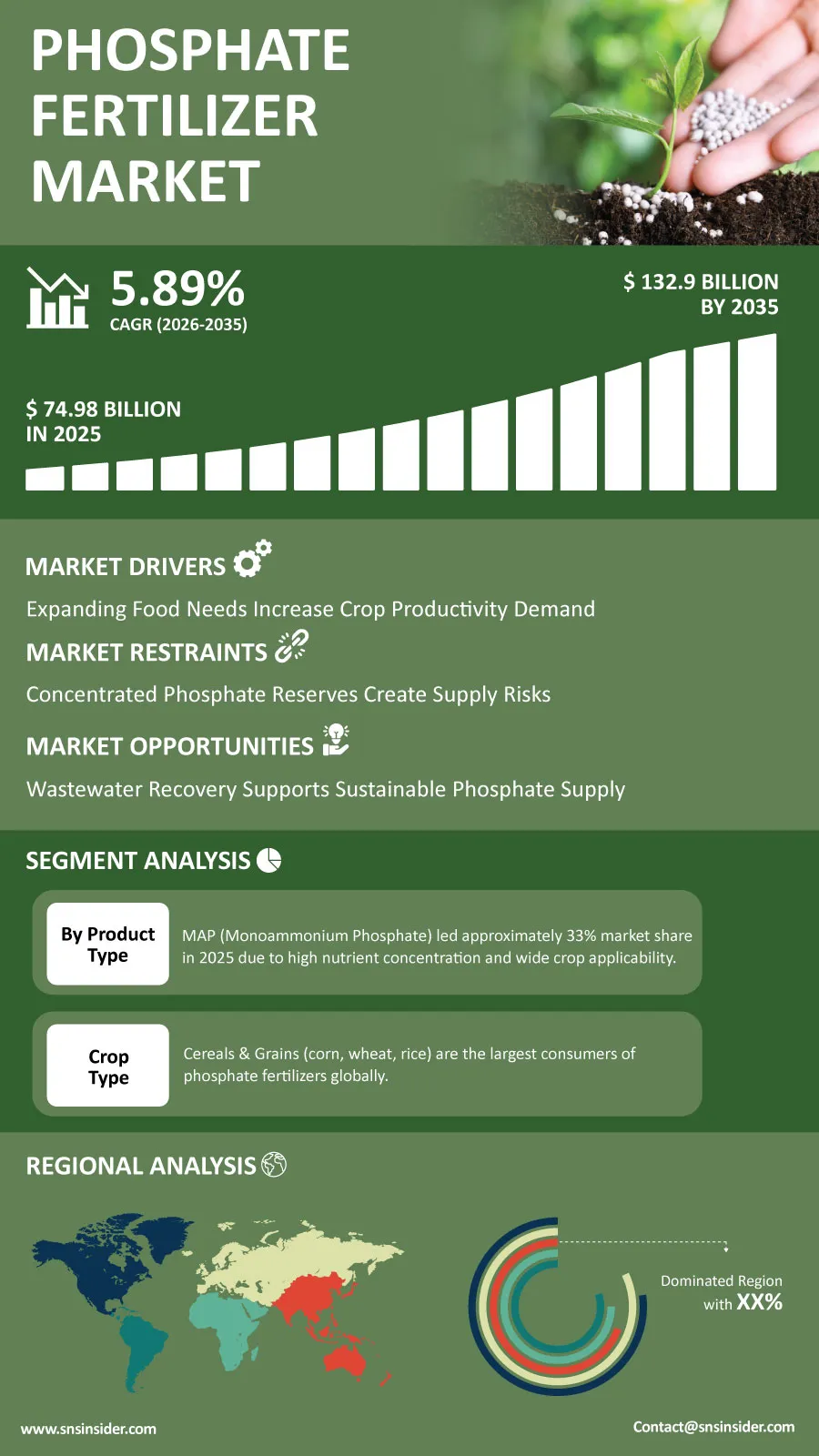
Global Phosphate Fertilizer Market has been steadily growing as agricultural producers are focused on enhancing yield per hectare, which is an increasing concern for food security. “According to a recent study by SNS Insider, the global Phosphate Fertilizer Market size valued at USD 74.98 Billion in 2025, is anticipated to grow to USD 132.9 Billion by 2035, registering a CAGR of 5.89% over the 2026–2035 forecast period.”
The continuous demand for phosphate-based fertilizers in both developed and developing agriculture economies despite increasing pressure to provide more food from finite arable land Phosphate fertilizers are ubiquitous in modern farming systems, because phosphorus is one of the most important nutrients for root development, crop establishment and yield increases. With the growing focus on efficient, robust fertilizer solutions as growers adopt novel cultivation practices to reap maximum productivity underway, demand is anticipated to maintain resilience.
The way fertilizers are applied is also changing with rapid advancements in precision farming technologies, digital agriculture platforms and nutrient management systems. It supports sustainable agricultural production that optimizes phosphate utilization, improves the health of soils, and minimizes nutrient losses.
To Get Detailed Insights on the Phosphate Fertilizer Market – Request a Sample Report
Sustainable Nutrient Management Creates Long-Term Market Opportunities
The global investments on food security projects, sustainable agriculture and nutrient efficiency management are increasing. This necessitates an increasing adoption of precision aquaculture, fertigation systems and regulated nutrient application which is opening new opportunities to innovative manufacturers of advanced phosphate fertilizer products.
Simultaneously, central is the rising interest in circular economy practices which are driving research into methods for recovering phosphorus from wastewater, organic waste and industrial by-products. Such technologies may provide alternative sources of phosphate supply, whilst addressing the environmental challenges associated with conventional mining and fertilizer production.
Specialty fertilizer portfolios have also been expanded by manufacturers as they create coated phosphate products, next-generation enhanced-efficiency fertilizers, and micronutrient-enriched formulations specifically for high-value crops and intensive production operations.
Key Market Insights Highlight Changing Agricultural Demand
As per product type, Monoammonium Phosphate (MAP) owns over one-third of the individual share in global revenue which should surpass 2025 due to its high phosphorus concentration, great nutrient efficiency and ability to cover wide variety of crops. One other important product category was Diammonium Phosphate (DAP), with both MAP and DAP accounting for over 60% of global phosphate fertilizer demand.
Based on Crop Type, Cereals and Grains were the largest segment and accounted for 40% of consumption during 2022 owing to extensive cultivation of corn, wheat, rice and other staple crops around the world. Therefore, with the current trend of growers prioritizing quality and productivity, particularly in fruits, vegetables, and other high-value crops where they can focus on nutritional delivery practices at soil level demand for phosphate fertilizers does continue to grow.
Application wise, during 2025, Soil Application was the largest segment followed by Fertigation and through Fertigation emergence as the fastest growing product type across the forecast period due to growing adoption rate of irrigation based nutrient management in precision agriculture.
Advanced Agricultural Technologies Improve Fertilizer Efficiency
Innovations to improve the use of the limited phosphate ore reserves with reduced environmental effects during fertilisation are emerging in the phosphate fertilizer sector. Data‑driven platforms for farm management, satellite crop monitoring, soil sampling and variable-rate application systems allow growers to apply phosphate in a more site-specific way than ever before.
Similar investments can be seen in coated fertilizers, slow-release formulations and integrated nutrient products that boost phosphorus availability while limiting losses through runoff. This practice facilitates sustainable agriculture and helps producers respond to increasingly restrictive environmental control measures related to nutrient management.
Asia Pacific Commands Largest Phosphate Fertilizers Market Share, North America Modernizes Farming and Morocco Reinforces Supply Chain
Asia Pacific continues to account for the largest per capita consumption of phosphatic fertilizers globally on the back of massive agricultural production in India, China etc. Strong food demand, increased area under cultivation, and government initiatives supporting agricultural production will continue to stimulate regional fertilizer use.
North America competes with highly mechanized farming operations and substantial corn, soybean, and wheat cultivation. Stable regional development is also reinforced by continuous investment in digital farming technologies, capitalism of precision agriculture and fertilizer application systems.
At the same time, Morocco with a clear strategic weight in world phosphate mining - largest reserves of phosphorous rock, increased fertilizer production also continues to hold its ground. Investment in its integrated mining and processing infrastructure cements ongoing strategic importance within the world phosphate supply/distribution chain.
Industry Participants Focus on Supply Security and Product Innovation
The competition within the market for phosphate fertilizers continues to revolve around capacity growth, logistics, sustainable production, and the manufacture of specialty fertilizers. Businesses are making investments in processing technologies, mining processes, and crop nutrients in order to enhance their market position globally.
Key companies operating in the global Phosphate Fertilizer Market include OCP Group, The Mosaic Company, PhosAgro, Nutrien Ltd., CF Industries Holdings, Jordan Phosphate Mines Company, Coromandel International, Israel Chemicals Ltd., Yara International ASA, Groupe Chimique Tunisien, Ma'aden Saudi Arabian Mining Company, Simplot Company, Agrium Inc. (merged into Nutrien), Bunge Limited, and Koch Fertilizer LLC.
An SNS Insider analyst Himanshu Sharma commented, "Growing global food demand, precision agriculture adoption, and the increasing emphasis on sustainable nutrient management are creating long-term opportunities for the phosphate fertilizer industry. Companies investing in production efficiency, specialty fertilizers, and diversified phosphate supply chains are expected to strengthen their competitive position as agriculture continues to modernize worldwide."
About the Author

Get in touch




