
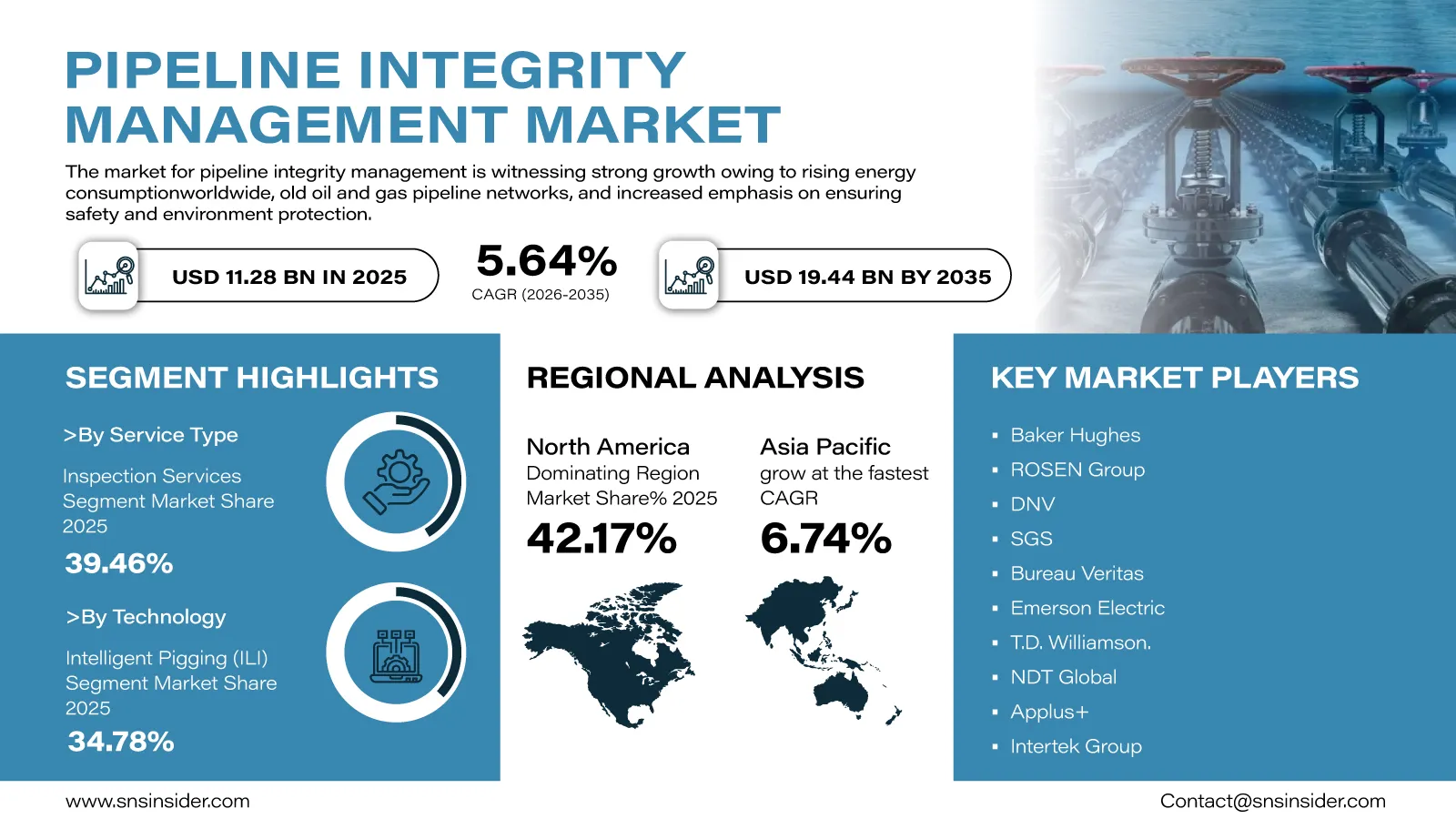
The Pipeline Integrity Management market globally will experience stable growth owing to growing investment from energy companies in pipeline safety, asset reliability, and environmental risk management. “According to a recent study by SNS Insider, the global Pipeline Integrity Management Market size valued at USD 11.28 billion in 2025, is anticipated to grow to USD 19.44 billion by 2035, registering a CAGR of 5.64% over the 2026–2035 forecast period.”
Global energy requirements have increased and the need for transport of oil and natural gas has become greater, thus making integrity management systems all the more essential. Pipeline managers are focusing on inspection, maintenance, and monitoring systems in order to ensure that their operations run smoothly and meet higher safety standards.
To Get Detailed Insights on the Pipeline Integrity Management Market – Request a Free Sample Report
In view of rapid technological advancements, there have been developments in the methods used in pipeline inspection and maintenance in the energy sector. The use of AI, smart pigs, digital twins, internet of things sensors, and cloud-based monitoring platforms allows pipeline organizations to enhance their maintenance activities.
Digital Inspection Technologies and Regulatory Compliance Create Long-Term Growth Opportunities
The requirements for the safety of the pipelines keep increasing due to the deterioration of the pipeline infrastructure and environmental considerations, which have led to an increased focus on maintenance in a proactive manner. This trend among energy companies is manifested in the upgrading of their integrity management programs using advanced inspection tools that can detect corrosion, cracks, metal loss, and even leak possibilities before any problems occur.
Also, digital asset management software is becoming a source of many opportunities in this industry. The intelligent monitoring systems with the ability to predict possible outcomes will allow operators to have constant monitoring of their pipelines in order to take decisions proactively and to save from expensive maintenance and unplanned shut down of their networks.
Moreover, the increasing interest in hydrogen infrastructure, carbon capture initiatives, and natural gas transportation will require more advanced integrity management programs.
Key Market Insights Highlight Shifting Demand Patterns
As per type of services, the inspection services are expected to represent 39.46% of the worldwide market revenue in 2025 due to rising adoption of in-line inspection, corrosion inspection, ultrasonic testing, and integrity management among aged pipeline network systems. The repair and rehabilitation services will witness the fastest growth until 2035 as there will be emphasis by the operators on increasing the lifespan of pipelines by means of rehabilitation, composite repairs, and pipeline replacements.
In terms of technology, intelligent pipeline inspection (ILI) is expected to contribute 34.78% of the total market revenue in 2025 as this technology is widely used for inspecting the inner parts of pipelines. AI-based predictive analytics will record the fastest growth in the forecast period since energy companies are using the machine learning algorithms to predict corrosion and leakage.
When it comes to types of pipelines, natural gas pipelines account for a market share of 46.25% in 2025 because of the increasing construction of gas transmission pipelines and investments in energy transportation via cleaner energy sources. This market is also likely to continue being the fastest-growing in the forecast period, as natural gas plays an important role in the global transition to clean energy. In terms of the location, onshore pipelines contributed to 62.31% of total market revenue in 2025, while subsea pipelines were likely to grow at a strong pace because of the growing offshore exploration and investments in deep-water energy projects.
Advanced Digital Technologies Accelerate Industry Transformation
The field of pipeline integrity management is currently experiencing quick digitalization through the use of AI technologies, creation of digital twins, satellite monitoring, GIS-based asset management, and IoT-based inspection systems. These new technologies help to ensure constant stream of operational intelligence, which allows detecting pipeline defects at an early stage.
Furthermore, manufacturers of technology solutions for this industry are developing sophisticated analytics solutions that will be able to aggregate inspection information collected from several sources into an integrity management system.
Regional Markets Demonstrate Strong Growth Potential
North America is set to occupy the lion’s share (42.17%) of total revenue generated in the worldwide market by 2025 due to a well-established network of pipelines, high-level of regulations, and use of advanced inspection solutions. Additional spending on monitoring systems and massive midstream capacity building operations will further drive the regional market position.
Asia Pacific is forecasted to become the fastest growing region in the period up to 2035, which is mainly explained by increased investments into modernization of pipelines, cross-border transportation of energy resources, and safety-related infrastructure in such countries as China, India, Japan, South Korea, and Australia. Natural gas transmission lines and greater interest from regulators in asset integrity will further fuel regional demand.
Europe remains another important driver of global market growth with its developed pipeline infrastructure, strict environmental regulations, and increasing investments into predictive maintenance technologies. At the same time, the Middle East, Africa, and Latin America are currently developing their integrity management solutions in view of increasing upstream activity and construction of pipeline networks.
Industry Participants Focus on Innovation and Intelligent Asset Integrity Solutions
There is still a changing competitive environment as the top technology firms invest further in artificial intelligence, intelligent inspection, digital asset management, and predictive maintenance technologies. Product innovations and digitalization efforts coupled with advanced sensor technology allow the organizations to improve the reliability of the pipeline network while complying with evolving regulatory and environmental standards.
Key companies operating in the global Pipeline Integrity Management Market include Baker Hughes, ROSEN Group, DNV, SGS, Bureau Veritas, Emerson Electric, T.D. Williamson, NDT Global, Applus+, Intertek Group, Schneider Electric, TechnipFMC, Schlumberger (SLB), Aker Solutions, Oceaneering International, MISTRAS Group, TÜV Rheinland, Fluor Corporation, Wood PLC, and Penspen Ltd.
An SNS Insider analyst Sakshi Kale commented, "The increasing emphasis on pipeline safety, digital asset intelligence, and predictive maintenance is reshaping integrity management strategies across the global energy industry. Companies investing in AI-driven inspection technologies, real-time monitoring platforms, and advanced integrity assessment solutions will be well positioned to address evolving regulatory requirements while improving operational reliability and environmental performance."
About the Author

Get in touch




