
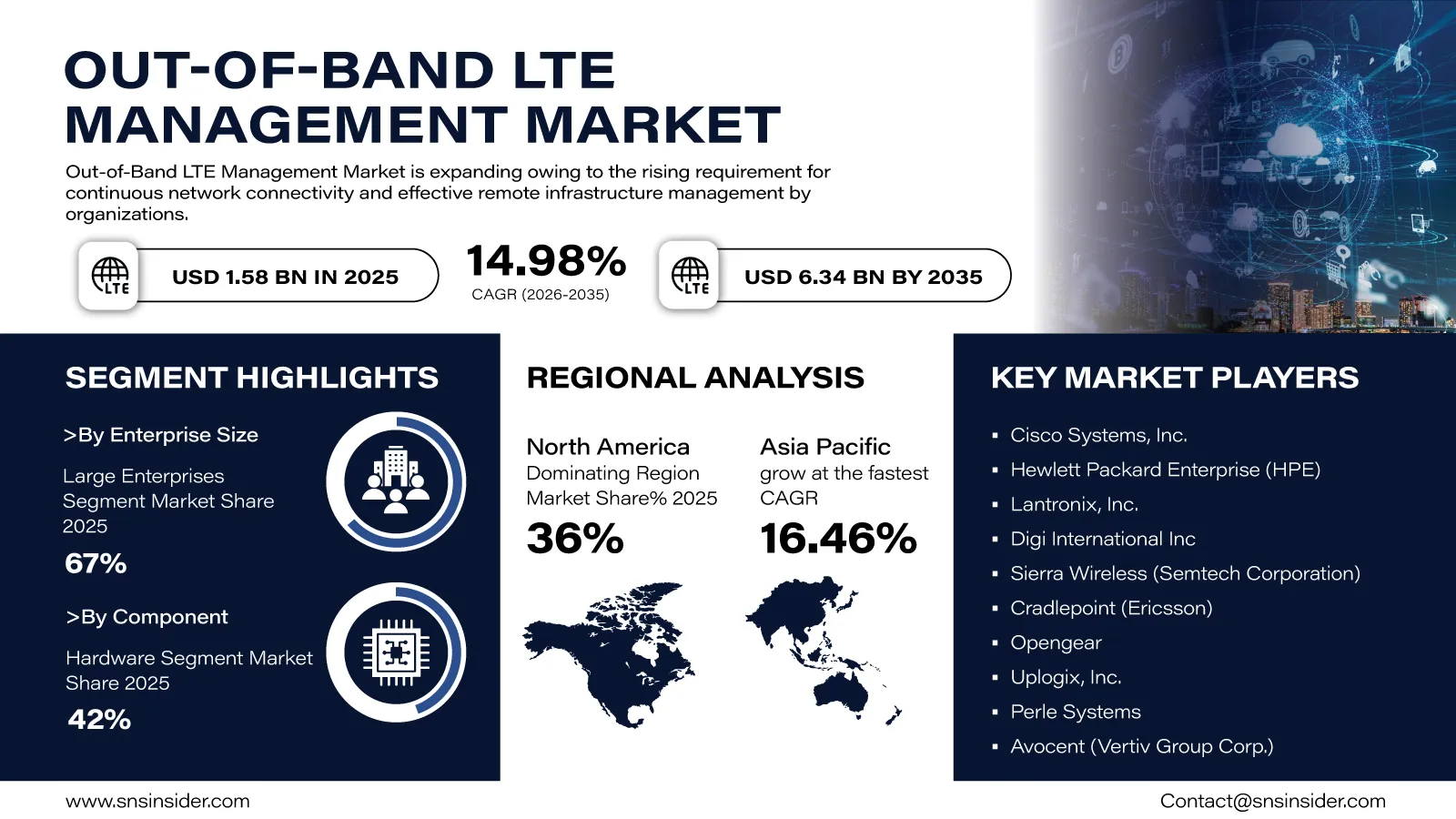
The worldwide Out-of-Band LTE Management Market is forecasted to experience tremendous growth because companies are focused on ensuring continuous operation of their network, secure access from afar, and intelligent infrastructure management. “According to a recent study by SNS Insider, the global Out-of-Band LTE Management Market size valued at USD 1.58 billion in 2025, is anticipated to grow to USD 6.34 billion by 2035, registering a CAGR of 14.98% over the 2026–2035 forecast period.”
With the ongoing rapid adoption of digital transformation in organizations, it is important to ensure that there is continuous connectivity. Companies in the fields of telecommunication, banking, healthcare, manufacturing, and governance have invested in out-of-band LTE management platforms to ensure uninterrupted access to the infrastructure by the administrators.
To Get Detailed Insights on the Out-of-Band LTE Management Market – Request a Free Sample Report
The increased usage of edge computing, cloud-native solutions, and Internet of Things (IoT) has made the market demand stronger than ever before. The businesses are showing interest in the robust network infrastructure that can enable real-time monitoring, recovery, and remote troubleshooting without any disruptions to operations.
Rising Digital Infrastructure Investments Create Long-Term Growth Opportunities
The modernization of network infrastructures by organizations all over the world to facilitate their decentralized network systems in today’s age of distributed and hybrid work environments is making sure that such organizations need to have dedicated management lines that can operate even if there are disruptions in the functioning of the production networks.
The increasing adoption of edge computing technology in manufacturing plants, logistic centers, utilities, retailers, and smart cities is providing many benefits to the out-of-band LTE management vendors in terms of business opportunities. Secure remote management technology allows IT professionals to supervise their far-flung assets without physically going to them.
In addition, the advancements in technologies like LTE, private wireless networks, cloud-based management services, and intelligence automation are helping organizations improve network resilience and allow predictive maintenance and faster incident response.
Key Market Insights Highlight Shifting Demand Patterns
According to the enterprise size, the large enterprise category is likely to make up almost 67% of the global market revenue in 2025 based on the complex nature of their network environment, heavy investments in the digital infrastructure and an increasing tendency towards ensuring minimal downtime of their operations. Small and medium enterprises (SMEs) are expected to record the highest growth through 2035 thanks to affordable cloud-based network management systems becoming available.
In terms of deployment type, on-premises deployment is predicted to account for around 59% of the overall market revenue in 2025 as it helps provide increased control, regulatory compliance, and enhanced security of the mission-critical infrastructure. Cloud-based deployment is forecast to grow at the highest CAGR over the forecast period.
Large enterprises, owing to their complex network environment, large investments in digital infrastructure and growing focus on minimizing downtime, are projected to account for nearly 67% of the overall market revenue in 2025, depending on the size of the enterprise. The SMEs segment is projected to witness fastest growth through 2035, owing to the increasing affordability of cloud-based network management solutions.
As far as deployment modes are concerned, on-premises solutions are forecasted to generate around 59% of the total market revenue in 2025 because of the provision of better control, regulation, and security of critical infrastructure. Cloud deployment will show the fastest growth during the forecast period because companies will be using scalable and remotely manageable networking infrastructure.
Advanced Network Intelligence Accelerates Industry Transformation
The out-of-band LTE management solutions have become quickly evolving due to artificial intelligence, automation, cloud orchestration, and cybersecurity. The intelligent monitoring tools allow predictive diagnostics, automated remediation, secure remote access, and real-time visibility into highly distributed enterprise networks.
Furthermore, there are innovative LTE and 5G management solutions being developed by manufacturers, which allow simple deployment and improved resiliency. As organizations increasingly focus on business continuity, zero-trust security models, and intelligent infrastructure management, the technology will remain one of the main competitive factors during the next decade.
Regional Markets Demonstrate Strong Growth Potential
The share of North America is estimated to be 36% of total market revenue in 2025 because of the high level of digital infrastructure development, the prevalence of enterprise networking applications, as well as significant investments in cybersecurity and communication security in the region. The presence of leading technology providers and the adoption of intelligent network management systems will continue to play a role in market dominance.
The Asia Pacific region is expected to become the fastest-growing regional market until 2035 due to the digitalization of businesses, development of telecommunication infrastructures, cloud computing adoption, and investment in smart manufacturing and smart cities. Countries in the region will continue making progress in network modernization in order to ensure their economic development.
Europe will see a continuous increase in market growth because of the focus on the development of digital infrastructure and compliance with regulations as well as remote management systems. At the same time, the Middle East, Africa, and Latin America regions offer new growth opportunities through the development of telecommunication infrastructure and enterprise connectivity.
Industry Participants Focus on Intelligent Remote Infrastructure Management
However, the competition is still very intense since leading tech companies keep on investing in network automation using AI technology, LTE/5G connectivity, management platforms based on the cloud, and cybersecurity-enabled remote access. Continuous development of new products, investments in edge networking technologies, and partnerships are helping companies meet the rising demands for secure and always-on infrastructure management solutions.
Key companies operating in the global Out-of-Band LTE Management Market include Cisco Systems, Inc., Hewlett Packard Enterprise (HPE), Lantronix, Inc., Digi International Inc., Sierra Wireless (Semtech Corporation), Cradlepoint (Ericsson), Opengear, Uplogix, Inc., Perle Systems, Avocent (Vertiv Group Corp.), Vertiv Group Corp., ZTE Corporation, Juniper Networks, Inc., Aruba Networks (HPE), SonicWall Inc., Riverbed Technology, Fortinet, Inc., Palo Alto Networks, Inc., Advantech Co., Ltd., and TP-Link Technologies Co., Ltd.
An SNS Insider analyst Sakshi Kale commented, “As enterprises continue expanding distributed IT environments and edge infrastructure, resilient out-of-band LTE management is becoming a strategic requirement rather than an operational enhancement. Organizations investing in intelligent automation, secure remote connectivity, and next-generation network resilience technologies will be well positioned to support uninterrupted business operations in an increasingly connected digital landscape.”
About the Author

Get in touch




