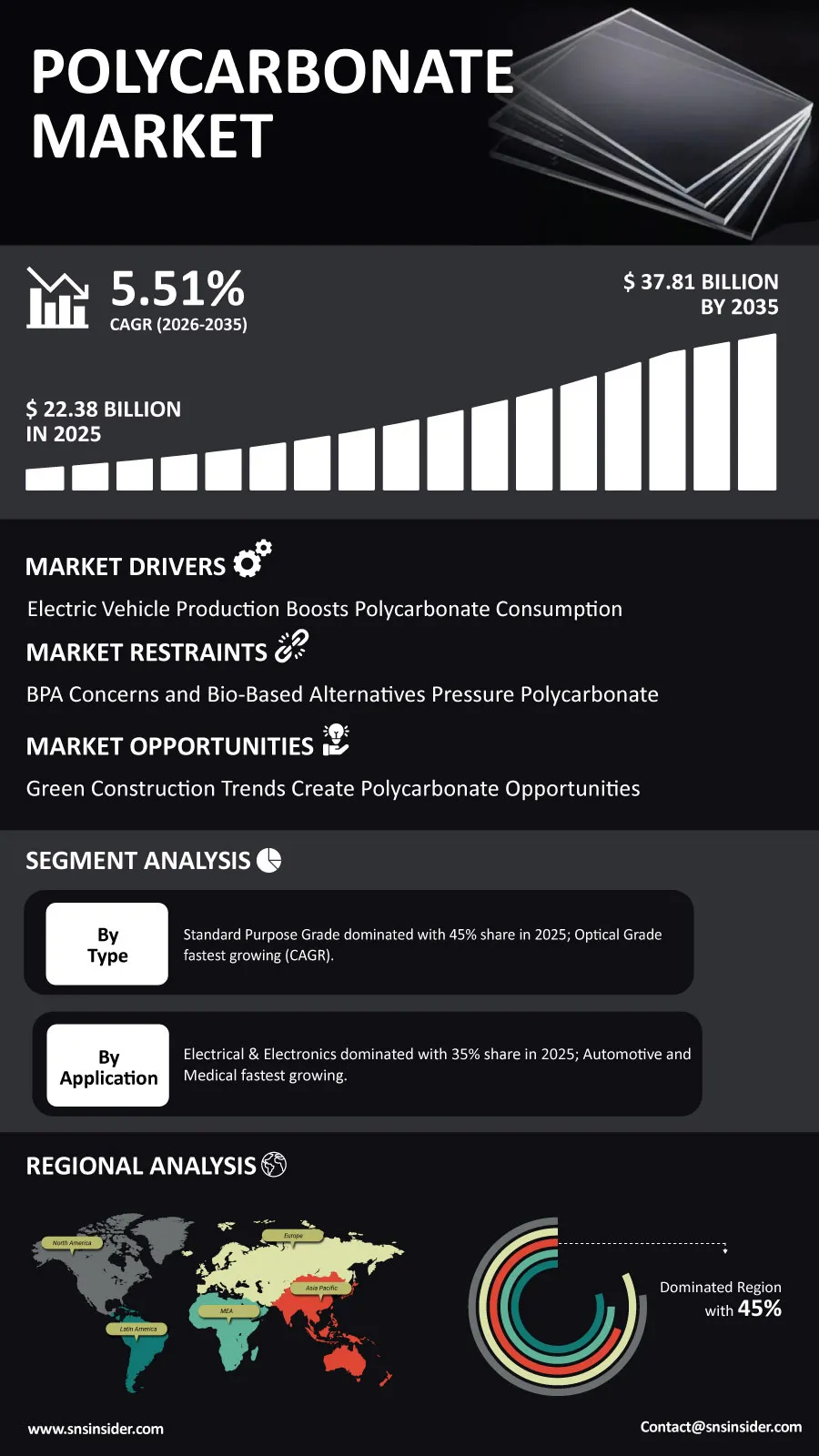
The Global Polycarbonate Market is set to enter into a phase of growth as manufacturing companies step up efforts to use engineering plastics in automotive, electronic, healthcare, and construction industries. “According to a recent study by SNS Insider, the global Polycarbonate Market size valued at USD 22.38 Billion in 2025, is anticipated to grow to USD 37.81 Billion by 2035, registering a CAGR of 5.51% over the 2026–2035 forecast period.”
The growing focus on lighter materials, energy-efficient production processes, and advanced design of products is increasingly fueling the demand for polycarbonate globally. The excellent strength-to-weight ratio and other properties such as transparency, stability, and thermal resistance make it possible for producers to substitute heavier materials in durable goods without sacrificing design versatility. With the growing focus on efficiency and sustainability objectives, polycarbonate remains more relevant than ever before.
To Get Detailed Insights on the Polycarbonate Market – Request a Sample Report
Electrification and Sustainable Materials Create Long-Term Market Opportunities
Electric Mobility is leading to fresh opportunities for Polycarbonate producers, as the carmakers will be looking for lighter materials that can help improve the efficiency of the batteries and enhance the performance of their cars. Engineered polymers are gaining popularity in the manufacture of batteries, charging equipment, lighting equipment, and other parts to reduce the weight of vehicles.
In addition, there are efforts to promote sustainability that will lead to increased use of recycled and renewable Polycarbonate products. Material producers will have to invest in circular manufacturing systems and recyclable systems to meet the changing regulations and customer requirements regarding sustainability. There is also increasing demand for Polycarbonate products in sustainable buildings, which use glass to cut on energy consumption.
Key Market Insights Highlight Evolving Industry Demand
In terms of type, Standard Purpose Grade contributed around 45% towards overall market revenues in 2025 owing to its wide range of applications in automotive, industrial machinery, and electrical applications. Optical Grade polycarbonate will emerge as the fastest-growing type during the forecast period due to growing applications in augmented reality devices, advanced automotive lighting, optical instruments, and medical imaging devices.
According to application, Electrical & Electronics emerged as the largest segment with a market share of almost 35% in 2025, aided by growing demand for smartphones, laptops, communication equipment, and consumer electronics. The Automotive and Medical applications segments are anticipated to be the fastest-growing during the forecast period owing to the increasing demand for polycarbonate material in the manufacture of electric vehicle components, diagnostics equipment, medical devices, and drug delivery systems.
Advanced Polymer Technologies Accelerate Product Innovation
Constant material innovation has led to the improvement of polycarbonate performance attributes for use in tough industrial applications. New special material formulations that have better optical properties, better flame resistance, better UV resistance, and better thermal performance are being developed to meet changing customer demands.
The polymer compounding technology has also increased the application of the material through blending it with engineering materials like ABS and silicone-based materials. The new formulations give more design freedom, along with better impact resistance and processing characteristics.
Asia Pacific Captured 45% of Engineering Plastics Market Revenue in 2025, While North America Emerges as the Fastest-Growing Regional Market
Asia-Pacific emerged as the largest regional market in 2025, representing nearly 45% of the revenue generated worldwide. This region enjoys the advantages of substantial automobile manufacturing, consumer electronics manufacturing, increased construction activities, and infrastructure development. China is driving regional growth through its dominance in automobile and consumer electronics industries, while India, Japan, and South Korea are making contributions to growth through industrial development and advanced manufacturing techniques.
North America remains an important growth market with accelerated growth in demand from electric vehicle manufacturing, aircraft manufacturing, healthcare technology, and advanced electronics. Europe is maintaining stable growth with sustainable manufacturing practices, circular economy laws, and electric mobility investments. In addition, the Middle East & Africa and Latin America regions are witnessing rising consumption from construction activity, petrochemical manufacturing, automobile manufacturing, and industrial development.
Industry Participants Invest in High-Performance and Sustainable Solutions
In the Polycarbonate Market that operates in a global environment, competition has become more about material innovations, sustainability, and production of speciality products. It is observed that major players are increasing production capacities and focusing a lot on production of materials with high levels of recycled content and bio-based polymers.
Key companies operating in the global Polycarbonate Market include Covestro AG, SABIC (Saudi Basic Industries Corporation), Teijin Limited, Mitsubishi Chemical Group Corporation, Trinseo plc, LG Chem Ltd., LOTTE Chemical Corporation, Chi Mei Corporation, Idemitsu Kosan Co., Ltd., Formosa Chemicals & Fibre Corp., Wanhua Chemical Group Co., Ltd., Samyang Corporation, Kingfa Science & Technology Co., Ltd., Samsung SDI Co., Ltd., Entec Polymers LLC, RTP Company, ENVALIOR (DSM-Lanxess JV), Clariant AG, Albis Plastic GmbH, and PolyOne Corporation (Avient).
An SNS Insider analyst Himanshu Sharma commented, "The continued expansion of electric mobility, advanced electronics, and sustainable manufacturing is redefining demand for high-performance engineering plastics. Companies investing in recycled-content polycarbonate, bio-based material technologies, and application-specific product innovation are expected to strengthen their competitive advantage as industries increasingly prioritize lightweight, durable, and environmentally responsible material solutions."
About the Author

Get in touch