
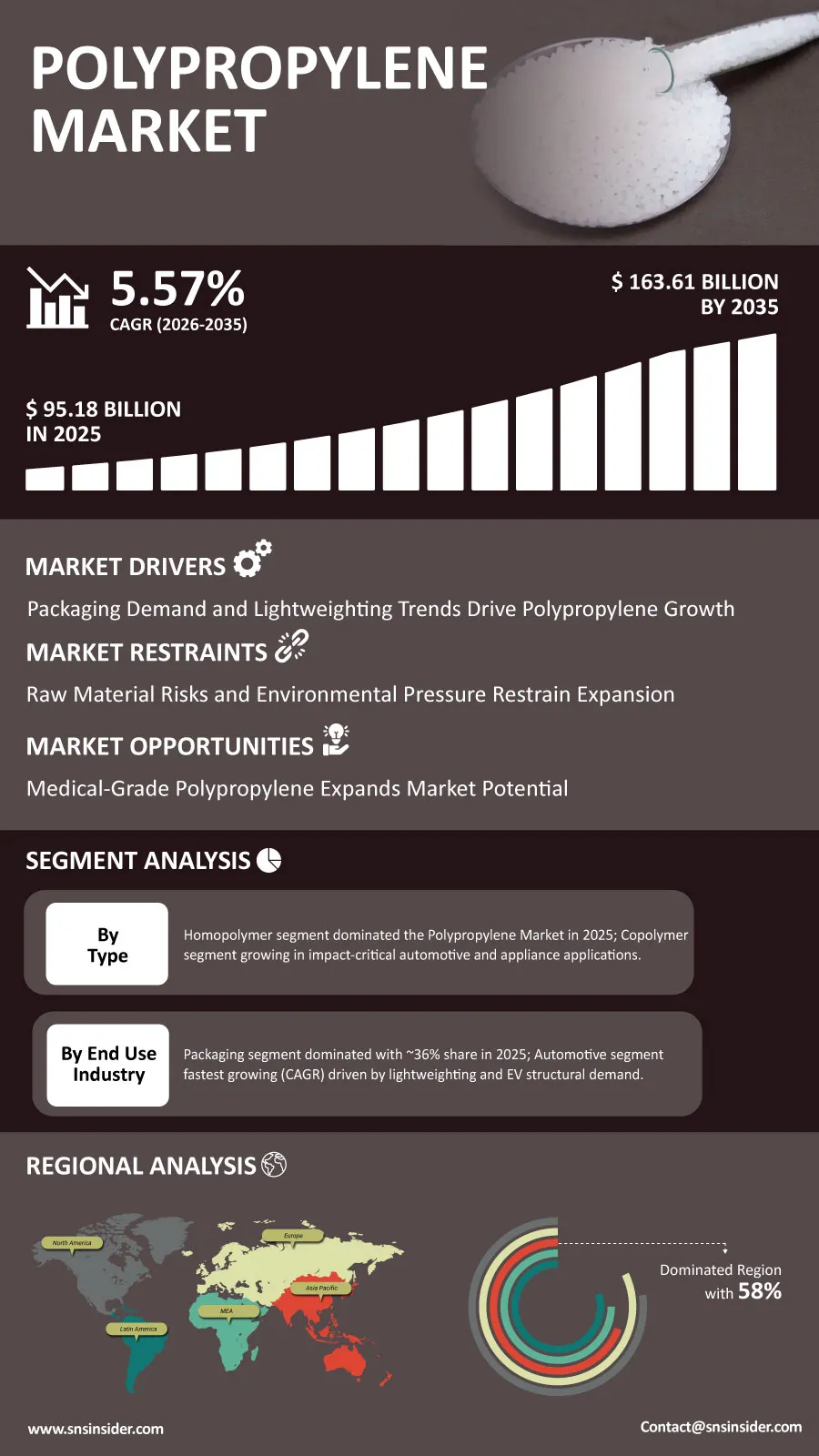
The Polypropylene market globally is experiencing consistent growth owing to increased use of lightweight and recyclable polymers by manufacturers in the packaging, automobile, health care, and consumer goods industries. “According to a recent study by SNS Insider, the global Polypropylene Market size valued at USD 95.18 Billion in 2025, is anticipated to grow to USD 163.61 Billion by 2035, registering a CAGR of 5.57% over the 2026–2035 forecast period.”
Demand remains robust as sectors focus on the use of materials offering a blend of high strength, chemical resistance, and processability while enabling efficient production. The rapid growth of e-commerce packaging, electric vehicle manufacture, and health care systems is providing sustained prospects for producers of polypropylene across the globe. On the other hand, developments in recycling processes and bioplastics are transforming the dynamics of competition among manufacturers.
To Get Detailed Insights on the Polypropylene Market – Request a Sample Report
Circular Economy Initiatives and Advanced Applications Create New Growth Opportunities
Global attempts to curb plastic waste are pushing manufactures to speed up their efforts towards bringing recyclable and recycled polypropylene products into the marketplace. Many brands in sectors such as food packaging, consumer goods, and healthcare are moving towards using single-material packages that make the process of recycling easier without reducing product efficacy or its shelf appeal.
Another promising opportunity that is opening up in the field is in the health care industry as more and more companies are starting to use polypropylene in syringes, laboratory equipment, drug packaging, and diagnostic devices. At the same time, bio-based and chemically recycled polypropylene are gaining attention due to lower carbon footprint.
Key Market Insights Highlight Evolving Demand Across End-Use Industries
By product type, the Homopolymer Polypropylene held the largest market share in 2025 owing to high adoption in packaging, consumer goods, fibers, and injection molding applications on account of its rigidity, cost-effectiveness, and processability. The Copolymer Polypropylene is expected to be the fastest-growing market between 2025 and 2035 as automotive companies and appliance makers demand higher impact resistance and mechanical properties.
On the basis of process type, the Injection Molding segment dominated the market in terms of market share in 2025 because of the large-scale use of this process for packaging closures, automotive applications, medical products, and housewares. The Extrusion Molding is likely to grow at a rapid rate during the forecast period due to the rising demand for films, fibers, sheets, nonwovens, and packaging applications using polypropylene.
Among end-use industries, the Packaging segment held almost 36% of the market revenue in 2025 on the back of the prominent usage of polypropylene in food packaging, flexible packaging, pharmaceuticals, and industrial packaging applications. The Automotive segment is expected to experience the fastest growth rate as automakers replace heavy metals with lighter polypropylene in their applications for better fuel efficiency and driving range of electric vehicles.
Material Innovation Accelerates Polypropylene Industry Transformation
Polymer engineering innovations keep pushing the boundaries of what can be done with polypropylene. Producers are creating polypropylene compounds with reinforced glass fibers, high clarity specialty materials, grades intended for medical use, and even high-performance copolymers that are able to withstand tough conditions.
The digitalization of production, precise compounding, and sophisticated catalyzing techniques improve efficiency and help maintain the consistency of produced material. Simultaneously, chemical recycling and diversified raw materials help manufacturers create premium recycled polypropylene grades used in such industries as food packaging, healthcare, and consumer packaging.
Asia Pacific Dominates 58% of Global Polypropylene Market in 2025; North America Holds 15% and Europe Accounts for 16% Revenue Share
Asia Pacific had a share of almost 58% of the total Polypropylene Market revenue in 2025 due to China’s leading manufacturing environment, large-scale packaging production, automotive sector, and growing consumer goods industry. The rapid industrialization, increasing domestic production of polymers, and infrastructure development in China and India have been contributing towards strengthening their dominance in the regional market.
North America is holding a prominent position in the global market with a share of around 15% of the global revenue owing to the large availability of shale propane, advanced polymer manufacturing facilities, and investments in electric vehicle production. Europe held a share of around 16% of the global market as the regulations focused on recycling of plastic products have been encouraging innovation in the region.
Industry Leaders Focus on Sustainable Materials and Capacity Expansion
Competition in the international polypropylene industry still centers on the expansion of production capacities, creation of specialty polymer products, and improving recycling capabilities. The major players in the industry are still putting emphasis on the development of state-of-the-art compounding technology, feedstock recycling processes, medical grade polymers, and automotive materials.
Key companies operating in the global Polypropylene Market include LyondellBasell Industries Holdings B.V., ExxonMobil Chemical Company, SABIC, Borealis AG, TotalEnergies SE, Braskem S.A., Mitsui Chemicals, Inc., Sumitomo Chemical Co., Ltd., INEOS Group Holdings S.A., Reliance Industries Limited, Formosa Plastics Corporation, Sinopec Corp., PetroChina Company Limited, Haldia Petrochemicals Ltd., Hyosung Corporation, SCG Chemicals Co., Ltd., BASF SE, Toray Industries, Inc., Repsol S.A., and PKN Orlen S.A.
An SNS Insider analyst Himanshu Sharma commented, "Polypropylene continues to strengthen its strategic position as industries balance performance, affordability, and sustainability objectives. Ongoing innovation in recyclable materials, specialty compounds, and circular production technologies is expected to unlock significant long-term opportunities as packaging, automotive, healthcare, and consumer goods manufacturers accelerate the transition toward more resource-efficient material solutions."
About the Author

Get in touch




