
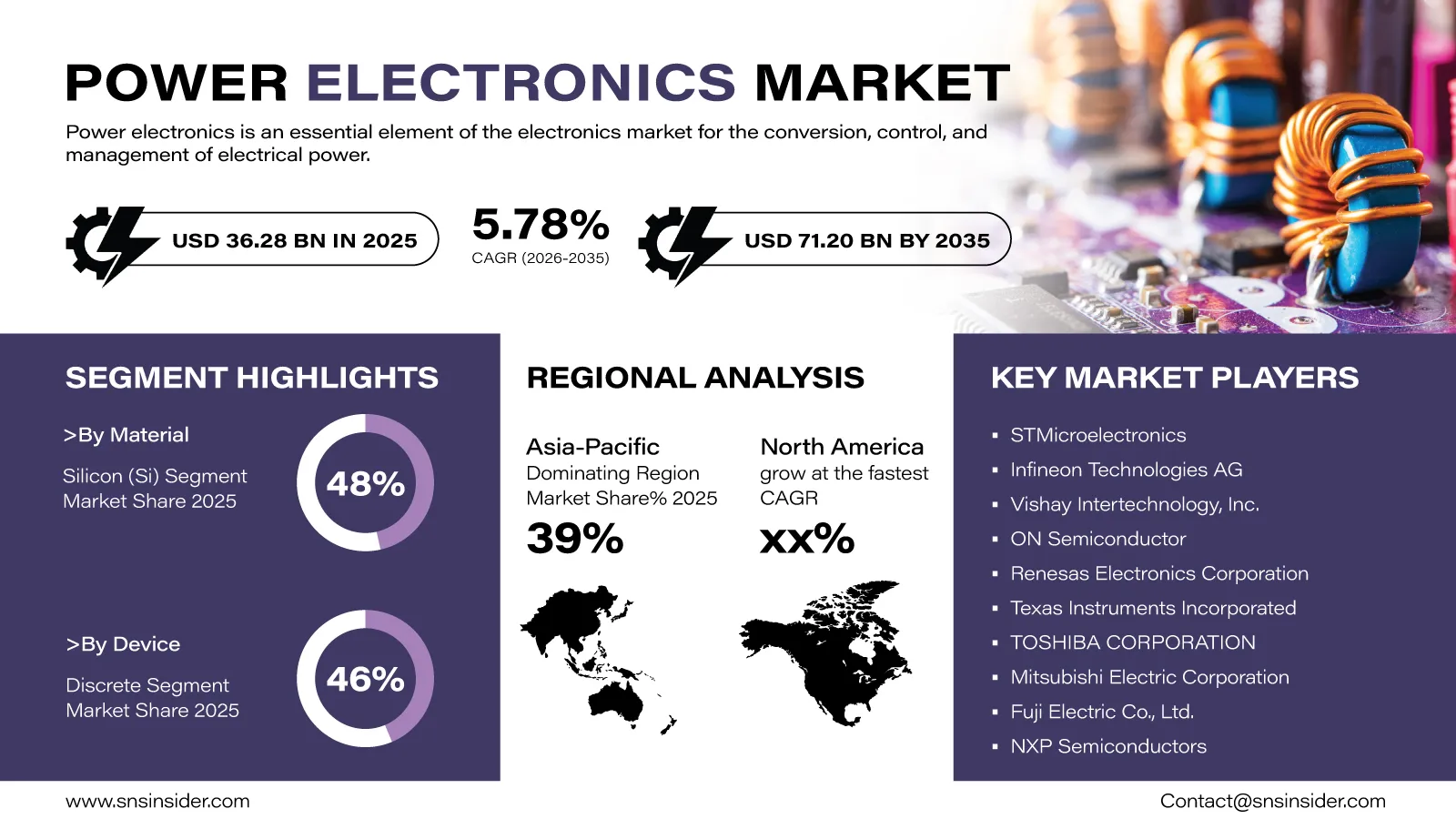
The global Power Electronics Market is expected to witness significant expansion as industries accelerate investments in energy-efficient technologies, electric mobility, and renewable energy infrastructure globally. According to a recent study by SNS Insider, the global Power Electronics Market size valued at USD 36.28 billion in 2025, is anticipated to grow to USD 71.20 billion by 2035, registering a CAGR of 5.78% over the 2026–2035 forecast period.
The increased global demand for electricity and the shift to low carbon energy systems have resulted in the rise of power electronics in industries, automobiles, and utilities. Through the use of power electronics, it is possible to achieve effective conversion, transmission, and management of power, which helps to reduce energy usage.
To Get Detailed Insights on the Power Electronics Market – Request a Free Sample Report
Rapid growth in electric vehicles, smart grid technologies, and industrial automation will further add to market demand. Innovative development in the field of semiconductors such as SiC (silicon carbide) and GaN (gallium nitride) will result in improved efficiency and reduced energy loss in these systems.
Electrification and Clean Energy Investments Create Long-Term Growth Opportunities
There is now a lot of money being invested by both governments and private sector companies in electrification projects designed to enhance efficiency and cut back on emissions of greenhouse gases. As more renewable energy systems get deployed all over the world, there is going to be more need for efficient inverters and converters.
Electric vehicle charging technology has also been creating many opportunities in the manufacturing of power electronics products. On-board chargers, battery management systems, and DC-DC converters have emerged as necessary components for the efficient functioning and reliable operation of contemporary electric vehicles.
At the same time, further progress in the field of wide bandgap semiconductors is contributing to the development of products that can function in conditions involving higher voltage, temperature, and frequency while increasing efficiency and decreasing maintenance costs.
Key Market Insights Highlight Shifting Demand Patterns
Based on material, silicon (Si) is estimated to hold 48% share of the global market revenue in 2025 owing to its low cost, mature production system, and extensive use in different applications. The gallium nitride (GaN) segment will experience the highest growth till 2035 due to the growing adoption of high-performance semiconductors for power application.
By device, discrete power electronics are expected to generate 46% of total market revenue by 2025 due to their wide application in power conversion and energy management systems. Power module is predicted to show the fastest growth over the forecast period because of the need for high-performing solutions in renewable energy, industrial automation, and electric vehicle applications.
In terms of application, the industrial segment held 28% market share in 2025 due to the rising use of automation technology, motor drives, and energy-saving manufacturing machines. The automotive sector will be growing at the fastest rate up until 2035 owing to an increase in production of electric vehicles.
An Infographic Representation of the Global Power Electronics Market
Advanced Semiconductor Technologies Accelerate Industry Transformation
Power electronics technology is experiencing rapid innovation and change as companies attempt to increase the energy conversion efficiency of their products. The latest developments in semiconductor technology, such as Silicon Carbide and Gallium Nitride are allowing for high power density, better thermal management, and increased switching speeds.
Intelligent energy management systems for the operation of digital energy networks, industrial automation, renewable energy generation, and advanced mobility systems are being developed by manufacturers. Such developments are assisting companies in lowering their operational expenses while improving energy efficiency.
Regional Markets Demonstrate Strong Growth Potential
Asia Pacific is likely to represent 39% share of total market revenues by 2025 owing to its huge electronics manufacturing industry, fast industrial growth, rising renewable energy power plants, and increasing electric vehicles production. Nations such as China and India remain committed towards developing clean energy generation facilities and advanced manufacturing technologies.
North America is likely to become the fastest-growing regional market until 2035. Growth in investments in renewable energy projects, development of smart grids, electric vehicles, and advanced semiconductor manufacturing are among the reasons behind robust growth in the region.
As governments continue strengthening energy security strategies while promoting electrification and carbon reduction initiatives, demand for advanced power electronics solutions is expected to increase across both developed and emerging economies.
Industry Participants Focus on Innovation and High-Efficiency Solutions
The competitive environment is still quite dynamic with the major players in the industry continually making investments in wide band gap semiconductors, intelligent power management, and semiconductor manufacturing technology. Investment in research and development activities is helping them meet the increasing demand for semiconductors in applications ranging from automotive to consumer electronics.
Key companies operating in the global Power Electronics Market include STMicroelectronics, Infineon Technologies AG, Vishay Intertechnology, Inc., ON Semiconductor, Renesas Electronics Corporation, Texas Instruments Incorporated, Toshiba Corporation, Mitsubishi Electric Corporation, Fuji Electric Co., Ltd., NXP Semiconductors, Broadcom Inc., Nexperia, Analog Devices, Inc., Maxim Integrated, Hitachi, Ltd., Semikron International GmbH, International Rectifier, Power Integrations, Schneider Electric, and Eaton Corporation.
An SNS Insider analyst Sushant Kadam commented, “The accelerating transition toward electrification, renewable energy deployment, and intelligent power management is creating sustained demand for advanced power electronics technologies. Companies investing in high-efficiency semiconductor materials, innovative power conversion solutions, and next-generation energy management platforms will be well positioned to capitalize on future market opportunities.”
About the Author

Get in touch




