
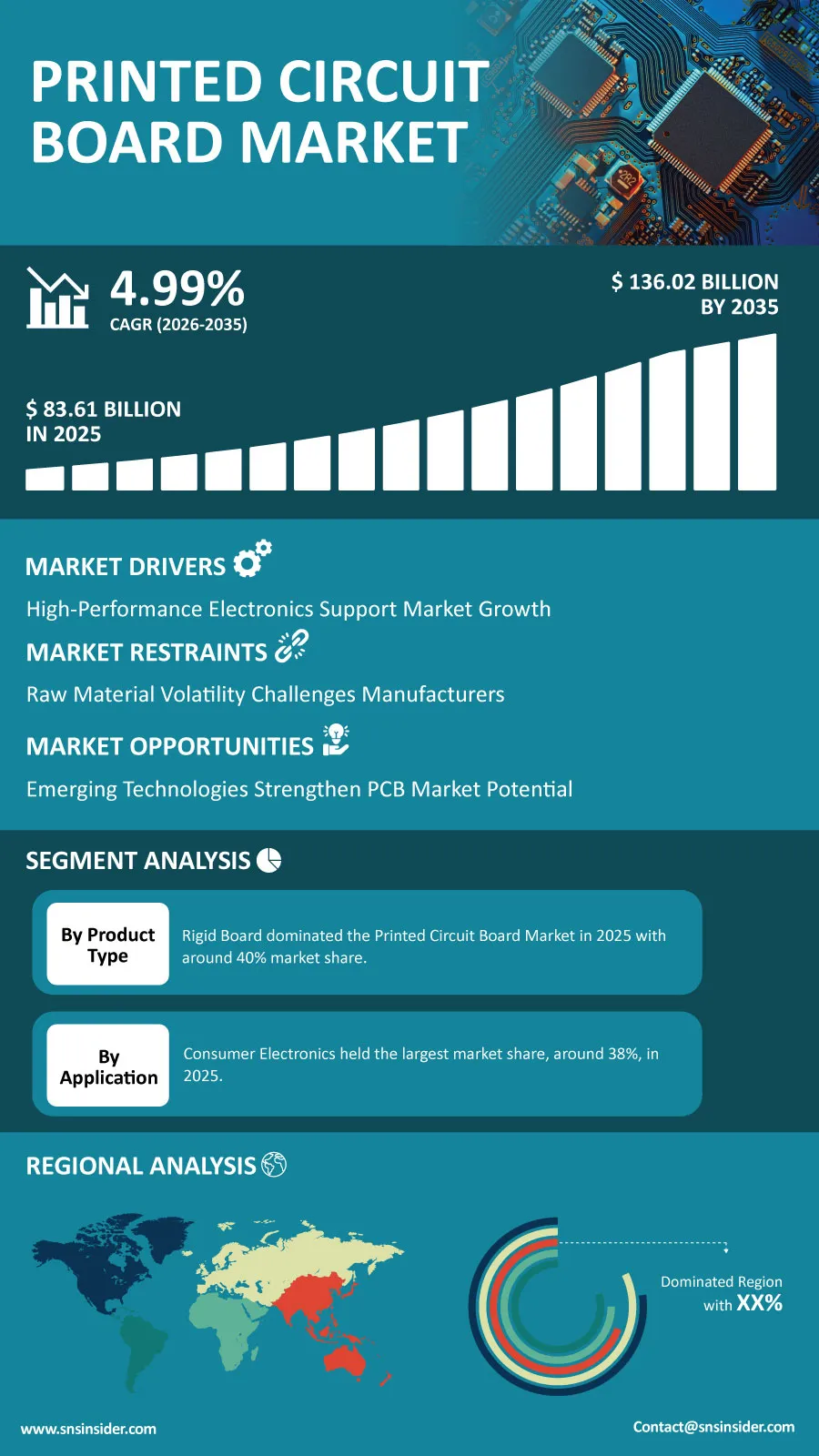
The global Printed Circuit Board Market is positioned for steady expansion as electronics manufacturers respond to rising demand for compact, high-performance, and increasingly connected devices. According to a recent study by SNS Insider, the global Printed Circuit Board Market size valued at USD 83.61 billion in 2025, is anticipated to grow to USD 136.02 billion by 2035, registering a CAGR of 4.99% over the 2026–2035 forecast period.
In the light of rapid advancements in AI infrastructure, electric vehicle technology, 5G technology, and IoT devices, the need for innovative circuit board solutions is increasing. PCBs continue to play a key role in integrating advanced electronics in various applications ranging from consumer electronics such as mobile phones and computing systems to cars, biomedical instruments, machinery, and telecommunication systems.
As electronic products become more and more complex, manufacturers have been innovating to create solutions that increase circuit board density, performance, and reliability in small sizes. Such innovations are enhancing the demand for multilayer, high density interconnect (HDI), flexible, and rigid-flex circuit boards in a wide range of applications.
To Get Detailed Insights on the Printed Circuit Board Market – Request a Sample Report
AI Infrastructure and Automotive Electrification Create New Growth Opportunities
There appears to be great potential for PCB manufacturers with regard to the quick build-up of the data center infrastructure as well as AI infrastructure. These high-performance computers demand complex circuit boards that can meet their power needs, as well as provide solutions for thermal dissipation and signal transmission.
The area of automotive electronics is also becoming very promising. With electric vehicles, ADAS (Advanced Driver Assistance Systems), battery management system, connected car electronics, and self-driving vehicles becoming common place, there has been an increase in the amount of electronic components present within the car.
Meanwhile, the expansion of semiconductor packaging, edge computing, and IoT ecosystems is creating additional applications for advanced PCB technologies, particularly in systems where compact architecture and high-speed data transmission are essential.
Key Market Insights Highlight Shifting Demand Patterns
By product type, rigid boards are expected to maintain the leading position with approximately 40% of market revenue in 2025, supported by extensive use across consumer electronics, computing, telecommunications, industrial equipment, and automotive systems. High-Density Interconnect (HDI) boards are projected to record the fastest growth through 2035 as manufacturers seek greater component density and smaller device footprints.
Based on application, consumer electronics are anticipated to account for approximately 38% of market revenue in 2025. The continued production of smartphones, laptops, tablets, gaming devices, televisions, and wearable products is sustaining demand for reliable and compact circuit boards. Automotive applications are expected to experience the fastest growth as EV production and vehicle intelligence continue to expand worldwide.
Multilayer PCBs also remain highly significant within the broader product landscape, supported by their ability to accommodate complex circuitry in compact configurations. Their use across servers, networking equipment, automotive electronics, and industrial automation is expected to remain strong as electronic systems become increasingly sophisticated.
Advanced Manufacturing Improves PCB Performance and Efficiency
PCB manufacture is experiencing major changes with the adoption of automation, intelligent testing, and computerized manufacture processes. The use of artificial intelligence in manufacturing process is aiding in improving defect detection, quality assurance, and production.
On the other hand, the need to have a manufacture that is environmentally friendly is spurring efforts towards making halogen free substrates, among others. Flexible and rigid flex PCBs are also gaining favor among electronics manufacturers because of their lightweight nature and improved utilization of space.
Asia Pacific Dominates the Global PCB Market as North America Emerges as the Fastest-Growing Region
Asia-Pacific region is anticipated to retain its supremacy within the regional markets owing to the large electronics manufacturing ecosystem as well as prominent presence within consumer electronics, telecommunications, automotive manufacturing, and semiconductors. Countries like China, Japan, South Korea, and Taiwan continue to maintain significant relevance in PCB manufacturing and advanced electronics value chain.
North America region is expected to grow at the highest CAGR owing to the growing investments in semiconductor manufacturing, artificial intelligence (AI) data centers, aerospace & defense electronics, and high-performance computing (HPC). Localization of critical electronics value chains is also expected to drive the growth of the domestic PCB manufacturing.
The U.S. continues to maintain the largest regional contribution in the growth of the PCBs due to the growing investments in the advanced manufacturing & semiconductor infrastructure.
Industry Participants Focus on Advanced PCB Technologies
The competitive landscape remains active as manufacturers expand production capacity and invest in next-generation circuit board technologies. Industry participants are concentrating on HDI, advanced substrates, multilayer architectures, and specialized PCB solutions designed for AI computing, automotive electronics, telecommunications, and aerospace applications.
Key companies operating in the global Printed Circuit Board Market include Zhen Ding Technology, Unimicron Technology, DSBJ, Nippon Mektron, Compeq, Tripod Technology, TTM Technologies, SCC, Ibiden, Hannstar Board, AT&S, Rhyming Technology, Sanmina Corporation, Wurth Elektronik Group, Becker & Muller Schaltungsdruck GmbH, Advanced Circuits Inc., Sumitomo Corporation, Murrietta Circuits, Shennan Circuits Co., Ltd., and Meiko Electronics Co., Ltd.
An SNS Insider analyst Sushant Kadam commented, “The expansion of AI computing, electric mobility, connected technologies, and advanced semiconductor systems is creating a sustained need for increasingly capable circuit boards. Manufacturers that invest in high-density designs, advanced packaging compatibility, production automation, and reliable supply chains will be well positioned to capture emerging opportunities across the global electronics industry.”
About the Author

Get in touch




