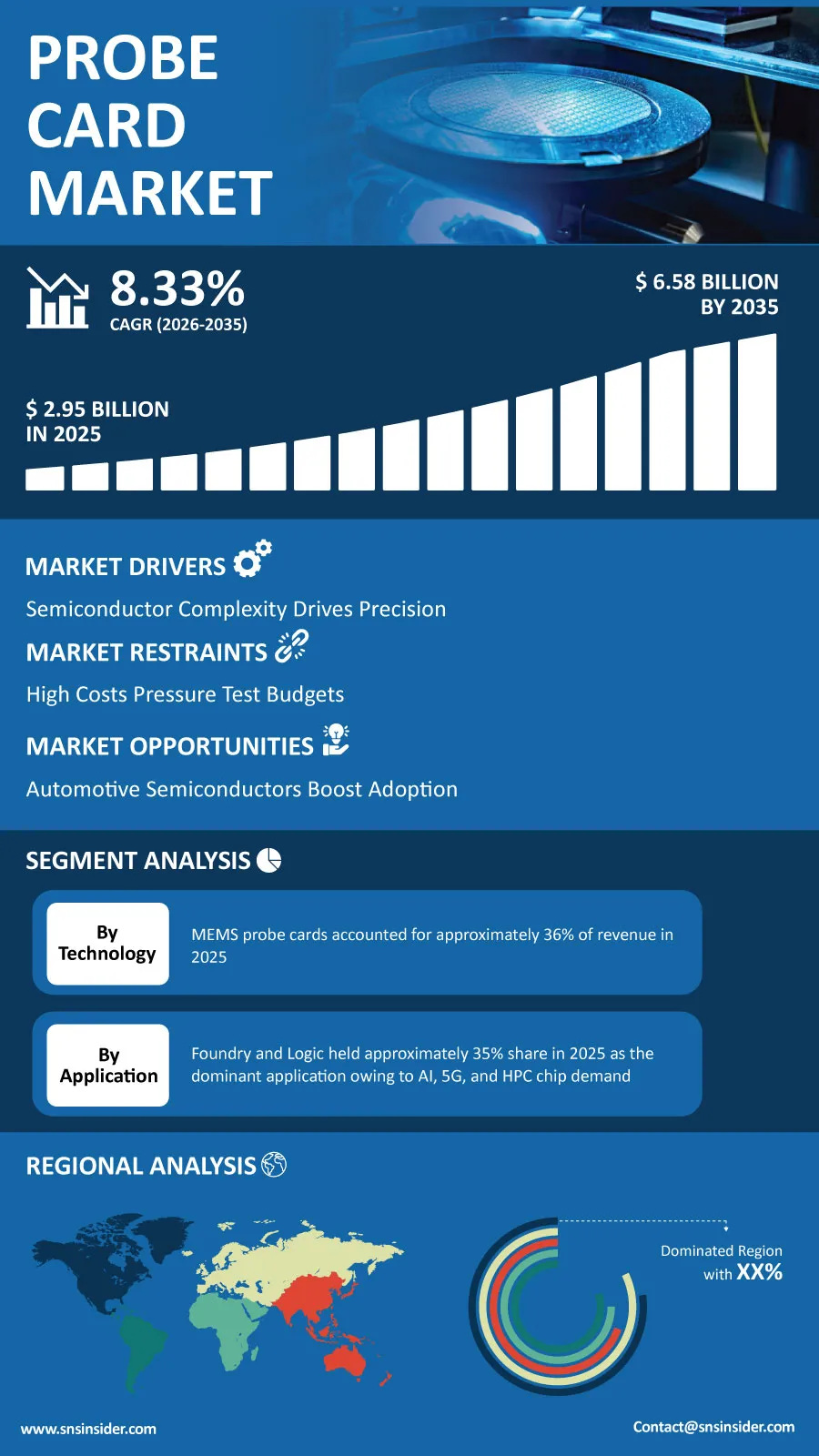
The global Probe Cards Market is entering a strong growth phase as semiconductor manufacturers accelerate investments in advanced chips, high-performance computing, artificial intelligence, and next-generation packaging technologies. According to a recent study by SNS Insider, the global Probe Card Market size valued at USD 2.95 billion in 2025, is anticipated to grow to USD 6.58 billion by 2035, registering a CAGR of 8.33% over the 2026–2035 forecast period.
The growing intricacy of semiconductor products is giving rise to new demands on wafer-level testing. As semiconductor producers turn to smaller process nodes, denser transistor counts, and advanced chiplet technology, test equipment needs to be more accurate and reliable prior to wafer packaging.
Another factor driving the demand is semiconductor manufacturing programs sponsored by government bodies. The construction and expansion of new manufacturing plants in North America, Europe, and the Asia Pacific region has prompted semiconductor firms to invest in testing equipment, providing good prospects for probe card producers.
To Get Detailed Insights on the Probe Card Market – Request a Sample Report
Advanced Semiconductor Manufacturing Creates New Growth Opportunities
The rapid expansion of AI accelerators, high-performance computing systems, 5G High-bandwidth memory and improved infrastructure are making wafer testing even more critical. Manufacturers of semiconductors are in search of probe cards that can manage fine pitches and denser pins and also have higher electrical performance standards.
A shift toward advanced packaging provides yet another opportunity to grow in the market. As chiplets and heterogeneous integration become more popular, testing of dies on wafer level gains importance.
Developments in the field such as MEMS technology, automatic alignment and modular architecture, and specific probing solutions are helping to cope with challenges faced by semiconductor producers.
Key Market Insights Highlight Shifting Demand Patterns
By technology, MEMS probe cards segment held approximately 36% of global market revenue in 2025, supported by their precision, consistent contact characteristics, and suitability for fine-pitch semiconductor testing. Vertical MEMS probe cards are projected to be the fastest-growing technology segment, expanding at approximately 9.17% CAGR as advanced process nodes demand improved contact uniformity and tighter pitch capabilities.
Based on application, foundry and logic testing was representing approximately 35% of market revenue in 2025. Strong demand for AI processors, high-performance computing chips, and advanced communication semiconductors continues to support this segment. DRAM is expected to register the fastest growth as rising demand for high-bandwidth memory increases testing requirements and drives investment in advanced probing technologies.
By type, advanced probe cards dominated the market as semiconductor architectures become increasingly sophisticated. Standard probe cards will continue serving mature-node manufacturing, parametric testing, and applications where cost efficiency remains a primary consideration.
In terms of end user, foundries held the dominant market share due to their substantial wafer production volumes and diverse customer base. OSAT companies are expected to experience the fastest growth as chiplet-based architectures increase the need for wafer-level validation outside traditional captive semiconductor manufacturing environments.
Semiconductor Miniaturization Continues to Raise Testing Requirements
The ongoing reduction in semiconductor feature sizes is placing greater demands on wafer testing accuracy and repeatability. Each new technology generation requires more precise electrical contact while maintaining stable performance across increasingly dense arrays of test points.
AI and data center infrastructure are further broadening the opportunity landscape. High-performance processors, memory technologies, and silicon photonics are creating specialized testing requirements that encourage innovation in probe card design and testing systems.
The development of double-sided probing, wafer-level burn-in, and advanced solutions for power semiconductor testing is also expanding the role of probe cards beyond conventional logic and memory applications.
Asia Pacific Emerges as the Fastest-Growing Probe Card Market Amid Expanding Semiconductor Investments
North America is expected to remain a major regional market, led by the United States, where AI chip development, 5G technologies, silicon photonics, and semiconductor manufacturing investments are supporting demand for advanced wafer testing infrastructure. Government incentives aimed at strengthening domestic chip production are expected to further stimulate equipment procurement.
Asia Pacific is projected to be the fastest-growing regional market, supported by Taiwan's foundry industry, South Korea's memory semiconductor ecosystem, and Japan's expanding fabrication capacity. Government incentives and new semiconductor investments across the region are encouraging manufacturers to strengthen local production and testing capabilities.
Europe is also gaining momentum as semiconductor investment programs support new manufacturing capacity. Growing demand for automotive electronics, industrial semiconductors, and specialized devices is creating additional opportunities for probe card suppliers across the region.
Industry Participants Focus on Precision and Advanced Testing Solutions
The competitive landscape remains innovation-driven as manufacturers focus on developing fine-pitch probing technologies, advanced MEMS architectures, improved durability, and solutions tailored to emerging semiconductor applications. Companies are also expanding production capacity and strengthening partnerships with chipmakers and testing equipment providers to support the transition toward advanced nodes and packaging.
Key companies operating in the global Probe Card Market include FormFactor Inc., Technoprobe S.p.A., Japan Electronic Materials Corporation, Micronics Japan Co. Ltd., MPI Corporation, Feinmetall GmbH, Korea Instruments Co. Ltd., Nidec Advance Technology Corporation, Star Technologies Inc., GGB Industries Inc., Wentworth Laboratories Inc., Cascade Microtech (FormFactor), Willtechnology Co. Ltd., TSE Co. Ltd., Chroma ATE Inc., Advantest Corporation, SV Probe (Nidec), Protec Mems Technology, Microworld Services Group, and Cohu Inc.
An SNS Insider analyst Sushant Kadam commented, “The semiconductor industry's transition toward advanced process nodes, AI-focused computing, and complex chiplet architectures is increasing the need for highly precise wafer-level testing. Probe card manufacturers that continue advancing fine-pitch capabilities, MEMS technology, and application-specific testing solutions will be well positioned to benefit from the next wave of semiconductor manufacturing investment.”
About the Author

Get in touch