
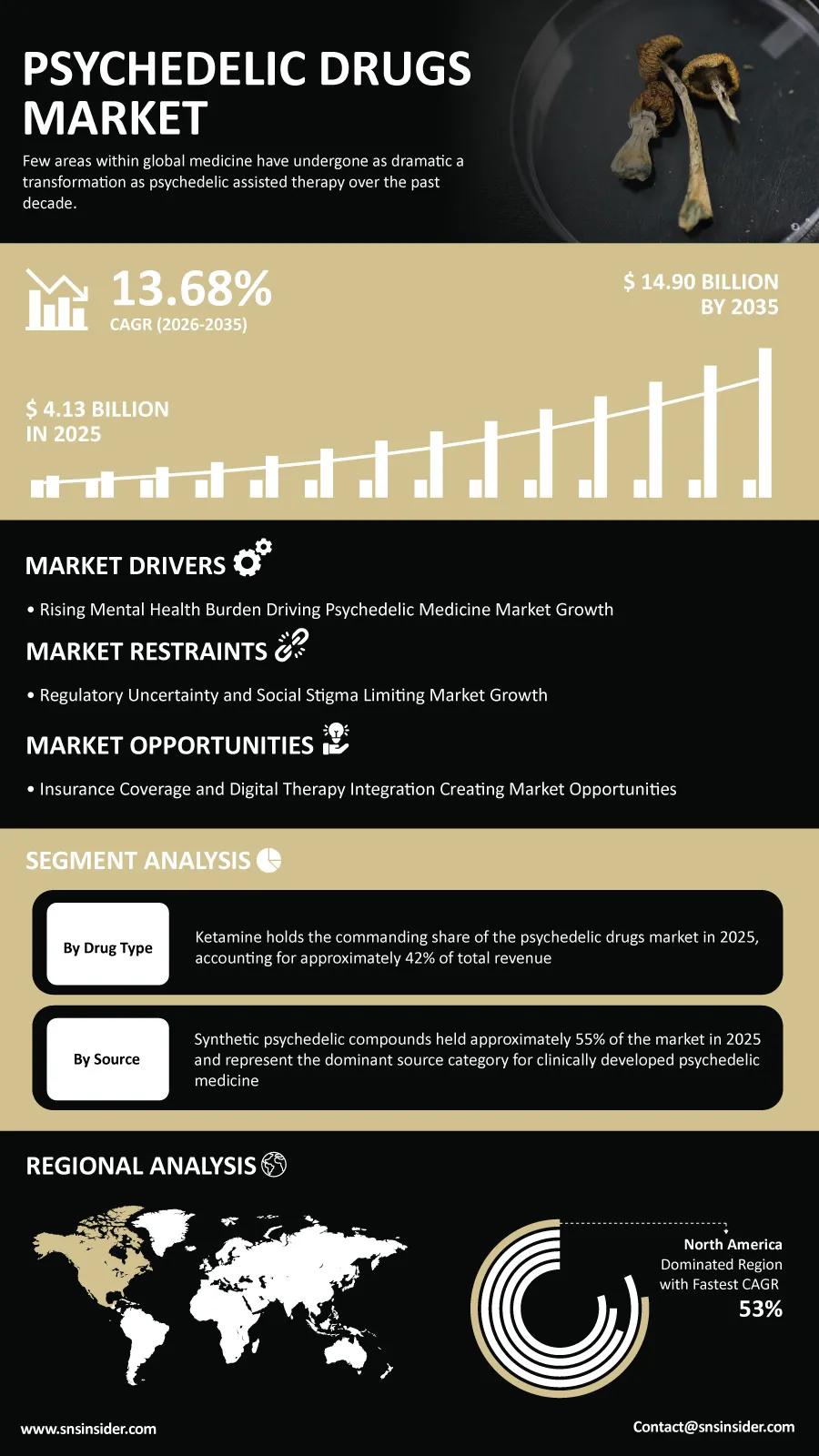
The global Psychedelic Drugs Market is gaining remarkable momentum as healthcare systems seek breakthrough solutions for complex psychiatric disorders that have long challenged conventional treatment approaches. According to a recent study by SNS Insider, the global Psychedelic Drugs Market size valued at USD 4.13 billion in 2025, is anticipated to grow to USD 14.90 billion by 2035, registering a CAGR of 13.68% over the 2026–2035 forecast period. Expanding scientific evidence, increasing investment in neuropsychiatric research, and evolving regulatory frameworks are positioning psychedelic medicines as a significant area of innovation within modern healthcare.
Healthcare professionals, pharmaceutical industries, and research centers are making great strides towards discovering drugs that can provide real help to those suffering from depression, anxiety disorders, PTSD, and drug dependence. Mental illness being identified as an important health issue worldwide has brought increased cooperation among regulatory authorities, biotech industries, and academic institutions.
To Get Detailed Insights on the Psychedelic Drugs Market – Request a Sample Report
Expanding Clinical Research Creates New Growth Opportunities
The development of psychedelics medicine industry is happening at an accelerated pace since current development programs yield positive results in many mental disorders. Over 400 clinical trials are being conducted around the world, which is indicative of the growing interest among the scientific community in the substances, such as psilocybin, ketamine, MDMA and LSD.
In parallel to that, investment flows into the sector grow, facilitating discovery of new drugs, clinical validation and building special facilities for administering treatments. Besides that, technologies such as artificial intelligence-based preparation and monitoring of patients, as well as biofeedback solutions, improve the quality of treatment.
Key Market Findings Highlight High-Growth Segments
Based on drug type, Ketamine accounted for approximately 42% of global market revenue in 2025, supported by its established clinical adoption and regulatory acceptance. Psilocybin is expected to register the fastest growth through 2035 as late-stage clinical programs continue advancing.
By source, synthetic compounds represented approximately 55% of market revenue in 2025, benefiting from scalable manufacturing and standardized pharmaceutical production, while naturally derived compounds continue gaining research attention.
Among applications, Treatment Resistant Depression remained the largest revenue-generating segment during 2025, whereas PTSD is projected to deliver the strongest growth throughout the forecast period due to expanding clinical evidence.
With respect to administration routes, intravenous therapies maintained the largest share in 2025, while oral and intranasal formulations are expected to experience rapid adoption as product pipelines mature.
By end-use setting, Specialized Psychedelic Clinics generated the highest revenue in 2025, whereas Research and Academic Institutes are forecast to record the fastest expansion through 2035 as clinical research programs continue to increase globally.
Innovation and Regulatory Progress Strengthen Market Confidence
The industry still gains from closer cooperation between drug developers, medical care providers, and regulatory bodies who are searching for an alternative solution for patients whose psychiatric requirements are not met. Precision medicine, monitoring systems, and standard treatment protocols have increased the level of trust of physicians and will further support market development.
Public understanding of the need for mental care along with growing acceptance of psychedelic medicine as evidenced-based treatment provides a favorable environment for future market expansion. With ongoing discussions of reimbursement and clearer regulatory framework, commercialization of the business is expected to speed up.
Regional Markets:
North America emerged as the largest regional market in 2025, contributing close to 53% of the global revenue share. The United States accounts for almost 79% of the North American revenues and remains dominant across the world for clinical development, investments, and specialized treatments. The value of the U.S. Psychedelic Drugs Market stood at USD 1.63 billion in 2025 and is estimated to rise to USD 5.09 billion by 2035, registering a CAGR of 12.06%.
The Asia Pacific region is projected to grow with the fastest growth rate through 2035 due to advancements in regulations and expansion in mental health care programs. Australia held about 38% of the regional revenue share and remains innovative in terms of regulated therapies.
In Europe, Germany constituted about 27% of the regional revenue and showcases the strength in research and pharmaceutical investments. At the same time, Brazil holds about 44% of the revenue of Latin America, while Israel has about 29% of the revenue of Middle East & Africa.
Leading Companies Drive Industry Development
Competition within the psychedelic therapeutics industry continues to intensify as companies expand clinical pipelines, pursue strategic collaborations, and invest in innovative treatment platforms. Major companies operating in the global psychedelic drugs market include Johnson and Johnson, Jazz Pharmaceuticals plc, COMPASS Pathways plc, MindMed Inc., Cybin Inc., Atai Life Sciences N.V., GH Research PLC, Seelos Therapeutics Inc., Beckley Psytech Ltd., Field Trip Health and Wellness Ltd., Numinus Wellness Inc., Mydecine Innovations Group Inc., Small Pharma Inc., Awakn Life Sciences Corp., Filament Health Corp., Tryp Therapeutics Inc., Psyence Group Inc., Entheon Biomedical Corp., Delic Holdings Corp., and PharmAla Biotech Holdings Inc.
An SNS Insider analyst Parry Kardani commented, "The growing convergence of neuroscience, pharmaceutical innovation, and supportive regulatory progress is transforming psychedelic medicine into one of the most promising areas within mental healthcare. Organizations capable of delivering clinically validated therapies supported by scalable treatment models are expected to shape the industry's next phase of growth."
About the Author

Get in touch




