
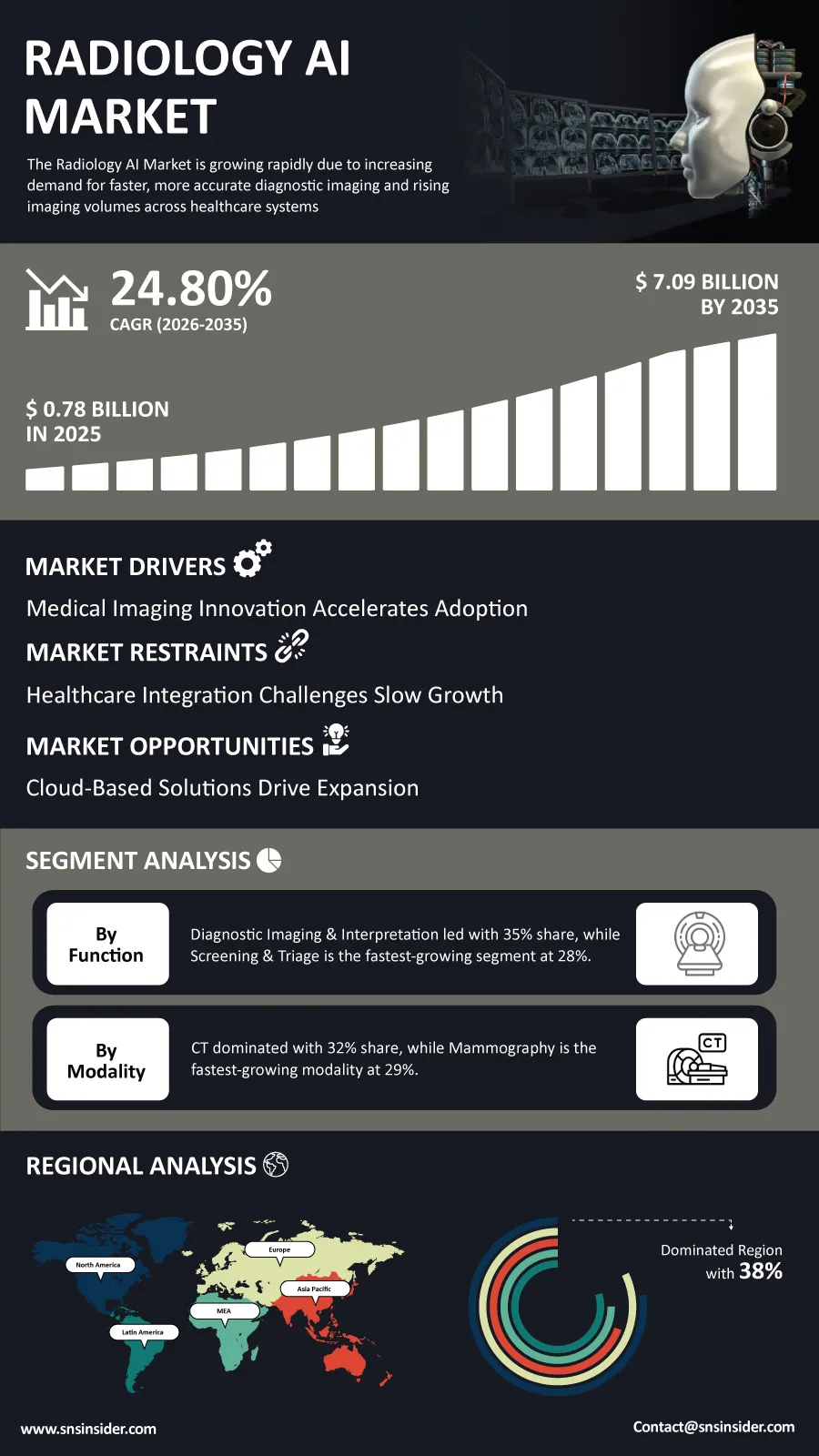
The global Radiology AI Market is poised for exceptional growth as healthcare providers increasingly embrace artificial intelligence to improve imaging accuracy, optimize clinical workflows, and enhance patient care. “According to a recent study by SNS Insider, the global Radiology AI Market size valued at USD 0.78 billion in 2025, is anticipated to grow to USD 7.09 billion by 2035, registering a CAGR of 24.80% over the 2026–2035 forecast period.”
Hospitals and imaging centers across the globe are increasingly adopting advanced imaging solutions through artificial intelligence to keep up with the growing volume of diagnoses in such facilities. Artificial intelligence is now playing an indispensable role in contemporary radiology through helping doctors interpret images, prioritize workflow, and make decisions that enable faster diagnoses.
The ongoing digital revolution in the health sector along with the high demand for precise diagnostics and value-based care services presents a lot of opportunities for AI-based imaging solutions.
To Get Detailed Insights on the Radiology AI Market – Request a Sample Report
Artificial Intelligence Reshapes the Future of Medical Imaging
Machine learning, deep learning, and cloud computing technologies are revolutionizing the functioning of radiology departments. AI-based tools are assisting medical practitioners in optimizing imaging process, reducing time spent on reporting, and ensuring uniformity in diagnostics.
The use of intelligent software in conjunction with new imaging technologies has made it possible for health care organizations to make quicker clinical decisions as well as optimize their use of radiology departments. Increased use of enterprise imaging platforms, cloud-based analytics, and intelligent workflow management tools is making the application of AI even more relevant in the diagnostic imaging environment.
In the light of continuing digitalization of the health care sector, artificial intelligence looks set to become an increasingly important tool for radiologists.
Key Market Findings Highlight Strong Growth Potential
Among functional applications, diagnostic imaging and interpretation accounted for 35% of total market revenue in 2025, reflecting the growing reliance on AI-assisted image analysis across healthcare settings.
Meanwhile, screening and triage solutions are projected to emerge as the fastest-growing function, expanding at approximately 28% during the forecast period, supported by increasing emphasis on early disease detection and faster patient prioritization.
From an imaging modality perspective, computed tomography (CT) represented 32% of global market revenue in 2025, maintaining its leadership due to broad clinical utilization across multiple disease areas. At the same time, mammography applications are expected to experience the fastest growth, advancing at nearly 29%, driven by expanding breast cancer screening programs and increasing adoption of AI-assisted image interpretation.
By offering, software and Software-as-a-Service (SaaS) solutions accounted for 62% of market revenue in 2025 while continuing to represent the fastest-growing category, reflecting healthcare providers' growing preference for scalable, cloud-enabled AI platforms.
Clinical applications continue to diversify as well. Oncology accounted for 28% of total market revenue in 2025, highlighting the increasing importance of AI in cancer detection and treatment planning. Meanwhile, cardiology applications are projected to witness the fastest expansion at approximately 18%, supported by growing demand for advanced cardiovascular imaging and early risk assessment.
Healthcare Digitalization Accelerates AI Adoption
Healthcare professionals are also getting more involved in the development and implementation of digital transformation strategies aimed at enhancing patient experience, increasing clinical effectiveness, and optimizing operations. With the help of AI-based imaging solutions, clinicians are able to process large volumes of imaging data and facilitate the consistent making of diagnoses.
As the number of technologies, including cloud computing and enterprise imaging, becomes higher, healthcare organizations will have an opportunity to implement their AI-based solution in many locations. This can contribute to collaboration between radiologists and specialists despite their location.
These factors are believed to provide more possibilities for technology companies, which produce scalable and interoperable AI platforms.
Regional Markets Continue to Expand
In North America, the share of global market revenue was recorded as 38% in 2025 owing to the presence of robust healthcare infrastructure, investments made in digital health technologies, and the application of artificial intelligence at an early stage in the medical imaging departments. Future innovations and positive technology adoption trends will ensure that the region maintains its dominance in the coming years.
Asia Pacific is likely to witness high growth among all other regions in terms of CAGR (27%) during the forecast period until 2035. The opportunities for AI solution providers will continue increasing owing to growing investments in the healthcare sector and hospital modernization.
Industry Leaders Continue to Accelerate Innovation
Competition within the radiology AI market remains highly dynamic as leading healthcare technology companies continue investing in artificial intelligence, cloud-based imaging platforms, workflow automation, and strategic collaborations designed to improve diagnostic performance and clinical productivity.
Major companies operating in the global Radiology AI Market include Siemens Healthineers, GE HealthCare, Philips, Aidoc, Canon Medical Systems, Lunit, Qure.ai, Rad AI, Subtle Medical, and United Imaging Healthcare.
An SNS Insider analyst Parry Kardani commented, "Artificial intelligence is rapidly becoming an essential technology within modern radiology by improving diagnostic confidence, enhancing workflow efficiency, and supporting faster clinical decision-making. Continued advancements in AI algorithms, cloud computing, and digital imaging infrastructure are expected to unlock significant growth opportunities across the global healthcare ecosystem."
About the Author

Get in touch




