
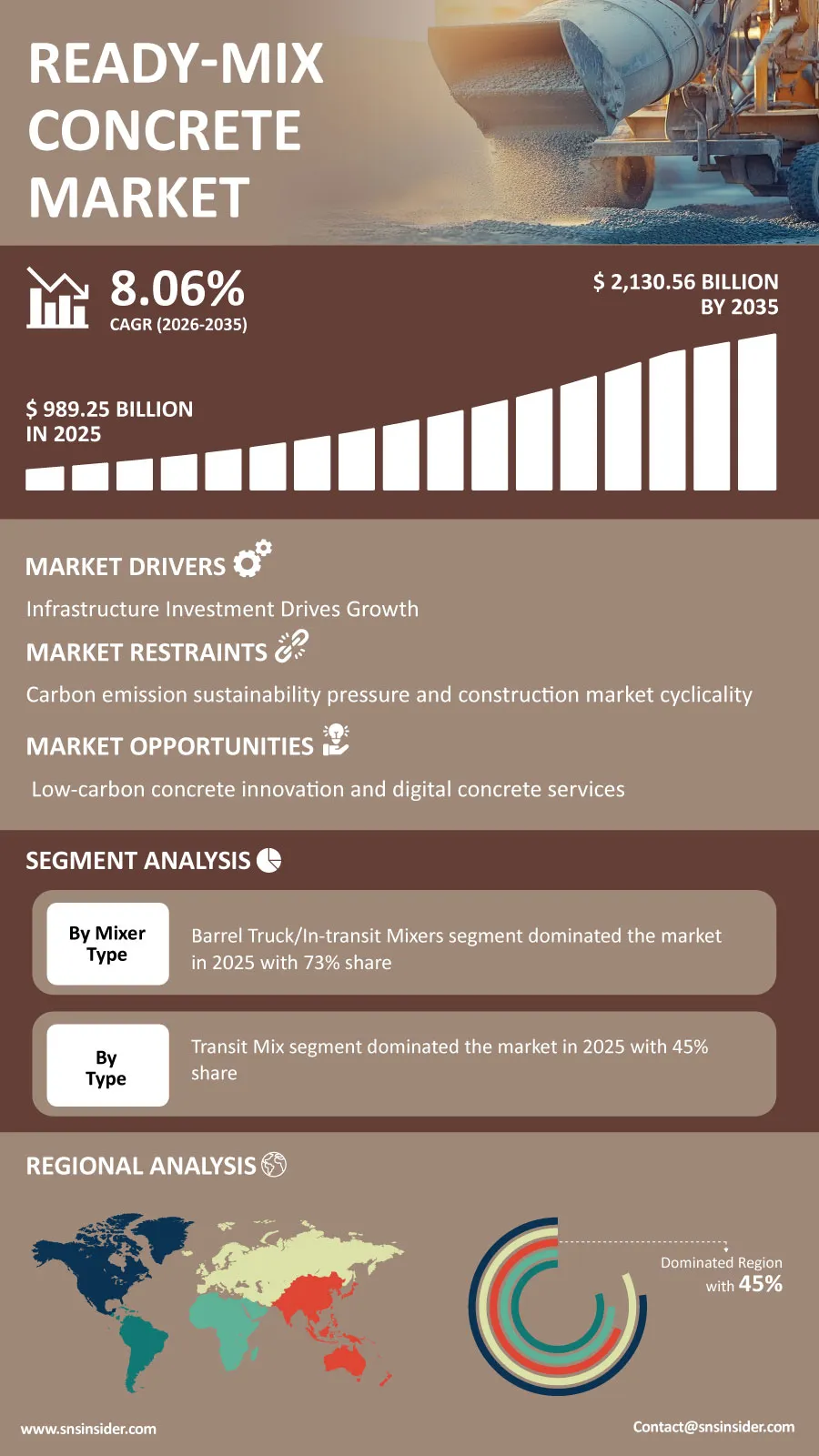
The Ready-mix Concrete Market is projected to grow considerably as Governments and private developers invest in transportation infrastructure, smart cities, residential housing and industrial construction on a global scale. “According to a recent study by SNS Insider, the global Ready-mix Concrete Market size valued at USD 989.25 Billion in 2025, is anticipated to grow to USD 2,130.56 Billion by 2035, registering a CAGR of 8.06% over the 2026–2035 forecast period.”
High-performance construction materials are witnessing tremendous demand due to the urban population and large-scale infrastructure modernization. Over time it has been found that ready-mix concrete is the best option for present days projects providing uniform quality, shorter execution times, efficient utilisation of resources and lesser labour requirement. Another factor which is figuring to drive efficiencies in a nation that is continuing its shift into factory-controlled concrete production while nurturing complex engineering applications.
Automation in production facilities with manufacturers starting to integrate highly-advanced batching technologies as well as digital quality monitoring. These technology developments assist contractors in improving the quality of concrete with improved accuracy, helping them attain sustainability targets by maximizing raw material consumption and minimizing environmental footprint.
To Get Detailed Insights on the Ready-mix Concrete Market – Request a Sample Report
Infrastructure Modernization and Green Construction Projects Create Significant Growth Opportunities
Massive public works programs and aggressive investments by the private sector keep creating long-term prospects for producers of ready-mix concrete across the globe. Greener infrastructure development like upgrading highway systems, airports, railway networks, industrial zones and possible renewable energy plants as well as urban housing will further strengthen demand for waterfall solutions reliable enough to satisfy the tough engineering standards.
Meanwhile, the increased focus on sustainable construction is pressuring producers to develop lower carbon concrete mixes, incorporate recycled aggregates and create new cement technologies. With some focus on commercial jobs, digital construction management platforms and smart concrete monitoring systems are increasing project productivity while providing contractors with the ability to improve structural performance over the building lifecycle.
Key Market Insights Highlight Shifting Demand Patterns
Mixer type-wise, Barrel Truck/In-transit Mixers captured nearly 73% of total market revenue in 2025 due to their importance in keeping concrete consistency stable during transport. Volumetric Mixers are projected to be the fastest growing segment over 2023-2035 as contractors look for on demand, flexible concrete production across varying construction environments.
Transit Mix segment accounted for nearly 45% revenue share of the market by type in 2025 owing to its effectiveness and wide application in residential, commercial or industrial purposes. Shrink Mix is expected to exhibit the most significant growth in the forecast period, as logistics optimization and transportation efficiency plays an important role.
On the basis of application, Residential accounted for nearly 40% share of global market revenue in 2025 owing to increasing residential construction coupled with urbanization. The Infrastructure segment is expected to be the fastest growing application as governments hasten spending on transportation systems, bridges, utilities, airports and public development projects.
Smart Concrete Technologies Accelerate Industry Transformation
The ready-mix concrete business has been adopting technological advancements quickly with a aim to enhance construction quality, improved sustainability and better project efficiency. Leveraging advanced batching systems, AI-driven mix optimization, IoT based monitoring solutions and automated production facilities to deliver high strength & quality products while minimizing operational waste.
In addition producers are investing in low carbon concrete technologies, supplementary cementitious materials, carbon capture solutions and recycling of construction materials. These innovations are enhancing environmental performance and allowing the construction industry to meet more ambitious sustainability targets and regulatory requirements.
Regional Markets Continue Expanding with Urban Development
Asia-Pacific was still the largest regional market; it accounted for around 45% of worldwide revenue. Regional demand remains supported by robust urbanization, expanding residential construction, large-scale infrastructure investment and persistent industrial activity throughout China, India, Japan and Southeast Asia. China continues to account for the largest share of regional consumption, while India is among the fastest-growing national markets thanks in part to significant public infrastructure projects and low-income housing schemes.
Modernization of infrastructure, commercial construction to meet the demand and increased use of sustainable building materials will continue supporting growth in North America and Europe. At the same time, ambitious urban development programs, transportation projects and growth of industrial construction activities create new opportunities in the Middle East, Africa, and Latin America.
Industry Participants Focus on Sustainable Innovation and Capacity Expansion
Competitiveness in the ready-mix concrete sector around the world is largely based on sustainability, innovations in digital technology, efficient manufacturing, and capacity expansion strategies. The major players in the industry are focusing on low carbon cement technologies, quality control systems, and advanced manufacturing plants in order to improve their competitive edge and meet customer needs.
Key companies operating in the global Ready-mix Concrete Market include CEMEX SAB de CV, Heidelberg Materials, Holcim Group, CRH plc, Vulcan Materials Company, Martin Marietta Materials, Argos USA LLC, Buzzi SpA, GCC (Grupo Cementos de Chihuahua), Thomas Concrete Group, Ozinga, Lehigh Hanson, Sika AG, SRM Concrete, Robertson's Ready Mix, Baker Concrete Construction, Kent Companies, Oldcastle Infrastructure, Premix Concrete SA, and Adbri Limited.
An SNS Insider analyst Himanshu Sharma commented, "Global infrastructure investment, accelerating urbanization, and the transition toward low-carbon construction materials are creating sustained momentum for the ready-mix concrete industry. Manufacturers that prioritize sustainable concrete technologies, digital production capabilities, and efficient supply chain operations will be well positioned to capitalize on long-term opportunities across residential, commercial, and infrastructure development worldwide."
About the Author

Get in touch




