
Ready-mix Concrete Market Report Scope & Overview:
The Ready-mix Concrete market is witnessing continuous growth owing to the increase in the number of cases associated with rapid urbanization and infrastructure development around the globe. Moreover, the growth can be attributed to the rising adoption of sustainable construction practices coupled with the advancements made in automated batching and quality control technologies. The ready-mix concrete is a pre-blended material used in construction to obtain consistent quality concrete at project sites. The concrete obtained is delivered in fresh form on an attached transit mixer without the use of on-site mixing that can hinder the process.
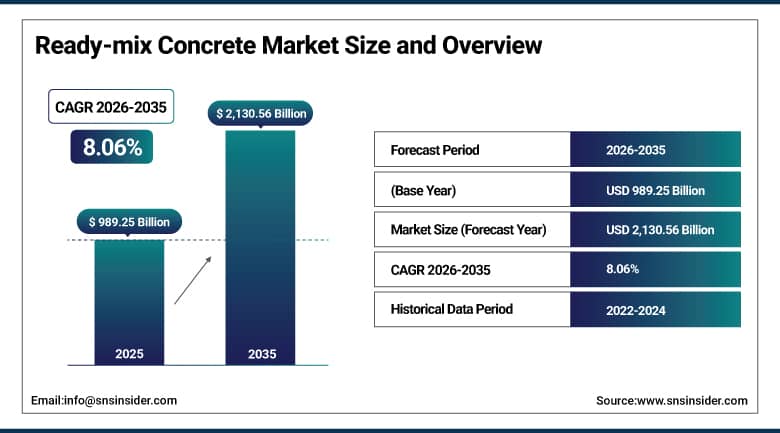
The Ready-mix Concrete Market was valued at USD 989.25 Billion in 2025 and is expected to reach USD 2,130.56 Billion by 2035, growing at a CAGR of 8.06% from 2026 to 2035.
According to the United Nations (UN), approximately 57% of the global population currently lives in urban areas, and this share is projected to reach nearly 68% by 2050. This rapid urban expansion is creating substantial demand for new housing developments, commercial buildings, transportation networks, and supporting infrastructure, thereby increasing the consumption of ready-mix concrete. Furthermore, the International Energy Agency (IEA) reports that buildings account for approximately 30% of global final energy consumption, encouraging investments in modern, durable, and energy-efficient construction projects.
To Get More Information On Ready-mix Concrete Market - Request Free Sample Report
Ready-mix Concrete Market Trends:
-
Rising investments in residential, commercial, and infrastructure construction projects driving strong demand for ready-mix concrete solutions
-
Growing adoption of automated batching and quality control technologies to ensure consistent concrete performance and construction efficiency
-
Increasing focus on sustainable construction practices encouraging the use of eco-friendly ready-mix concrete with lower carbon emissions
-
Expanding urbanization and smart city development projects boosting demand for high-quality and time-efficient concrete supply systems
-
Rising preference for ready-mix concrete over on-site mixing due to reduced labor requirements, faster project execution, and improved material utilization
Key Market Highlights
|
Market Parameter |
Market Highlight / Data |
Key Growth Driver |
|---|---|---|
|
Largest Mixer Type |
Barrel Truck/In-transit Mixers – 73.00% share in 2025 |
Consistent mixing, minimized segregation, and efficient service across many construction sites. |
|
Fastest-Growing Mixer Type |
Volumetric Mixers – Fastest growth over forecast period |
Flexibility to customize production and growing emphasis on minimizing waste. |
|
Largest Type |
Transit Mix – 45.00% share in 2025 |
Capability to transport freshly mixed concrete while maintaining high quality and consistency. |
|
Fastest-Growing Type |
Shrink Mix – Fastest growth over forecast period |
Minimized transportation costs and higher loading capacities for logistics efficiency. |
|
Largest Application |
Residential – 40.00% share in 2025 |
Consistent quality, faster construction times, and lower labor needs for housing. |
|
Fastest-Growing Application |
Infrastructure – Fastest growth over forecast period |
Higher spending on transport infrastructure, bridges, roads, airports, and utilities. |
|
Largest Production Method |
Off-site Production – 63.00% share in 2025 |
Controlled environment production resulting in high-quality concrete and minimized waste. |
|
Fastest-Growing Production Method |
On-site Production – Fastest growth over forecast period |
Increased demand for project-oriented mixing and reduced transportation problems. |
|
Largest Region |
Asia Pacific – 45.00% share in 2025 |
China’s construction scale and India’s rapidly expanding infrastructure investment. |
|
Fastest-Growing Region |
Asia Pacific – Fastest growth over forecast period |
Rising urbanization, expanding infrastructure, and increasing digital construction adoption. |
U.S. Ready-mix Concrete Market Outlook:
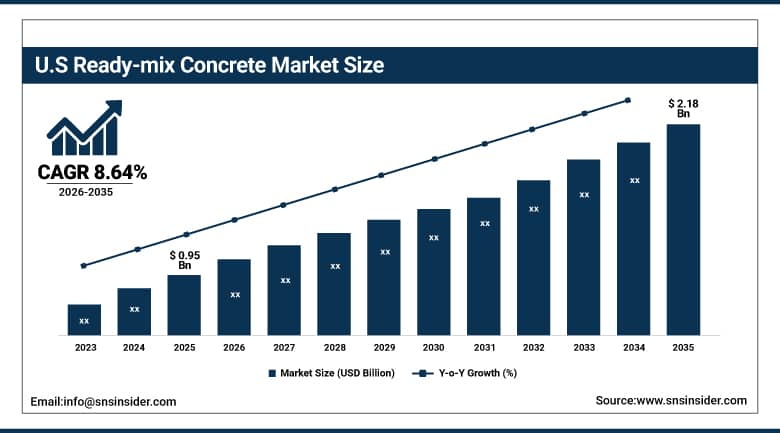
The U.S. Ready-mix Concrete Market was valued at USD 0.95 billion in 2025 and is expected to reach USD 2.18 billion by 2035, growing at a CAGR of 8.64% from 2026-2035.
The U.S. Ready-mix Concrete Market is one of the most commercially significant national ready-mix concrete markets globally, driven by the Bipartisan Infrastructure Law’s USD 1.2 trillion infrastructure investment, the residential construction sector’s demand recovery, and the industrial and data centre construction wave creating above-average commercial procurement. The IRA’s domestic manufacturing investment incentive is creating new industrial facility concrete procurement from semiconductor fabs, EV battery factories, and clean energy infrastructure whose concrete volume requirement sustains above-average U.S. market engagement.
In 2024, Holcim US launched its ECOPact low-carbon ready-mix concrete product line expansion with net-zero carbon concrete formulations achieving 40-90% carbon reduction versus standard concrete through fly ash replacement and CCUS technology, targeting U.S. green building certification programmes and federal infrastructure projects with Buy Clean procurement requirements.
According to the latest official U.S. government statistics from the U.S. Geological Survey for 2024, Portland and blended cement production in the U.S. decreased by 4% to about 84 million tons.
Ready-mix Concrete Market Segment Analysis:
-
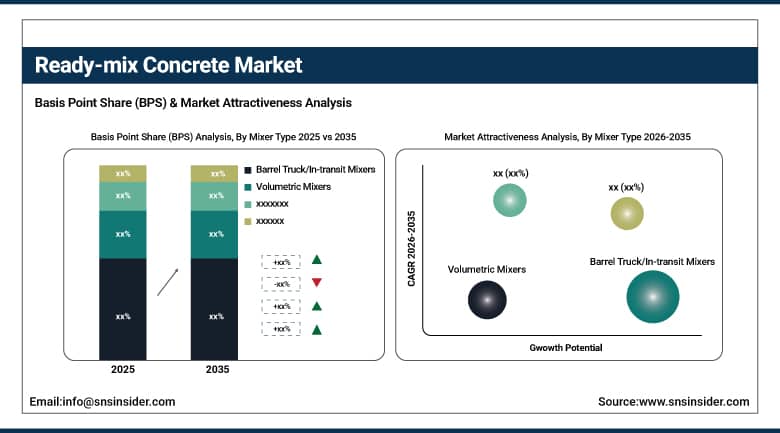
By Mixer Type, Barrel Truck/In-transit Mixers segment dominated the market in 2025 with 73% share; Volumetric Mixers segment is the fastest growing segment.
-
By Type, Transit Mix segment dominated the market in 2025 with 45% share; Shrink Mix segment is the fastest growing segment.
-
By Application, Residential segment dominated the market in 2025 with 40% share; Infrastructure segment is the fastest growing segment.
-
By Production Method, Off-site Production segment dominated the market in 2025 with 63% share; On-site Production segment is the fastest growing segment.
By Mixer Type, barrel truck/in-transit mixers segment dominates the market, while volumetric mixers segment is the fastest-growing segment
The Barrel Truck/In-transit Mixers segment dominated the market in 2025 because of their widespread application in moving concrete while ensuring that it remains uniform and consistent. The mixers play a crucial role in delivering concrete that maintains consistency since they help to ensure constant mixing of the materials, minimize segregation of different parts, and ensure efficient project completion. They have gained an edge owing to the reliable service, ease of integration into current ready-mix concrete operations, and efficient service in many construction sites.
The Volumetric Mixers segment is the fastest growing because of the need to create customized products. The demand for these mixers is increasing owing to their flexibility, which allows contractors to customize production of concrete according to the needs of their projects. There is also growing emphasis on minimizing waste and making processes more sustainable and efficient, thus promoting the use of volumetric mixers. There is a surge in the number of construction activities in far-flung locations.
By Type, transit mix segment dominates the market, while shrink mix segment is the fastest-growing segment
The Transit Mix segment dominated the market in 2025 due to its capability to transport freshly mixed concrete directly from the manufacturing plants to the sites where it is needed while still keeping high-quality levels and consistency. This segment is widely used both in residential, commercial, and industrial areas thanks to its effectiveness in working along with its less dependence on mixing facilities. Increased use of ready-to-mix concrete, which results in improved speed and quality of work, also contributes to the predominance of the Transit Mix segment on the market.
The Shrink Mix segment is the fastest growing because of the benefits offered by the process in terms of minimizing transportation costs and making deliveries efficient. With this process, concrete is loaded in partially mixed form and is finished in the process of transportation, resulting in higher loading capacities and logistics efficiency. The rising need for economic concrete distribution processes along with increased construction activity plays an important role in the fast-growing nature of the segment.
By Application, residential segment dominates the market, while infrastructure segment is the fastest-growing segment
The Residential segment dominated the market in 2025 due to high demand for residential construction, urban development, and infrastructure. Ready-mix concrete is extensively used in residential applications owing to the benefits offered by it, which include consistent quality, faster construction times, and lower labor needs. Urbanization and population growth coupled with efforts being made by governments for development of housing have contributed towards high demand for the segment. Moreover, increased use of advanced methods of construction further bolstered the segment’s dominance in the market.
The Infrastructure segment is the fastest growing owing to higher spending on transport infrastructure, bridges, roads, airports, railroads, and utilities. Governments as well as private players are becoming more active in building infrastructure owing to the role it plays in economic development. Ready-mix concrete offers the attributes needed for large-scale infrastructure development, including longevity, strength, and efficiency. Growth in terms of spending on infrastructure and development programs remains a key driver of segment growth.
By Production Method, off-site production segment dominates the market, while on-site production segment is the fastest-growing segment
The Off-site Production segment dominated the market in 2025 owing to its capability to produce concrete batches in one place in a controlled environment, which results in high-quality concrete production. In addition, off-site production enhances operational efficiency and minimizes waste. The popularity of off-site production can be attributed to its high-efficiency capabilities. The presence of highly efficient batching plant networks also helped the off-site production market segment maintain its dominant position.
The On-site Production segment is the fastest growing owing to increased demand for project-oriented concrete mixing. With on-site concrete production, contractors have the opportunity to modify the formula of concrete according to varying demands of projects. In addition, on-site production of concrete helps in reducing problems related to transportation. Hence, increasing demand for flexible production and reduced delivery problems have contributed to the rapid growth of the on-site production market segment.
Regional Analysis:
|
Region |
Major Country |
Share within Region, 2025 (%) |
|---|---|---|
|
North America |
United States |
87.4% |
|
Europe |
Germany |
22.3% |
|
Asia Pacific |
China |
54.6% |
|
Middle East & Africa |
Saudi Arabia |
31.2% |
|
Latin America |
Brazil |
44.2% |
Asia Pacific Ready-mix Concrete Market Insights
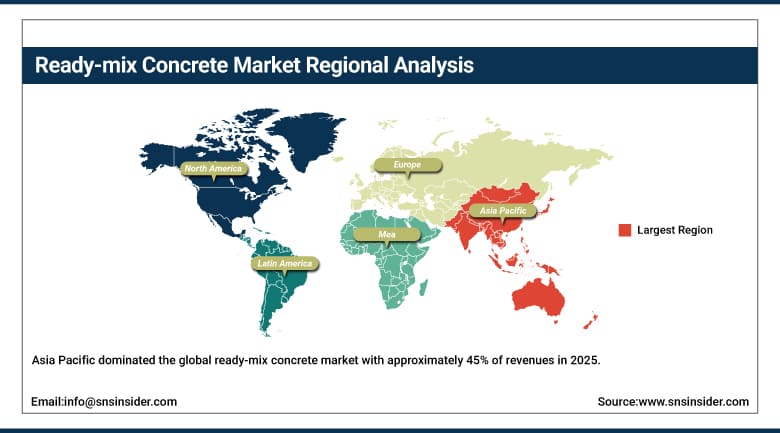
Asia Pacific dominated the global ready-mix concrete market with approximately 45% of revenues in 2025, driven by China’s extraordinary construction scale, India’s rapidly expanding infrastructure investment, Southeast Asia’s urbanisation, and Japan and South Korea’s mature urban construction markets. China accounts for approximately 54.6% of Asia Pacific revenues through its position as the world’s largest concrete producer and consumer whose combined residential, commercial, and infrastructure construction volume creates the most commercially significant national ready-mix concrete procurement.
According to the World Bank, Asia remains the largest contributor to global urban population growth, supporting significant residential, commercial, and public infrastructure construction activities.
Furthermore, the National Bureau of Statistics of China reports that China continues to be the world's largest construction market, supported by extensive investments in transportation networks, housing developments, and industrial infrastructure projects.
India represents the most commercially dynamic emerging market within Asia Pacific where the National Infrastructure Pipeline’s USD 1.5 trillion investment, the Smart Cities Mission’s urban infrastructure development, and the residential housing market’s PM Awas Yojana programme create above-average ready-mix concrete demand growth that compounds with India’s economic development trajectory.
Get Customized Report as Per Your Business Requirement - Enquiry Now
North America Ready-mix Concrete Market Insights
North America is a commercially significant ready-mix concrete market whose Bipartisan Infrastructure Law investment, residential construction demand, and industrial construction wave create structured procurement. The United States accounts for approximately 87.4% of North American revenues through CEMEX USA, LaFargeHolcim US, Martin Marietta Materials, and US Concrete’s domestic operations.
Cement was produced at 99 plants in 34 states plus Puerto Rico, with Texas, Missouri, California, and Florida as the top producers representing approximately 43% of total production. Total cement shipments in 2024 were around 110 million tons, valued at roughly USD 17 billion.
According to the U.S. Census Bureau, annual U.S. construction spending exceeds US$2 trillion, reflecting strong demand for construction materials, including concrete products. The U.S. Department of Transportation reports that the country has more than 620,000 bridges, many of which require repair, rehabilitation, or replacement, creating substantial opportunities for concrete suppliers.
Canada contributes approximately 12.6% of North American revenues through its construction sector’s infrastructure investment, the housing market’s concrete foundation procurement, and the resource sector’s industrial facility construction.
Europe Ready-mix Concrete Market Insights
Europe is a technically sophisticated ready-mix concrete market where sustainability requirements, circular economy construction material standards, and green building certification programmes create above-average low-carbon concrete specification motivation. Germany accounts for approximately 22.3% of European revenues through its industrial construction sector, the residential market’s concrete specification, and HeidelbergMaterials’ domestic operations.
According to Eurostat, the construction industry contributes approximately 5–6% of the European Union’s GDP and employs millions of workers, highlighting the sector’s significant role in regional development. Additionally, the European Commission is directing substantial funding toward green infrastructure projects and energy-efficient building renovations, driving demand for advanced and sustainable construction materials.
The United Kingdom, France, and the Netherlands are significant secondary markets where infrastructure investment programmes, residential housing shortfall creating construction urgency, and sustainability specification creating low-carbon concrete demand sustain consistent commercial activity. Holcim and CEMEX’s European operations sustain regional market supply from established commercial presences.
MEA & Latin America Ready-mix Concrete Market Insights
Saudi Arabia leads MEA revenues at approximately 31.2% through Vision 2030’s extraordinary NEOM, Red Sea Project, and Qiddiya construction programme requiring extraordinary ready-mix volumes, ARAMCO’s industrial facility construction, and the government housing programme.
Brazil leads Latin American revenues at approximately 44.2% through its large construction sector’s infrastructure and residential concrete procurement, the growing commercial construction market, and Votorantim Cimentos’ domestic operations. Africa’s rapid urbanisation creating first-time ready-mix adoption and Gulf infrastructure investment collectively sustain growing regional market development through 2035.
Market Dynamics:
Growth Drivers: Government infrastructure investment and urbanisation driving residential construction creating structured concrete demand
Government infrastructure investment programmes are the ready-mix concrete market’s most commercially certain structural growth driver. The aggregate of U.S. Bipartisan Infrastructure Law, China’s infrastructure capital expenditure, India’s National Infrastructure Pipeline, Saudi Arabia’s Vision 2030, and European infrastructure investment creates multi-trillion-dollar public sector concrete procurement whose multi-year programme duration creates long-horizon commercial certainty that private sector construction cycles cannot replicate. Each highway corridor, bridge replacement, and urban transit project creates ready-mix concrete procurement whose project scale creates supply security motivation for regional producer relationships.
Urbanisation’s structural demographic momentum, whose 68% of global population projection to live in urban areas by 2050 creates continuous net new urban construction demand, sustains ready-mix concrete market growth through the entire forecast period independently of cyclical construction investment variations. Each new urban resident creates demand for housing, urban services, and transport infrastructure whose concrete material requirement compounds with urbanisation’s global pace across Asia, Africa, and Latin America.
Restraints: Carbon emission sustainability pressure and construction market cyclicality
Ready-mix concrete’s carbon footprint from Portland cement clinker production, which accounts for approximately 8% of global CO2 emissions, creates regulatory and reputational pressure whose carbon reduction requirement creates product reformulation investment that moderates conventional concrete revenue growth while creating market development opportunity for low-carbon alternatives. Each carbon border adjustment mechanism, green procurement policy, and net-zero building commitment creates specification pressure for low-carbon concrete products whose premium pricing creates margin opportunity but procurement volume constraint.
Construction market cyclicality creates revenue volatility that moderates ready-mix concrete market growth consistency. Each interest rate cycle that reduces residential construction starts, each government fiscal consolidation that defers infrastructure investment, and each commercial real estate cycle that reduces new building starts creates ready-mix volume decline whose commercial impact on producers with high fixed cost batching plant infrastructure creates margin pressure.
Opportunities: Low-carbon concrete innovation and digital concrete services
Low-carbon ready-mix concrete development represents the most commercially transformative near-term product innovation opportunity whose ECOPact, Vertua, and equivalent low-carbon branded concrete products create premium pricing justification from green building certification value, Buy Clean procurement compliance, and corporate sustainability reporting metric improvement. Each 10% carbon reduction in concrete formulation that sustains structural performance creates commercial differentiation whose premium sustains above-commodity pricing across an expanding addressable procurement market.
Digital concrete services including IoT-connected strength monitoring, AI-powered mix design optimisation, and digital delivery management platforms create value-added service revenue whose subscription or project-based commercial model creates recurring revenue independent of concrete volume cycles. Each construction project that adopts digital concrete services creates above-commodity commercial relationships whose data value creates switching cost that sustains platform loyalty across subsequent project cycles.
Recent Developments:
-
2025: CEMEX expanded its Planetcement digital concrete monitoring platform in 2025 integrating IoT sensors in fresh concrete transmitting real-time strength development data during curing, enabling construction teams to accelerate formwork stripping decisions based on actual strength measurement.
-
2024: Holcim US launched its ECOPact net-zero carbon concrete product line expansion in 2024 achieving 40-90% carbon reduction versus standard concrete through fly ash replacement and CCUS technology, targeting U.S. green building certification and federal Buy Clean procurement requirements.
-
2024: LaFargeHolcim launched its Vertua low-carbon concrete global product family expansion in 2024 with new ultra-low and net-zero formulations for residential, commercial, and infrastructure applications targeting European carbon border adjustment mechanism compliance and LEED credit procurement.
-
2023: HeidelbergMaterials launched its Topmix permeable concrete system in 2023 with enhanced drainage capacity for urban flood management infrastructure, enabling 4,000 litres per hour per square metre drainage that sustains urban heat island reduction and stormwater management benefits in dense urban construction.
-
2023: CEMEX launched its Regenera concrete with recycled aggregate integration in 2023, incorporating up to 30% recycled construction and demolition waste material that meets structural performance standards while reducing virgin aggregate consumption in circular economy procurement programmes.
Ready-mix Concrete Market Key Players:
-
CEMEX SAB de CV
-
Holcim Group
-
CRH plc
-
Vulcan Materials Company
-
Martin Marietta Materials
-
Argos USA LLC
-
GCC (Grupo Cementos de Chihuahua)
-
Thomas Concrete Group
-
Ozinga
-
Lehigh Hanson
-
Sika AG
-
SRM Concrete
-
Robertson’s Ready Mix
-
Baker Concrete Construction
-
Kent Companies
-
Oldcastle Infrastructure
-
Premix Concrete SA
-
Adbri Limited
Ready-mix Concrete Market Report Scope:
| Report Attributes | Details |
|---|---|
| Market Size in 2025 | USD 989.5 Billion |
| Market Size by 2035 | USD 2,130.56 Billion |
| CAGR | CAGR of 8.06% From 2026 to 2035 |
| Base Year | 2025 |
| Forecast Period | 2026-2035 |
| Historical Data | 2022-2024 |
| Report Scope & Coverage | Market Size, Segments Analysis, Competitive Landscape, Regional Analysis, DROC & SWOT Analysis, Forecast Outlook |
| Key Segments | • By Type (Transit Mix, Central Mix, Shrink Mix) • By Application (Residential, Commercial, Infrastructure) • By Production Method (Off-site Production, On-site Production) • By Mixer Type (Barrel Truck/In-transit Mixers, Volumetric Mixers) |
| Regional Analysis/Coverage | North America (US, Canada), Europe (Germany, UK, France, Italy, Spain, Russia, Poland, Rest of Europe), Asia Pacific (China, India, Japan, South Korea, Australia, ASEAN Countries, Rest of Asia Pacific), Middle East & Africa (UAE, Saudi Arabia, Qatar, South Africa, Rest of Middle East & Africa), Latin America (Brazil, Argentina, Mexico, Colombia, Rest of Latin America). |
| Company Profiles | CEMEX SAB de CV, Heidelberg Materials, Holcim Group, CRH plc, Vulcan Materials Company, Martin Marietta Materials, Argos USA LLC, Buzzi SpA, GCC (Grupo Cementos de Chihuahua), Thomas Concrete Group, Ozinga, Lehigh Hanson, Sika AG, SRM Concrete, Robertson’s Ready Mix, Baker Concrete Construction, Kent Companies, Oldcastle Infrastructure, Premix Concrete SA, Adbri Limited |
Frequently Asked Questions
The Ready-mix Concrete Market is expected to grow at a CAGR of 8.06% from 2026 to 2035.
The Ready-mix Concrete Market was valued at USD 989.25 Billion in 2025.
Government infrastructure investment programs and rapid urbanization across emerging economies are driving large-scale concrete demand and construction activity.
Transit Mix dominated the Ready-mix Concrete Market in 2025, while Central Mix is the fastest growing segment.
Asia Pacific dominated the Ready-mix Concrete Market with approximately 45% of revenues in 2025.
