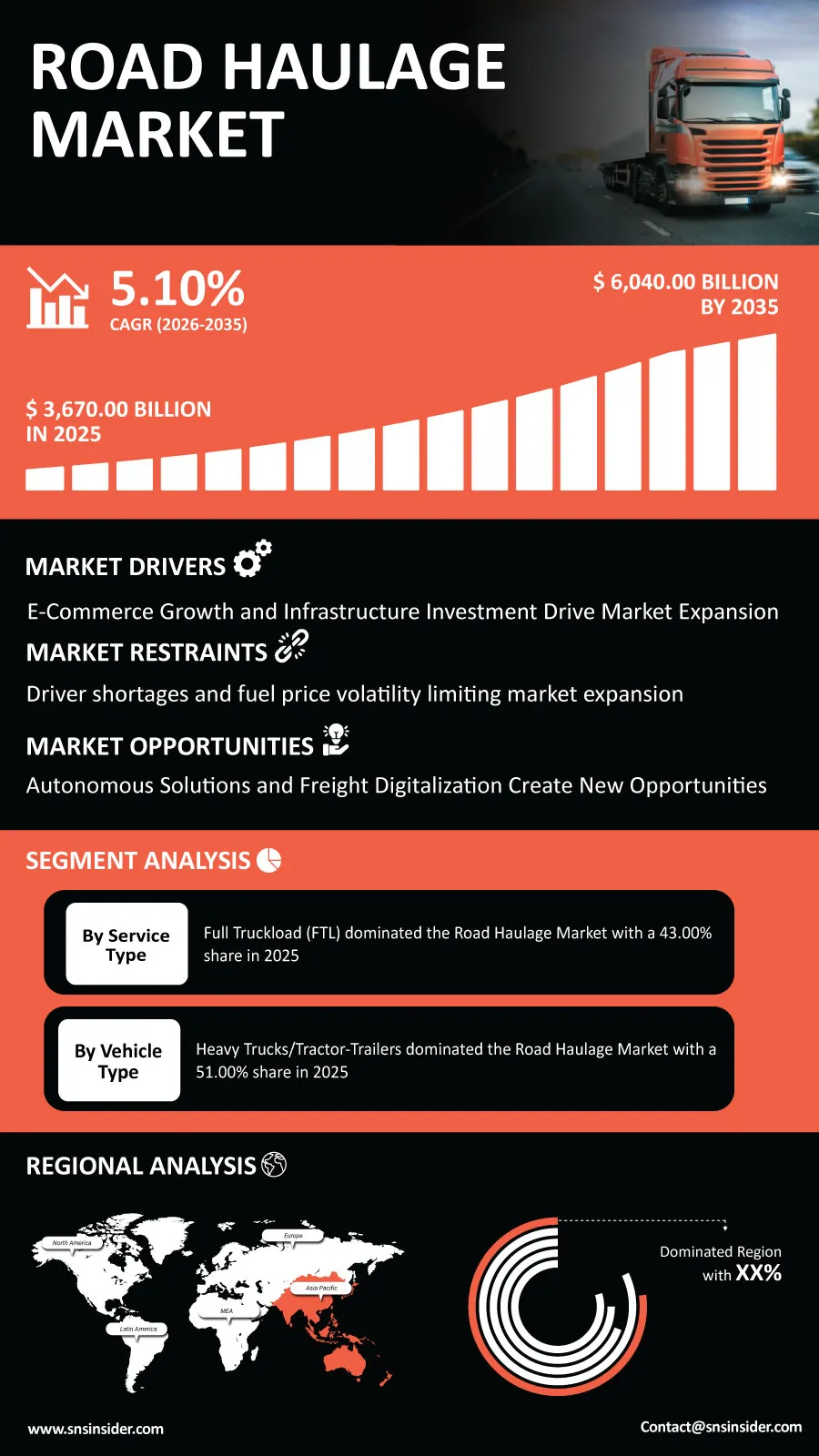
The global Road Haulage Market is set for significant expansion as e-commerce growth, infrastructure investment, and digital logistics technology reshape freight transportation worldwide. “According to a recent study by SNS Insider, the global Road Haulage Market size valued at USD 3,670.00 billion in 2025, is anticipated to grow to USD 6,040.00 billion by 2035, registering a CAGR of 5.10% over the 2026–2035 forecast period.”
There have been tremendous changes within freight transportation technology over time, due to which many logistics providers who aim at improving efficiency of their operations can take advantage of this trend. This includes the need for more digitally integrated fleet management systems that will provide carriers with the ability to move freight more reliably and cost-effectively. This applies in situations where road haulage is used for e-commerce fulfillment, manufacturing supply chains, retail distribution, and cross-border trade. Logistics providers are constantly working hard to ensure that their fleets perform better than before in order to meet various needs of shippers and end customers.
To Get Detailed Insights on the Road Haulage Market – Request a Sample Report
Digital Freight Ecosystems Create New Demand
The road haulage market has evolved from basic point-to-point trucking to more advanced, digitally integrated freight ecosystems. The growing investment in telematics, transport management systems, and digital freight matching platforms across logistics providers of all sizes has required the development of more efficient and reliable freight capacity solutions.
New digital freight platforms can increase load matching efficiency, reduce empty miles, and allow for real-time shipment visibility. This gives shippers and carriers the possibility to be more effective when planning routes and managing increasingly complex, multi-modal supply chains.
Logistics providers, technology platforms, and shippers are increasingly cooperating thanks to the growing interest in developing future solutions for efficient, digitally connected freight transportation.
Key Market Findings Highlight High-Growth Segments
The full truckload (FTL) segment dominated all categories in the road haulage market share with a market revenue share of 43.00% in 2025 due to its cost efficiency for large-volume shipments. The fastest growing category is expected to be less than truckload (LTL) services which will grow at a CAGR of 6.80% through 2035, owing to rising e-commerce fulfillment demand for smaller, consolidated shipments.
By vehicle type, heavy trucks and tractor-trailers held the largest share of total market revenue at 51.00% in 2025 due to their superior cargo capacity for long-haul freight movement. Medium trucks will see the fastest growth in revenue generation at a CAGR of 6.40%, driven by growing urban and regional distribution demand tied to e-commerce networks.
Based on ownership and provider type, third-party logistics providers generated a share of 47.00% of market revenue in 2025 thanks to their scalable, flexible freight capacity offerings. On the other hand, in-house and dedicated fleet haulage will be the segment recording the fastest revenue growth at a CAGR of 6.10%, supported by large shippers seeking greater delivery control.
Distributive cargo trends are changing as well. Dry and general goods accounted for a 68.60% revenue share in 2025 as the majority of freight volume moved via standard trailer configurations. But perishables and temperature-sensitive cargo will turn out to be the fastest-growing cargo type through 2035, on the back of rising consumer demand for fresh food and pharmaceutical product delivery.
Efficiency, Reliability, and Sustainability Gain Importance
In this regard, shippers and carriers have been looking at freight solutions that would make their operations more reliable, require less empty mileage, and be more energy efficient.
Innovation in telematics, route optimization software, and vehicle electrification has been making it possible for companies to come up with freight solutions that can operate effectively while reducing environmental impact. In addition to that, increasing emphasis on sustainability and emissions reduction is also making it possible for carriers to find solutions that meet tightening regulatory standards. Such trends are likely to become even more prominent in the future.
Asia Pacific Emerges as the Largest Market with 44.80% Regional Revenue Share Amid Rising E-Commerce Deployment
The Asia Pacific region represented the largest share of regional market revenue in 2025, owing to rapid expansion of e-commerce and online retail, a high concentration of manufacturing industries, and substantial ongoing investment in road transport infrastructure. On the other hand, Latin America is expected to be the fastest-growing market during the forecast period through 2035, propelled by industrial expansion, growing e-commerce fulfillment infrastructure investment, and rising foreign investment in regional logistics networks.
Leading Companies Drive Innovation and Competition
The environment continues to stay very dynamic since players continue innovating on digital platforms and fleet technology as well as forming partnerships in order to enhance their position in the industry. Some of the major companies that operate in the global road haulage market are DHL Group, DSV A/S, Kuehne + Nagel, DB Schenker, XPO, J.B. Hunt Transport Services, Old Dominion Freight Line, C.H. Robinson Worldwide, Ryder System, and Werner Enterprises.
An SNS Insider analyst Santosh Bhul commented, "The rapid digitalization of freight transportation is creating unprecedented demand for technology-enabled, efficient road haulage capacity. Logistics providers that successfully combine digital freight matching, fleet electrification, and operational reliability will be best positioned to capitalize on emerging opportunities across e-commerce, manufacturing, and cross-border trade applications."
About the Author

Get in touch