
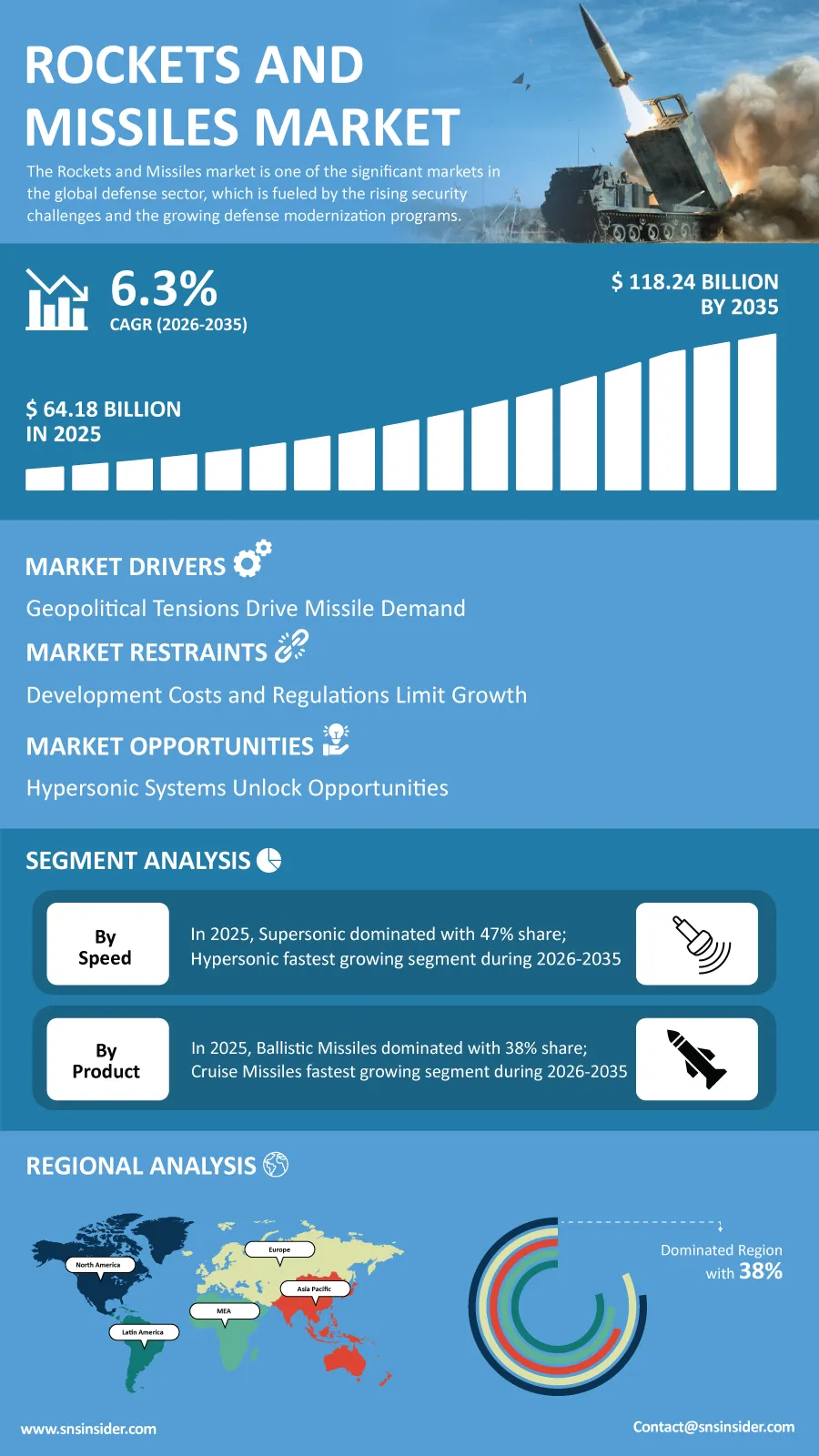
The global Rockets and Missiles Market is expected to witness sustained growth over the coming decade as governments strengthen national defense capabilities and accelerate investments in next-generation precision strike technologies. “According to a recent study by SNS Insider, the global Rockets and Missiles Market size valued at USD 64.18 billion in 2025, is anticipated to grow to USD 118.24 billion by 2035, registering a CAGR of 6.3% over the 2026–2035 forecast period.”
The combination of growing geopolitical uncertainties, changing security considerations, and efforts in military modernization is spurring the need for improvement of strategic deterrence capabilities of nations. Defense organizations are spending more money on the development of advanced missiles that will have increased accuracy, range, and survivability under combat conditions.
Meanwhile, constant developments in propulsion systems, artificial intelligence, autonomous targeting, and guidance systems are redefining modern defense strategies. With the increasing demand for technology-driven and indigenous capabilities in defense, the market is gaining momentum among traditional and emerging defense markets.
To Get Detailed Insights on the Rockets and Missiles Market – Request a Sample Report
Defense Modernization Programs Create Long-Term Growth Opportunities
There is a trend amongst the world’s armed forces in emphasizing the modernization drive towards improving the readiness of their forces through various land, air, naval, and multi-domain warfare. The need for an effective and integrated defensive system has resulted in the high demand for advanced missile technologies.
Hypersonic weapons and advanced intercepting capabilities, along with the precision strike technologies based on networking, have opened up new avenues for manufacturers in the defense industry. At the same time, efforts are being made for indigenously developing the manufacturing capabilities to enhance security and reduce reliance on foreign military hardware.
With technological developments, such as digital battlefield management, sensing, and real-time intelligence integration, missiles will continue to become more operationally efficient.
Key Market Insights Reflect Evolving Defense Priorities
Among speed categories, supersonic systems accounted for 47% of total market revenue in 2025, supported by their widespread deployment across tactical and strategic military operations. Meanwhile, hypersonic missiles are expected to register the fastest growth through 2035 as defense organizations accelerate investment in ultra-high-speed strike capabilities.
Based on product type, ballistic missiles represented 38% of market revenue in 2025 owing to their strategic importance in national defense doctrines. Cruise missiles are forecast to witness the strongest expansion during the forecast period due to their precision targeting capabilities and operational flexibility.
By propulsion type, solid propulsion systems held the largest market share at 52% in 2025 because of their reliability, rapid deployment capability, and ease of maintenance. In contrast, scramjet propulsion is projected to emerge as the fastest-growing technology segment with increasing development of hypersonic weapon platforms.
Guided missile systems accounted for 73% of overall revenue in 2025 and are expected to remain the fastest-growing guidance category as military organizations continue integrating artificial intelligence, advanced sensors, and real-time navigation technologies.
Within launch modes, surface-to-surface systems generated 33% of market revenue during 2025, while subsea-to-surface platforms are anticipated to record the highest growth as naval modernization programs expand globally.
Technological Innovation Continues to Transform Modern Missile Systems
The trend among defense contractors is towards the creation of high-precision, intelligent, and fast-deploying missiles designed to operate in hostile conditions. The advancements being made in terms of propulsion, autonomy, electronic warfare resistance, and platform compatibility are contributing to the development of the next generation of missiles.
AI is becoming increasingly important in terms of target recognition, mission planning, and dynamic control, making these missiles more effective and quicker to react to threats. At the same time, technological advancements in terms of materials and digital engineering make these missiles even better in terms of performance.
With the increased requirement for interoperability between different allied defense organizations, demand for compatible missiles will increase further.
North America Accounted for 38% Market Share in 2025; Asia Pacific Forecast to Witness the Fastest Growth Through 2035
In North America, the share of Rockets and Missiles Market was 38% in 2025 because of high military expenditure, ongoing modernization of weapons and presence of large aerospace and defense companies in the region. The growth of investments in the production of missile defense systems, hypersonic systems and other types of guided weapons will support its leadership position.
The Asia Pacific region is expected to become one of the fastest growing regional segments during the forecast period due to high geopolitical pressure, growing development of domestic defense industry and modernization efforts in China, India, Japan and South Korea.
Europe is also strengthening its position through collaborative defense programs, enhanced NATO cooperation, and growing investments in integrated air and missile defense capabilities.
Leading Defense Companies Accelerate Next-Generation Innovation
Competition within the global Rockets and Missiles Market remains highly dynamic as leading defense contractors invest heavily in research, advanced manufacturing technologies, and strategic partnerships. Industry participants continue expanding their portfolios with precision-guided systems, hypersonic platforms, missile defense technologies, and next-generation propulsion solutions to address evolving military requirements.
Key companies operating in the global Rockets and Missiles Market include Lockheed Martin Corporation, RTX Corporation, Northrop Grumman Corporation, Boeing Defense, Space & Security, BAE Systems plc, MBDA Inc., Thales Group, Saab AB, Rafael Advanced Defense Systems Ltd., Israel Aerospace Industries (IAI), General Dynamics Corporation, L3Harris Technologies Inc., Kongsberg Gruppen ASA, Bharat Dynamics Limited, Defence Research and Development Organisation (DRDO), China Aerospace Science and Technology Corporation (CASC), China Aerospace Science and Industry Corporation (CASIC), Rostec State Corporation, Tactical Missiles Corporation (KTRV), and Mitsubishi Heavy Industries Ltd.
An SNS Insider analyst Santosh Bhul commented, "Rising investments in defense modernization, rapid advances in hypersonic technologies, and increasing demand for precision-guided weapon systems are reshaping the global rockets and missiles industry. Organizations that continue innovating in propulsion, guidance, and integrated defense capabilities are expected to maintain strong competitive advantages throughout the coming decade."
About the Author

Get in touch




