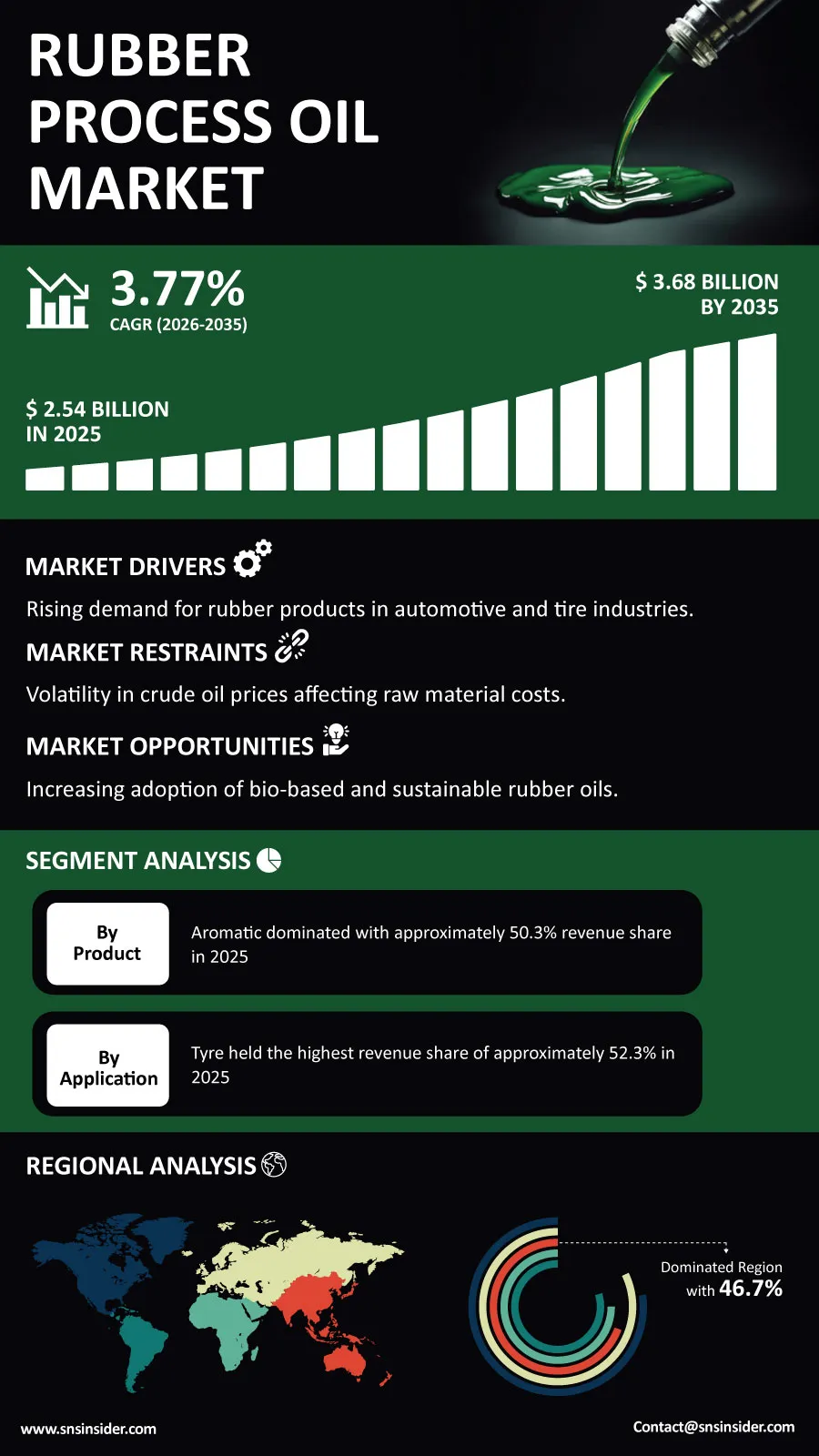
The global Rubber Process Oil Market is anticipated to grow steadily due to the increase in automobile production, requirements for replacement tyres, and production of industrial rubber. “According to a recent study by SNS Insider, the global Rubber Process Oil Market size valued at USD 2.54 Billion in 2025, is anticipated to grow to USD 3.68 Billion by 2035, registering a CAGR of 3.77% over the 2026–2035 forecast period.”
Rubber process oils continue to be essential in rubber compounding in order to assist manufacturers in increasing the flexibility of rubber materials, improving dispersion of fillers, and ensuring efficient processing. Increasing global production of tyres along with increased production of industrial rubber products for construction, infrastructure, and automotive purposes is expected to drive the future demand for market. Additionally, increasing environmental regulations favoring manufacturers in producing low PAH process oils for use in rubber compounding processes are expected to drive the market growth.
Increasing developments in specialty lubricants and sustainable feedstocks are changing the dynamics of the market. Advanced paraffinic, naphthenic, and renewable rubber process oils are being developed by the manufacturers.
To Get Detailed Insights on the Rubber Process Oil Market – Request a Sample Report
Sustainable Process Oils and Electric Vehicle Applications Create New Growth Opportunities
The shift towards environmental-friendly production in the industry is creating substantial possibilities for innovations. There is growing demand for bio-based rubber process oils made from renewable raw materials due to the efforts of tyre manufacturers and industrial rubber manufacturers to achieve reduced CO2 emissions and reduce reliance on regular petroleum-derived products.
The increasing growth rate of electric vehicles leads to the increased demand for rubber compounds, which can be used in low rolling resistance tyres, battery seals, damping devices, and insulation of high voltage cables. Such applications need top-grade process oils with excellent thermal stability and compatibility with modern elastomers formulations.
Key Market Insights Highlight Shifting Demand Patterns
In terms of products, Aromatic Rubber Process Oil will hold 50.3% share in terms of revenue globally in 2025 due to its excellent compatibility with natural and synthetic rubber compounds employed in the manufacture of large volumes of tyres. Paraffinic Rubber Process Oil is expected to be the fastest growing product type during 2025-2035 owing to rising adoption of environmentally friendly formulas.
On the basis of application, the Tyres segment will hold 52.3% revenue share in 2025 owing to increasing manufacture of automobiles and replacement tyres. The Flooring Materials application will be growing at the fastest CAGR of 5.44% during the forecast period due to growing use of rubber flooring materials in commercial buildings, hospitals, stadiums, and industries.
Advanced Formulation Technologies Accelerate Industry Transformation
Innovation in product development continues to be one of the biggest competitive strategies in the global rubber process oils market. Investment is being made by firms on the development of next generation process oils that are aimed at increasing efficiencies in the compounding process, emission reductions and improved performance characteristics of rubber products.
Innovations in areas such as renewables-based feedstocks, low-PAH aromatic oils and specialized paraffinic oils have allowed companies to conform to increasingly tougher environmental standards without compromising on physical properties necessary for automotive and industrial use.
Asia Pacific Held 46.7% of Rubber Process Oil Market Revenue in 2025, North America Driven by 71% U.S. Regional Demand
Asia Pacific is expected to have held a market share of about 46.7% due to dominance in tyres production, growing production of automobiles and industrial rubber processing in China, India, Japan, Thailand and Southeast Asia. The manufacturing capabilities and infrastructure development in the region will help to maintain dominance in the market.
North America holds an important share in the market owing to US accounting for nearly 71% of demand in the region. Increasing replacement tyre production, growth in industrial rubber production and use of green rubbers will help in the expansion of the market. Europe continues to be an important market for innovations due to growing regulatory initiatives for low-PAH and renewable rubber process oils.
Industry Participants Focus on Sustainable Innovation and Regulatory Compliance
Competitiveness in the international Rubber Process Oil market is getting heightened as the top producers diversify their specialty products range, improve their refining facilities, and adopt eco-friendly technologies. The investment by producers in renewable raw materials, efficient refining techniques, and regulatory formulations has made it possible for them to cater to the changing needs of their clients.
Key companies operating in the global Rubber Process Oil Market include Nynas AB, Ergon, Inc., H&R Group, Apar Industries Ltd., Panama Petrochem Ltd., Raj Petro Specialities Pvt. Ltd., Behran Oil Company, Sinopec Lubricant Company, ORGI Chemie FZC, Savita Oil Technologies Ltd., ExxonMobil Corporation, TotalEnergies SE, Shell plc, Chevron Phillips Chemical Company, Indian Oil Corporation Ltd., Cross Oil Refining & Marketing, Inc., HF Sinclair Corporation, Repsol S.A., Petro Rubiales, and CEPSA.
An SNS Insider analyst Himanshu Sharma commented, "The transition toward sustainable rubber manufacturing, combined with expanding tyre production and the growing adoption of electric vehicles, is reshaping demand for advanced rubber process oils. Companies investing in low-PAH technologies, renewable feedstocks, and specialty formulations will be well positioned to capitalize on long-term opportunities across the global rubber value chain."
About the Author

Get in touch