
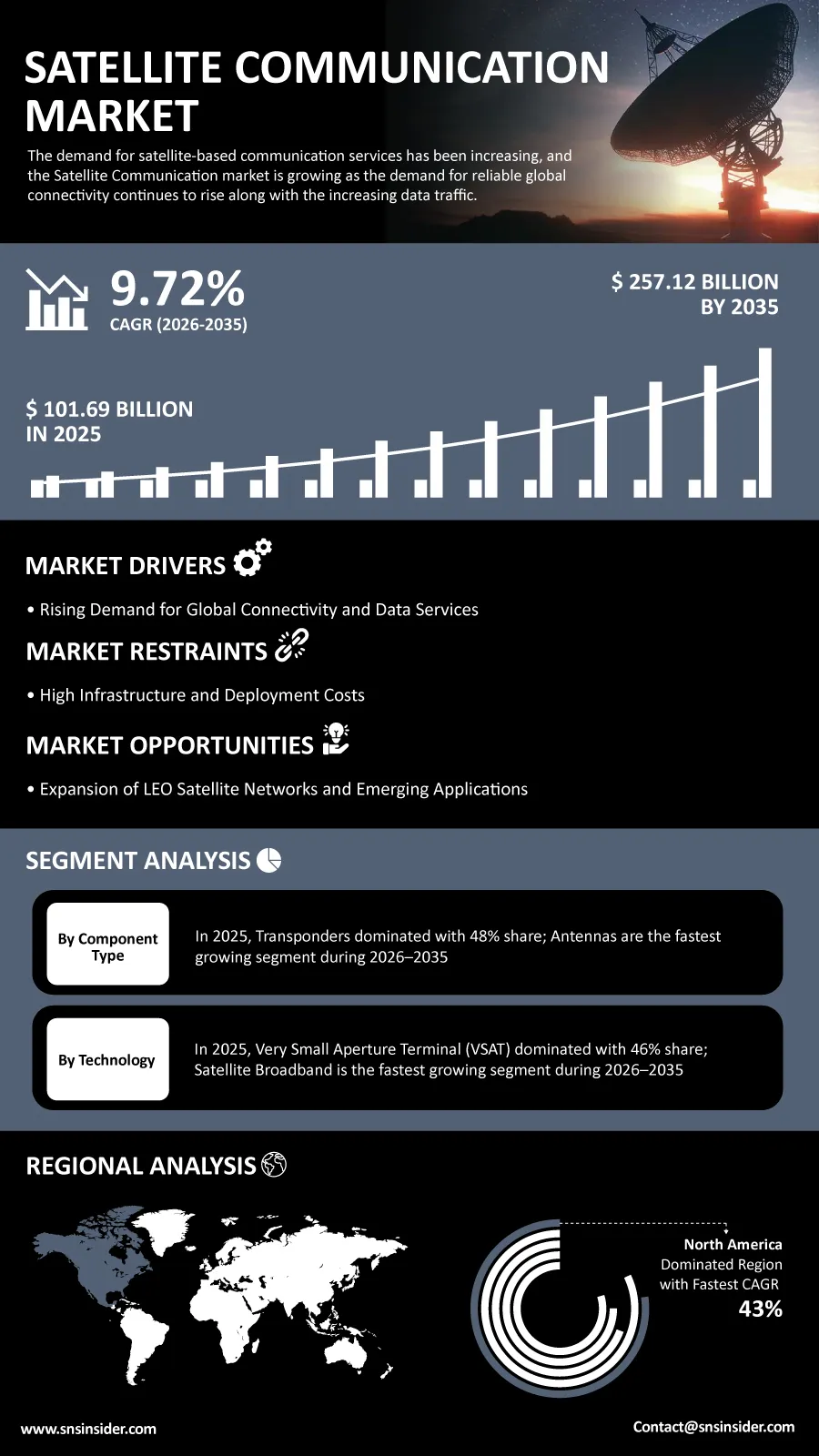
The global Satellite Communication Market is positioned for robust growth as businesses, governments, and consumers seek dependable connectivity across increasingly remote and data-intensive environments. According to a recent study by SNS Insider, the global Satellite Communication Market size valued at USD 101.69 billion in 2025, is anticipated to grow to USD 257.12 billion by 2035, registering a CAGR of 9.72% over the 2026–2035 forecast period.
The growing number of digital services is leading to an increasing need for communication networks that operate independent of conventional terrestrial networks. Satellite-based communication systems are now more important than ever in the fields of defense, aviation, marine, broadcasting, telecommunications, and business, especially in scenarios where continuous coverage and a wider geographic area of operation are key.
Advancement in technology is also affecting the industry. The advancement in the form of low earth orbit constellations and high-throughput satellites not only helped improve the network but also gave birth to some new possibilities for broadband, IoT, and mission critical communication.
To Get Detailed Insights on the Satellite Communication Market – Request a Sample Report
Next-Generation Satellite Networks Create New Growth Opportunities
However, there are new opportunities coming up due to the advancements in the satellite broadband technology. There is an increasing need for the services in the remote parts, industries that need broadband connectivity in addition to airplanes and ships. The attention being paid to LEOs has been increasing significantly due to their proximity to the earth.
In addition to this, satellite technology is being incorporated into terrestrial communication systems as well. The integration of satellite communication systems with 5G can aid in providing coverage to areas that are underserved, while at the same time offering resilience against natural calamities.
The rising demand for connectivity in aircraft and ships is opening yet another window of opportunity. The airlines are focusing on enhancing connectivity for passengers whereas satellite broadband is being utilized in the maritime sector for ship connectivity.
Key Market Insights Highlight Shifting Demand Patterns
According to the type of component, transponder will constitute 48% of the overall market revenue by 2025 due to its crucial function in reception, amplification, and transmission of communication signals. Antennas are forecasted to be the fastest-growing segment in terms of components until 2035 owing to the increasing demand for electronically steered antennas and high-end terminals.
Considering the technology, Very Small Aperture Terminals (VSAT) are expected to have 46% share of revenue by 2025 due to their installation in enterprises, remote sites, governmental communications, and industrial facilities. The highest CAGR is expected for satellite broadband due to the development of next-generation LEO systems, which will enhance high-speed internet coverage and its quality.
Based on the applications’ performance, the sector is expected to occupy the topmost revenue market share position at 41% in 2025 due to the presence of satellites used for television, radio, and media broadcasting. Data communications are expected to experience the highest growth rate since companies have been making use of satellites for broadband, cloud, and Internet of Things services.
By 2025, the segments of end-users of government and defense are expected to generate 44% of the revenue earned in total market owing to the requirements of secure communications, surveillance, intelligence and strategy. The segments of end-users of maritime and aviation are expected to register the highest growth rates owing to the increasing demands of on-board broadband and communications.
Connectivity Demand and Digital Transformation Strengthen Market Momentum
Satellite communications are now slowly emerging to be an integral part of the connectivity infrastructure. Industries that operate remotely, emergency agencies, and businesses that operate in areas that are hard to reach by terrestrial networks are now increasingly relying on satellite communication technology.
The convergence of satellite networks with IoT systems is also increasing the size of the target market for this technology. Data collected by connected devices can be transmitted from remote objects, industrial facilities, vessels, and infrastructure, thus making possible a wide range of applications.
However, expensive investments in the process of creation and implementation, regulatory concerns, spectrum management concerns, and competition with fiber and terrestrial 5G are all concerns that have to be considered by companies. The more efficient utilization of launchers that can be reused and improvements in satellite production will help in tackling cost concerns.
North America Leads with 43% Revenue Share While Asia Pacific Advances at a 10.69% CAGR
North America is anticipated to continue being the leading player in the market and will hold more than 43% of the global market revenue share by 2025. Its robust aerospace sector, defense spending, satellite service providers, and use in broadcasting, aviation, marine and enterprise communications have enabled it to be at the top of the market.
Asia-Pacific is predicted to be the fastest growing region in terms of growth rate with the space market in this region forecasted to grow at a CAGR of around 10.69% up till 2035 owing to increased investments in national space programs, improvements in digital infrastructure, increased broadband demands, and increasing adoptions in defense and transportation sectors.
Since there is continued improvement in connectivity in rural areas in Asia Pacific, it is anticipated that satellite communication will gain more importance as part of the digital inclusion agenda.
Industry Participants Focus on Capacity Expansion and Network Innovation
However, the competitive environment continues to be highly active, with players making further investments in large constellations, enhanced ground segment systems, and high bandwidth communications. All players have been emphasizing the expansion of network coverage, reduction of latency, increase in bandwidth, and development of niche products for specific customer segments.
Key companies operating in the global Satellite Communication Market include SpaceX, Hughes Network Systems, Viasat Inc., SES S.A., Intelsat S.A., Eutelsat Communications, Thales Alenia Space, Boeing Defense, Space & Security, Lockheed Martin Corporation, Northrop Grumman Corporation, Cobham SATCOM, Gilat Satellite Networks, Inmarsat, Globalstar, Inc., Telesat, Iridium Communications Inc., Orbital ATK, Kratos Defense & Security Solutions, L3Harris Technologies, and Blue Origin.
An SNS Insider analyst Sushant Kadam commented, “The satellite communication industry is entering a transformative phase as LEO constellations, broadband demand, and the convergence of space and terrestrial networks reshape global connectivity. Providers that can deliver scalable, high-capacity, low-latency services while addressing the needs of remote, mobile, and mission-critical users will be well positioned to capture emerging opportunities across the global market.”
About the Author

Get in touch




