
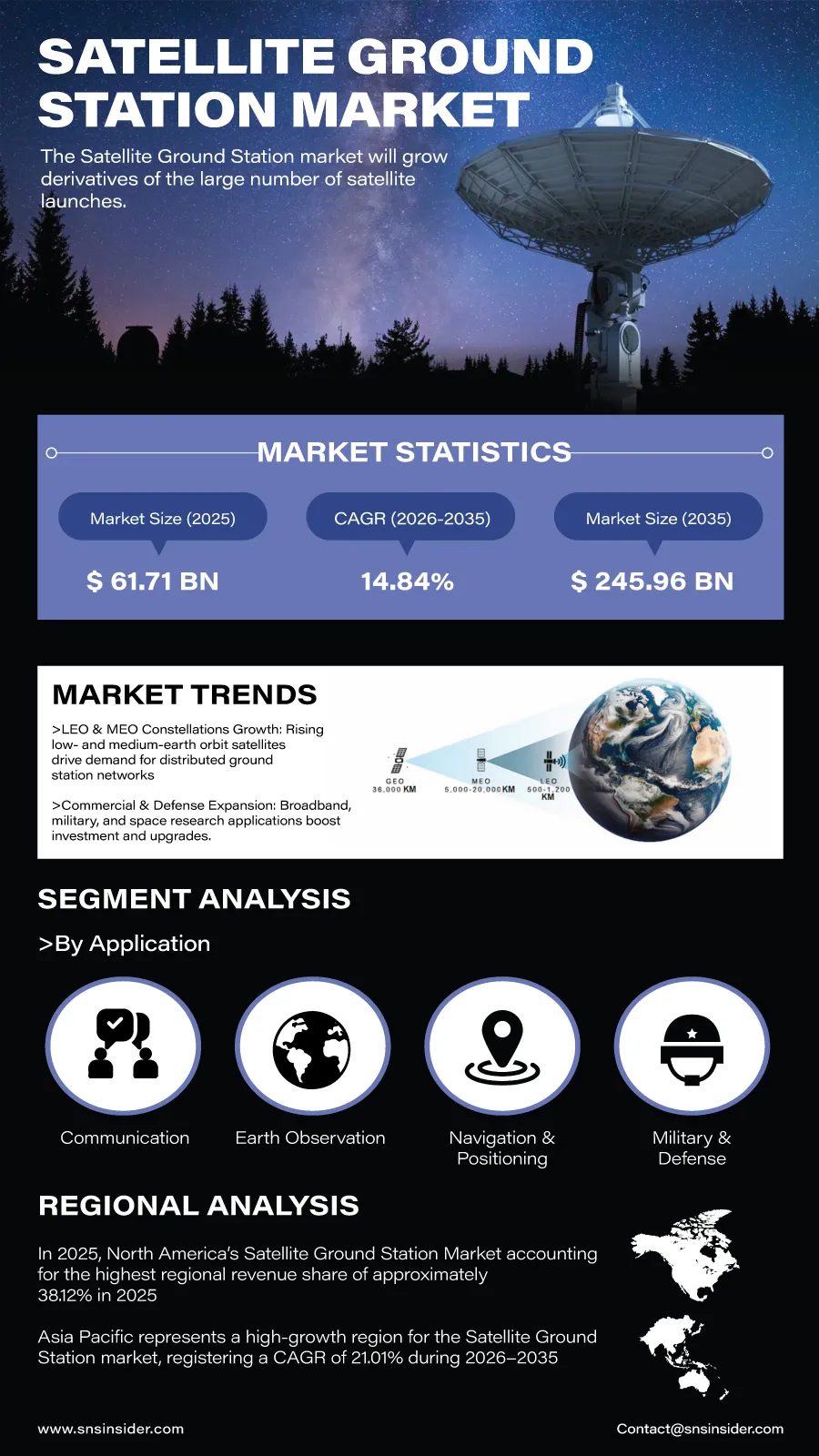
The global Satellite Ground Station Market is expected to witness robust expansion over the next decade as governments, commercial satellite operators, and defense organizations strengthen investments in space-based communication infrastructure. According to a recent study by SNS Insider, the global Satellite Ground Station Market size valued at USD 61.71 billion in 2025, is anticipated to grow to USD 245.96 billion by 2035, registering a CAGR of 14.84% over the 2026–2035 forecast period.
The increase in the utilization of satellite constellations, along with the increasing need for broadband communication, earth observation, and secure communication, is changing the demands for ground infrastructure that can support them. Businesses are upgrading their ground infrastructures to support higher satellite traffic, reduced latency, and increased mission operations.
Another development is rapid technological advancements in software-defined architecture, cloud-based services, and automation technologies, which are changing the landscape of the industry. With these new technologies, satellite operators have been able to make their systems more efficient and cost-effective.
Expanding Space Infrastructure Creates New Growth Opportunities
The growing trend of rapid global satellite launches has led to a sustained requirement for next-generation ground stations which can support various missions in space. Investments being made in LEO and MEO satellite constellations have also been contributing to the increased requirements for ground networks providing communications, telemetry, tracking, and command services.
Rise in the use of Ground Station as a Service has changed the market environment by allowing satellite owners to make use of cloud-based infrastructure without spending any heavy capital investment. Such an operating model is helping both legacy players and new entrants in the space industry.
In addition, increasing integration of artificial intelligence, edge computing, and automated antenna management is improving network utilization and enabling real-time processing of mission-critical satellite data.
Key Market Insights Highlight Shifting Demand Patterns
By solution, hardware is expected to account for 48% of global market revenue in 2025 due to continued investments in antennas, tracking equipment, receivers, and communication infrastructure. Ground Station as a Service (GSaaS) is projected to be the fastest-growing segment through 2035 as cloud-enabled satellite operations become increasingly mainstream.
Based on platform, fixed ground stations are anticipated to contribute 52% of market revenue in 2025, reflecting their widespread use across commercial, government, and defense communication networks. On-the-move ground stations are forecast to experience the strongest growth during the forecast period as military, maritime, aviation, and emergency response applications require greater mobility.
By frequency band, C-Band is expected to represent 45% of market revenue in 2025 owing to its proven reliability across multiple communication applications. Ka-Band is projected to register the fastest growth as demand increases for high-throughput satellite services, broadband connectivity, and data-intensive applications.
In terms of application, communication services are forecast to account for 40% of global market revenue in 2025. Earth observation is expected to emerge as the fastest-growing application segment as governments and commercial organizations expand investments in environmental monitoring, disaster management, agriculture, and geospatial intelligence.
Cloud-Based Operations and Automation Drive Industry Transformation
In recent times, there have been increased efforts towards digital transformation by the satellite communication companies as a strategy to improve their operational flexibility and network performance. The automated schedule process, software-defined networks, and cloud-based architectures facilitate the management of several satellite missions with minimal operational complications.
There have also been improvements on behalf of the ground station operators in providing services to new applications such as autonomous vehicles, IoT connectivity, climate monitoring, and advanced military communications. This emerging need will definitely expedite technology developments during the forecast period.
Continued growth of commercial space activities will continue to create the demand for scalable and automation capabilities in the ground stations of the satellite industry.
Regional Markets Demonstrate Strong Growth Momentum
North America held 38.12% of total market share revenue in 2025, supported by established space infrastructure, high government spending, and leading commercial satellite firms. Ongoing developments of satellite constellations and defense spending have bolstered North America’s leadership in the satellite ground stations market.
Asia Pacific region is expected to lead the market growth with a CAGR of 21.01% till 2035. The rising spending on the national space program and launch of satellites, broadband communications, and communication technology in the region have created vast opportunities.
Growing investments to develop capabilities in space and digital connectivity in the region have created demands for high-end satellite ground stations infrastructure in both developed and developing nations.
Industry Participants Focus on Advanced Network Capabilities
The competitive landscape is constantly changing because the top competitors are continuing to invest in cloud-based platforms, automation of ground stations, cybersecurity measures, and software defined communications. Collaboration between aerospace companies, defense agencies, and satellite service providers is expected to lead to innovative solutions that will meet the growing demands for satellite services globally.
Key companies operating in the global Satellite Ground Station Market include General Dynamics Mission Systems, L3Harris Technologies, RTX (Raytheon Technologies), Airbus Defence and Space, Lockheed Martin Corporation, Viasat Inc., SES S.A., Intelsat S.A., Eutelsat Communications, Inmarsat Global Limited, Gilat Satellite Networks, Kratos Defense & Security Solutions, Comtech Telecommunications Corp., Hughes Network Systems, Kongsberg Satellite Services (KSAT), Amazon Web Services (AWS) Ground Station, Microsoft Azure Orbital, Leaf Space S.p.A., Infostellar, and Atlas Space Operations.
An SNS Insider analyst Santosh Bhul commented, “Growing satellite deployments, rapid adoption of cloud-based ground station services, and increasing demand for secure, high-capacity communications are reshaping the global satellite infrastructure landscape. Organizations investing in automation, software-defined systems, and scalable network architectures will be well positioned to capitalize on long-term market opportunities.”
About the Author

Get in touch




