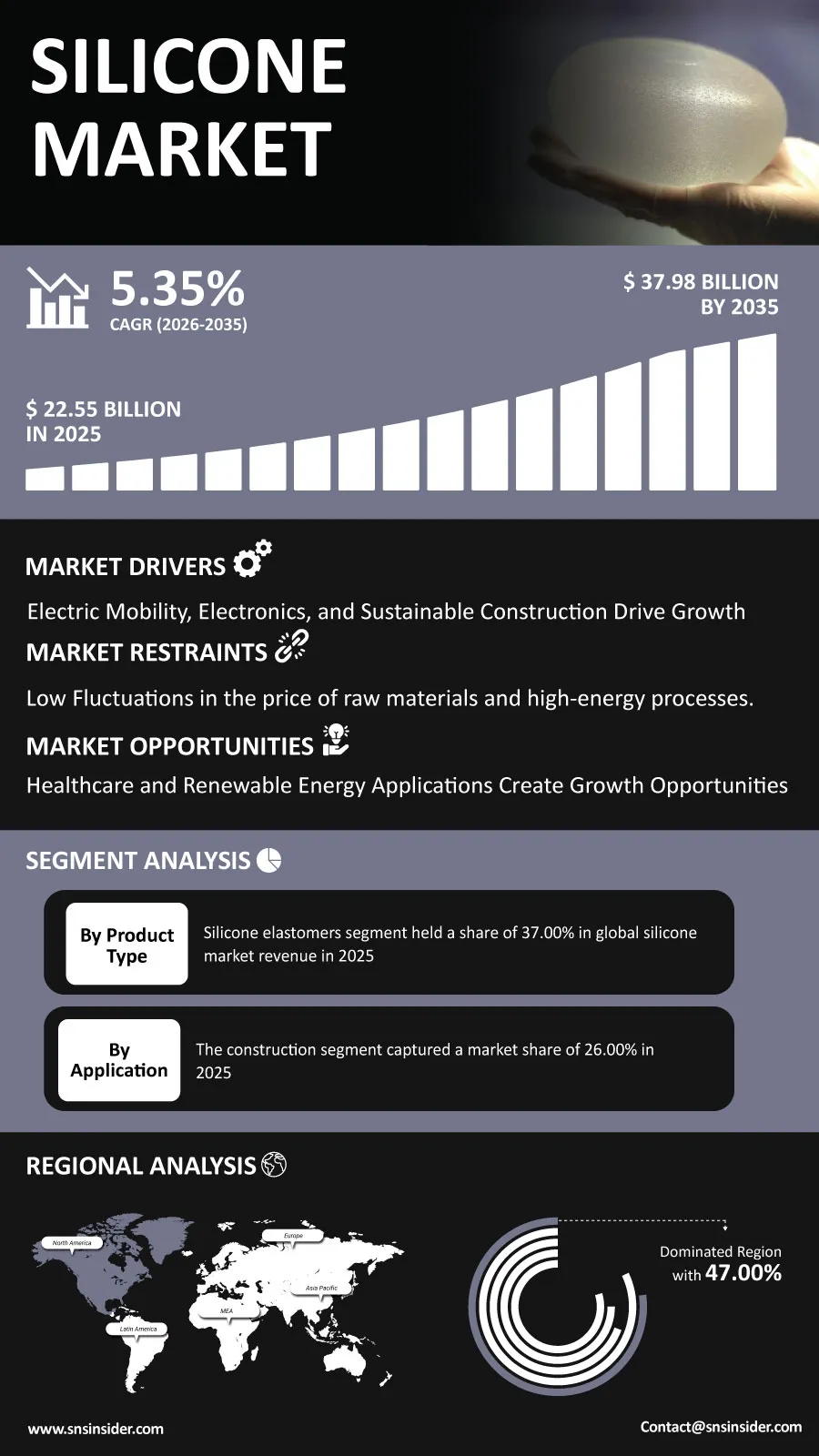
The worldwide Silicone Market is experiencing an era of growth as companies in the automotive, electronics, construction, health care, and energy sectors look for substances that will offer consistent performance in harsh conditions. “According to a recent study by SNS Insider, the global Silicone Market size valued at 22.55 Billion in 2025, is anticipated to grow to USD 37.98 Billion by 2035, registering a CAGR of 5.35% over the 2026–2035 forecast period.”
The demand for silicone products is growing due to the shift towards electric cars, advanced electronics, energy-efficient structures, and advanced medical technologies. Elastomers, fluids, gels, and resins made from silicone exhibit unique properties that make them fit for use in situations where conventional products might not perform as required.
The industry is also embracing special formulas and more environmentally friendly manufacturing processes. Manufacturers are concentrating on high-quality materials, improved production methods, and specialized products designed for semiconductors, batteries, medical equipment, renewable energy sources, and industrial applications. In April 2026, China scrapped the 13% tax rebate on basic polysiloxane to tackle the issues of low price dumping and competition.
To Get Detailed Insights on the Silicone Market – Request a Sample Report
Electrification and Specialty Applications Create Long-Term Opportunities
The fast evolution of electric cars is also paving the way for new silicone uses. The growing requirements for thermal management systems, insulation materials, seals, connectors, and batteries in the field are becoming more stringent.
Semiconductor industry and advanced electronics are also areas where silicone products are expected to see increased use. Specialized silicone gels and encapsulants are able to provide protection from environmental effects to delicate components. On the other hand, medical grade silicones can be used for various healthcare purposes, including wearable technology.
Key Market Insights Highlight Shifting Product Demand
As per product type, silicone elastomers captured 37.00% of the revenue share globally in 2025 owing to extensive usage in the automotive, construction, electronics, industrial, and healthcare industries. Silicone gels are expected to witness the fastest growth at a CAGR of 6.27% up to 2035 due to applications in electronic protection, thermal management, LED encapsulation, and medical technologies.
On the basis of processing type, high temperature vulcanized (HTV) silicone dominated with a 34.00% share in 2025. The product has durability along with thermal stability and thus finds extensive applications in industries such as industrial, automotive, electrical, aerospace, and construction. Liquid silicone rubber (LSR) is estimated to experience the fastest growth with a CAGR of 7.42% due to automation in molding, miniaturization of electronics, healthcare equipment, and electric mobility.
By application, construction contributed 26.00% to the overall market revenue in 2025 due to usage in sealants, adhesives, glazing, insulation, waterproofing, and protection systems. Healthcare is expected to witness the fastest growth with a CAGR of 7.90% due to growing demand for healthcare products.
Advanced Silicone Technologies Support Industry Transformation
Manufactures are increasingly creating silicone products designed for high-performance use cases. Advancements in liquid silicone rubber molding, silicone gels, thermal interface materials, and high-purity formulations are aiding in helping manufacturers to address the increasingly stringent demands of electronics, mobility, and health care companies.
Another field in which there are advancements made in the creation of silicone products is sustainability. Manufacturers are looking at lower emission manufacturing, resource efficient manufacturing, formulation advancements, and lifecycle management of silicone products. This may lead to the application of silicone in renewable energy and advanced manufacturing.
Regional Markets Demonstrate Strong Growth Potential
North America had the biggest regional share of the market with 47.00% in 2025. The demand for silicone from construction, automotive, aerospace, electronics, healthcare, and high-tech manufacturing industries still drives regional consumption. The United States is one of the major contributors with the Silicone Market in the region forecasted to grow from USD 9.64 billion in 2025 to about USD 16.59 billion in 2035, growing at a 5.68% CAGR.
The Asia-Pacific region is estimated to have the fastest growth among regions with a 5.99% CAGR up until 2035. There are a lot of opportunities created in China, India, Japan, South Korea, and Southeast Asia due to expanding electronics, semiconductor, EV manufacturing, industrialization, construction, and renewable energy sectors.
Industry Participants Focus on Specialty Products and Capacity Expansion
The competitive environment still revolves around innovations in products, production process efficiencies, sustainability, and application-specific silicones. Large firms are extending their reach to cater to the increasing needs of mobility, electronic, health care, building, and renewable energy clients.
Key companies operating in the global Silicone Market include Dow Inc., WACKER Chemie AG, Shin-Etsu Chemical Co., Ltd., Elkem ASA, Momentive Performance Materials Inc., Evonik Industries AG, KCC Corporation, Siltech Corporation, Specialty Silicone Products, Inc., Reiss Manufacturing, Inc., CHT Germany GmbH, BRB International B.V., Jiangsu Hongda New Material Co., Ltd., Dongyue Group Limited, Guangzhou Tinci Materials Technology Co., Ltd., Supreme Silicones India Pvt. Ltd., ACC Silicones Ltd., NuSil Technology LLC, and Hoshine Silicon Industry Co., Ltd.
An SNS Insider analyst Himanshu Sharma commented, “The convergence of electrification, advanced electronics, sustainable infrastructure, and next-generation healthcare is creating a broader demand base for high-performance silicone materials. Companies developing specialized formulations while improving manufacturing efficiency and sustainability are positioned to capture emerging opportunities across high-value applications.”
About the Author

Get in touch