
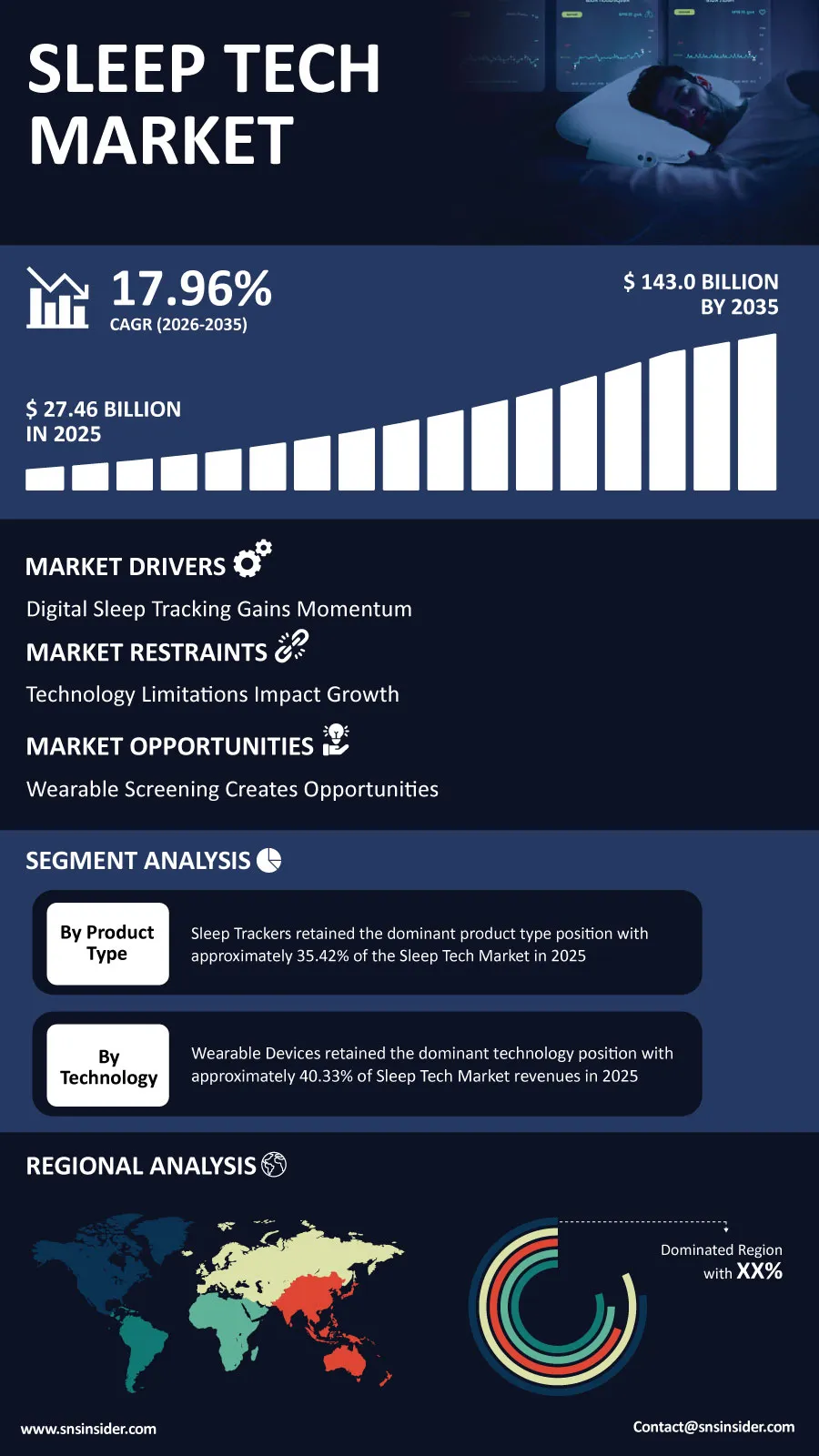
The global Sleep Tech Market is entering a new phase of expansion as consumers, healthcare providers, and employers increasingly recognize quality sleep as a cornerstone of long-term health and productivity. "According to a recent study by SNS Insider, the global Sleep Tech Market size valued at USD 27.46 billion in 2025, is anticipated to grow to USD 143.0 billion by 2035, registering a CAGR of 17.96% over the 2026–2035 forecast period."
As connected health technologies, wearable devices, smart bedding systems, and AI-assisted wellness services become more popular, people are becoming more knowledgeable and aware of their sleep practice. The rise in instances of sleep dysfunction, growing awareness of health issues, and increased digital healthcare infrastructure are paving the way for investment in advanced equipment that is able to offer personalized insight while supporting preventive healthcare strategy for home and hospital environments.
To Get Detailed Insights on the Sleep Tech Market – Request a Sample Report
AI and Digital Health Revolution Reshape Sleep Management
Due to advances in artificial intelligence, the sleep technology industry is rapidly developing. Sleep technology is moving away from basic sleep tracking to provide users with practical advice. In particular, smart ecosystems that include wearable devices, environmental management systems, mobile apps and smart home technology are helping people adjust their sleeping rituals to maximize recovery.
In addition, healthcare professionals are also benefiting from new digital sleep technologies that provide remote monitoring, digital insomnia treatments and artificial intelligence-enhanced diagnostic methods. The corporate world is adding impetus to the growth of the sleep technology industry by encouraging employees to apply these technologies.
Key Market Findings Highlight Fast-Evolving Segments
Sleep Trackers remained the leading product category, accounting for 35.42% of market revenue in 2025, supported by widespread consumer adoption of smart wearables. Meanwhile, Smart Mattresses are projected to register the fastest growth, advancing at a 19.23% CAGR through 2035 as demand rises for intelligent sleep environments.
Among technologies, Wearable Devices captured 40.33% of global revenue in 2025 due to their convenience and growing health-monitoring capabilities. AI-Enabled Solutions are expected to emerge as the fastest-growing technology segment with a 21.07% CAGR, reflecting increasing demand for predictive analytics and personalized sleep coaching.
By end user, the Residential/Household segment accounted for 48.19% of total market revenue in 2025, while Wellness & Fitness Centers are forecast to expand at the fastest pace with a 20.01% CAGR during the forecast period.
Across distribution channels, Online Retail led the market with a 38.92% revenue share in 2025, whereas Specialty Stores are anticipated to witness the highest growth, progressing at a 20.55% CAGR through 2035.
Smart Sleep Ecosystems Become the Next Growth Engine
Technology firms are increasingly integrating sleep solutions into broader digital wellness ecosystems. Customers can now construct customized sleeping environments with little manual intervention thanks to AI-powered coaching platforms, non-contact monitoring sensors, connected lighting systems, automated temperature adjustment, and voice-enabled home assistants.
Additionally, innovation in digital therapeutics and remote healthcare is speeding up, making it possible for doctors to monitor patients more efficiently and increase access to evidence-based sleep improvement programs. These improvements are projected to strengthen long-term consumer engagement and create recurring income opportunities across software, subscription services, and linked devices.
Regional Markets Continue to Gain Momentum
With the help of sophisticated healthcare infrastructure, high consumer awareness, and extensive use of digital health technology, North America continued to hold the top spot in 2025. In 2025, the United States generated USD 8.24 billion, accounting for about 85.6% of North American market revenue. The U.S. market is expected to grow at a rate of about 18% CAGR and reach about USD 42.9 billion by 2035.
Through 2035, Asia Pacific is predicted to maintain its position as the fastest-growing regional market because to increased wearable adoption, rising smartphone penetration, and rising investments in digital healthcare. In 2025, China contributed about 41.3% of regional income.
The United Kingdom accounted for 23.7% of regional revenue in Europe, the United Arab Emirates for 28.4% of the Middle East and Africa market, and Brazil for 43.2% of Latin American revenue. These figures demonstrate the increased interest of consumers in linked wellness technology.
Leading Companies Accelerate Innovation Across the Industry
Competition within the global sleep tech industry continues to intensify as companies invest in AI capabilities, biometric sensing, connected hardware, and clinically validated digital health platforms. Strategic product launches, software enhancements, and ecosystem partnerships are strengthening competitive positioning while expanding consumer adoption worldwide.
Major companies operating in the Sleep Tech Market include ResMed Inc., Philips Healthcare (Philips Respironics), Apple Inc., Samsung Electronics Co. Ltd., Garmin Ltd., Fitbit (Google), Oura Health, Eight Sleep Inc., Sleep Number Corporation, Withings SA, Dreem (ResMed), Nox Medical, SleepScore Labs, Beddr Inc., Casper Sleep Inc., Purple Innovation LLC, Tempur-Pedic, Fisher & Paykel Healthcare, Inspire Medical Systems, and SomnoMed.
An SNS Insider analyst Parry Kardani commented, "The convergence of artificial intelligence, connected health ecosystems, and growing awareness of sleep's role in overall wellness is redefining the global sleep technology industry. Companies delivering accurate monitoring, personalized recommendations, and seamless user experiences will be best positioned to capitalize on the market's strong long-term growth trajectory.
About the Author

Get in touch




