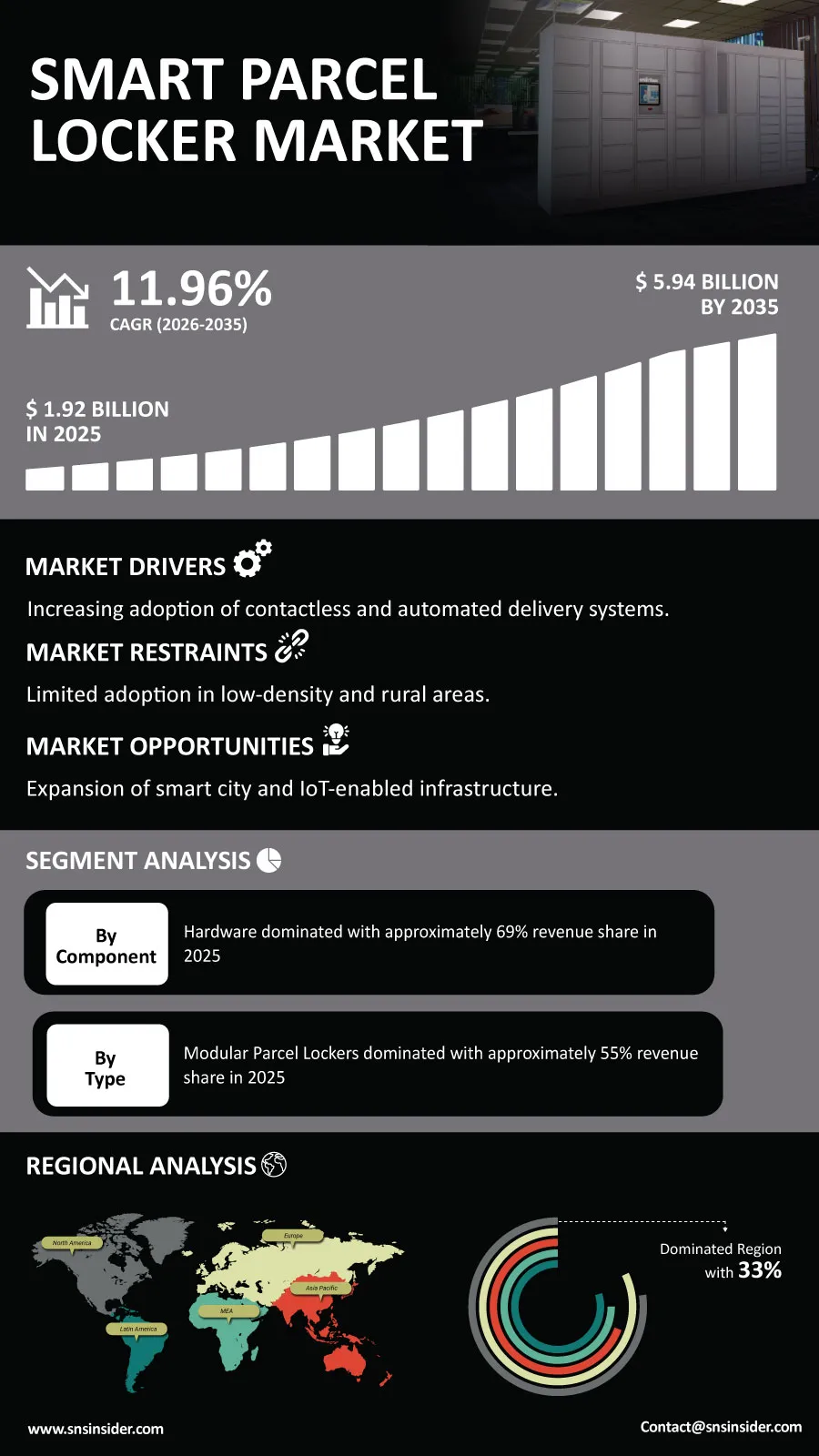
The Smart Parcel Locker Market on a global scale is experiencing an entirely new stage of growth as more companies and public bodies in retail, logistics, residential development and public infrastructure become interested in automated parcel distribution systems. “According to a recent study by SNS Insider, the global Smart Parcel Locker Market size valued at USD 1.92 billion in 2025, is anticipated to grow to USD 5.94 billion by 2035, registering a CAGR of 11.96% over the 2026–2035 forecast period.”
The increasing number of parcels resulting from online shopping has led to pressure on the existing home delivery service and has motivated companies to adopt a secure and self-service parcel collection system. The smart parcel locker has proved to be an effective tool in facilitating 24/7 parcel collection and in minimizing missed deliveries and the cost and congestion involved in multiple delivery attempts.
Furthermore, digital revolution in logistics is motivating the implementation of interconnected locker network system linked to cloud-based services, mobile apps, and real-time tracking system. This is contributing to efficient parcel handling by the delivery companies as well as offering convenience to customers in different settings.
To Get Detailed Insights on the Smart Parcel Locker Market – Request a Sample Report
Automated Delivery Networks Unlock New Growth Opportunities
Companies all around the world are increasing their spending on smart delivery systems due to the growing needs for fast and versatile deliveries from customers. Intelligent parcel lockers have become an integral part of modern distribution systems due to their ability to provide contactless delivery and increased efficiency.
Further development of mixed-use properties, apartments, university grounds, and transportation centers is creating a good environment for installation of smart lockers. Property managers start perceiving automated parcel delivery as a value-adding feature that not only improves tenants’ satisfaction but also reduces administrative costs.
Modern technology is making the market opportunities even greater thanks to advanced authentication mechanisms, device management, predictive maintenance, and analytical features which allow operators to keep their locker networks utilized at full capacity.
Key Market Insights Highlight Shifting Demand Patterns
On the basis of component, hardware contributed around 69% of the market revenue in 2025, driven by the installation of physical locker infrastructure in the world. The software segment will witness the highest growth rate up to 2035 due to the expansion of cloud management platform, mobile apps, and analytics.
According to deployment type, the indoor segment comprised almost 59% of the total revenue in 2025 due to deployment in retail stores, residential complexes, and commercial places. The outdoor locker systems are predicted to grow the most due to the rising demand in transit terminals, public places, and suburban deliveries.
On the basis of application, retail click and collect (BOPIS) accounted for about 28% of the market revenue in 2025. The residential segment will grow at the highest rate up to 2035 due to the increasing integration of automated parcel management systems in urban residential developments.
Intelligent Locker Technologies Transform Modern Logistics
Innovations will be the driving force behind future developments in smart parcel locker systems. The new innovations include the use of cloud-based platforms which will enable centralized management of the system, utilization and monitoring, as well as upgrades through remote diagnostics.
There will also be better security systems in place such as biometrics, intelligent access control, and monitoring systems to ensure that high-value items are delivered safely and securely.
Temperature controlled lockers are also emerging in the market and are widening the addressable market since it would allow delivery of goods such as groceries and pharmaceuticals safely and securely.
The development of artificial intelligence, Internet of Things connectivity, and predictive analytics within logistics is expected to make smart parcel lockers increasingly popular as they provide last-mile delivery solutions that rely on data.
North America Held 33% of the Smart Parcel Locker Market Share in 2025; Asia Pacific Projected to Register the Fastest CAGR Through 2035
North America had a share of around 33% of the world market revenues in 2025, aided by the presence of extensive e-commerce, advanced logistics infrastructure, expansion of omnichannel retailing, and increased use of automated delivery solutions in the United States and Canada.
Asia Pacific will be the fastest growing market due to rapid urbanization trends, increased instances of online shopping, and investments in the digital infrastructure of logistics. Residential growth and development of smart cities is also expected to aid in adoption across the region.
Europe continues to be a key market owing to well-established parcel delivery services. Emerging markets of Latin America and Middle East are now increasingly making investments in intelligent logistics infrastructure for improved delivery services.
Industry Participants Focus on Expanding Intelligent Delivery Infrastructure
Competitive Landscape of the Smart Parcel Lockers Industry is heating up as innovative and software-centric lockers gain prominence amongst key players in the business. These companies are focusing on developing innovative and intelligent locker systems along with their scalability and cloud-based management systems that offer improved security for their customers.
Key companies operating in the global Smart Parcel Locker Market include Quadient S.A., InPost S.A., ASSA ABLOY AB, Cleveron AS, KEBA AG, Bell and Howell, LLC, Pitney Bowes Inc., Ricoh Group, Gibraltar Industries, Inc., Hollman Inc., Luxer One, Smartbox USA Inc., Gantner Electronic GmbH, Meridian Kiosks, eLocker Ltd., TZ Limited, Patterson Pope, DeBourgh Manufacturing, RENOME-ELECTRIC, and Package Concierge.
An SNS Insider analyst Sakshi Kale commented, "The evolution of digital commerce is creating sustained demand for automated parcel management solutions that improve delivery flexibility and operational efficiency. Organizations investing in connected locker technologies, intelligent software platforms, and scalable logistics infrastructure are expected to strengthen their competitive advantage as global parcel volumes continue to increase."
About the Author

Get in touch