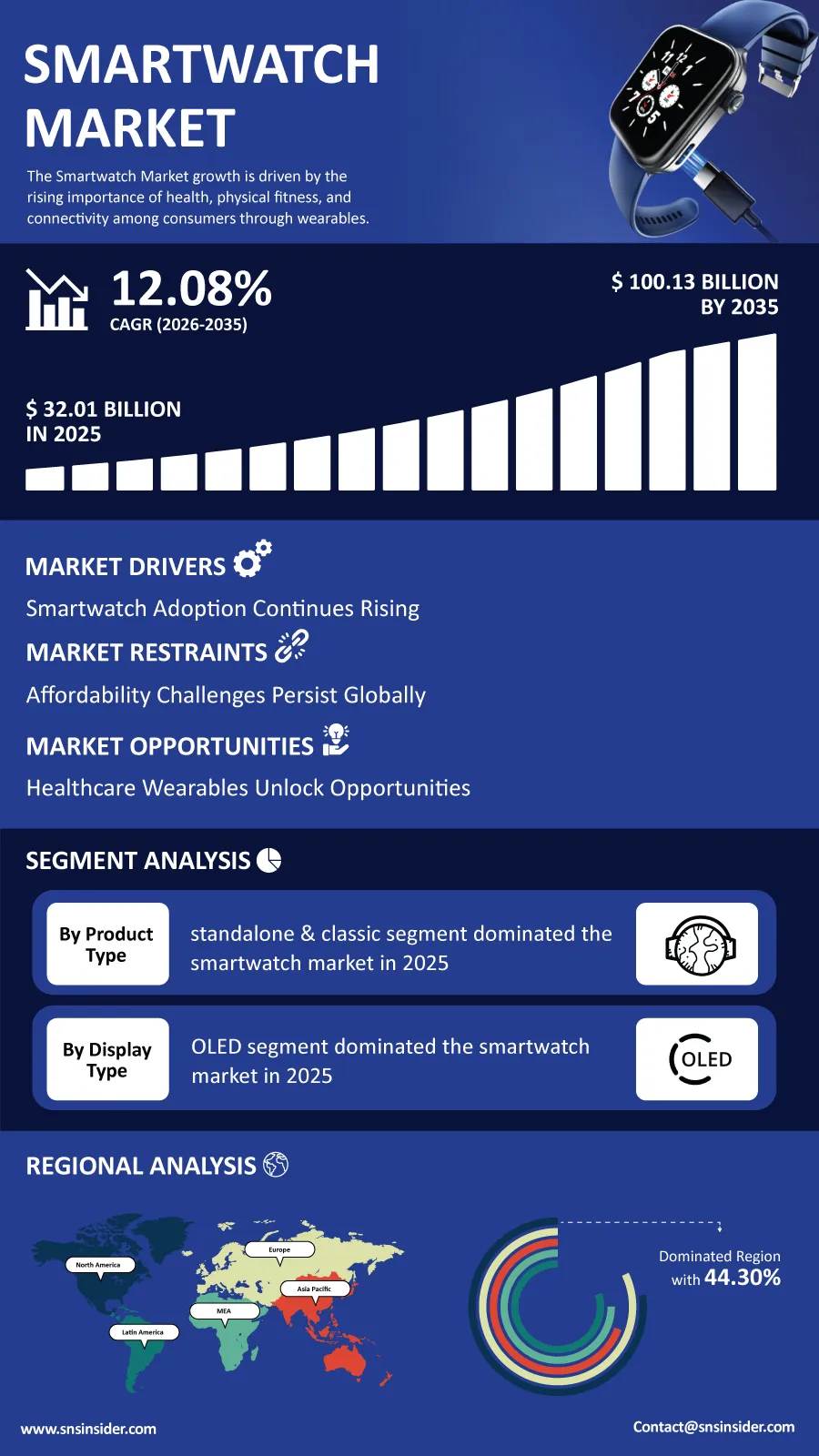
The global Smartwatch Market is expected to witness robust expansion over the coming decade as consumers increasingly embrace connected wearables for health management, fitness tracking, and everyday digital convenience. According to a recent study by SNS Insider, the global Smartwatch Market size valued at USD 32.01 billion in 2025, is anticipated to grow to USD 100.13 billion by 2035, registering a CAGR of 12.08% over the 2026–2035 forecast period.
Awareness of preventive healthcare measures, increased smartphone usage, and digitalization drive customers towards adopting wearable technologies into their everyday life. Modern-day smartwatches are much more than simple gadgets for notifications, and they represent multi-functional health assistants that use sensors, GPS, contactless payments, and AI algorithms to analyze the users’ condition.
The development of battery performance, screens, communication channels, and software ecosystems allows for constant improvements of the existing products which drive the demand from different customer categories – premium as well as mid-tier.
To Get Detailed Insights on the Smartwatch Market – Request a Sample Report
Digital Health Ecosystems Continue to Unlock New Growth Opportunities
The growing convergence of healthcare and consumer electronics is giving rise to numerous opportunities for manufacturers of smartwatches. Healthcare institutions, insurance companies, and digital wellbeing platforms are identifying wearable gadgets as a means of providing health monitoring and wellness initiatives.
Artificial intelligence, cloud computing, and remote patient monitoring technologies are turning the smartwatches into intelligent health management systems that can provide valuable wellbeing insights to users. Increased compatibility with smart home gadgets and mobile applications is adding more value to these gadgets.
At the same time, expanding internet accessibility, rising disposable incomes, and broader adoption of digital lifestyles are supporting sustained market demand across emerging economies.
Key Market Insights Highlight Shifting Demand Patterns
On the basis of product type, standalone and classic smartwatches are projected to account for approximately 61.40% of global market revenue in 2025, supported by consumer demand for independent connectivity, advanced health monitoring, and communication capabilities. The extension smartwatch segment is expected to witness the fastest growth through 2035 as budget-conscious consumers increasingly adopt companion wearable devices.
By operating system, Android-powered smartwatches are anticipated to generate nearly 47.80% of market revenue in 2025 due to broad device compatibility and extensive product availability. The iOS segment is forecast to register the fastest growth as premium wearable adoption continues to expand within Apple's ecosystem.
Based on display technology, OLED displays are expected to represent approximately 68.30% of market revenue in 2025 while also remaining the fastest-growing display category, driven by superior image quality, energy efficiency, and continued technological advancements.
On the basis of application, notification management is projected to account for around 33.50% of market revenue in 2025 owing to increasing consumer reliance on instant communication. Running and fitness-focused applications are anticipated to experience the fastest growth as wearable devices become central to active lifestyle management.
Based on end user, male consumers are expected to contribute approximately 56.20% of market revenue in 2025. However, the female consumer segment is projected to expand at the fastest pace, supported by increasing adoption of personalized wellness, sleep tracking, stress monitoring, and women's health features.
Health Monitoring and AI Features Drive Consumer Adoption
The smartwatch industry keeps gaining from advancements in health care technology and software intelligence. The manufacturers are adding biometric sensors, AI analytics, ECG tests, blood oxygen test, sleep tracking, and personalized fitness programs in order to provide better health experience.
Higher requirements for connectivity, payment services, voice assistants, GPS location, and compatibility are making smartwatches more and more crucial for people's lives. As people prefer convenient preventive health care, wearable technology is going to stay an important part of consumer electronics.
Regional Markets Demonstrate Strong Growth Potential
The North American region is anticipated to generate above 44.30% of the total worldwide smartwatch market revenue in 2025 due to the high spending power of consumers, extensive usage of wearable devices, sophisticated digital infrastructure, and availability of leading technology players.
The Asia-Pacific region is anticipated to gain maximum traction in terms of growth, recording a CAGR of around 12.95% till 2035. This growth is driven by the growing smartphone penetration, rising middle classes, higher disposable income, and increased awareness about digital health technologies.
Increasing investment in building a connected ecosystem and rise in consumer inclination towards health-centric wearables would drive market growth in emerging economies.
Industry Participants Focus on Innovation and Ecosystem Expansion
Competition within the global smartwatch market remains intense as manufacturers continue introducing new hardware innovations, AI-enabled health features, premium display technologies, and enhanced software experiences. Companies are emphasizing ecosystem integration, personalized health intelligence, extended battery performance, and fitness-oriented capabilities to strengthen consumer engagement and brand loyalty.
Key companies operating in the global Smartwatch Market include Apple, Huawei, Samsung, Xiaomi, Garmin, Fitbit, Amazfit, Fossil Group, Mobvoi, Suunto, Polar, Coros, Withings, and Honor.
An SNS Insider analyst Sushant Kadam commented, “The smartwatch market is evolving rapidly as wearable technology becomes increasingly central to digital health, connected lifestyles, and preventive wellness. Companies that continue advancing AI-powered health analytics, seamless ecosystem integration, and personalized user experiences are expected to capitalize on significant long-term growth opportunities.”
About the Author

Get in touch