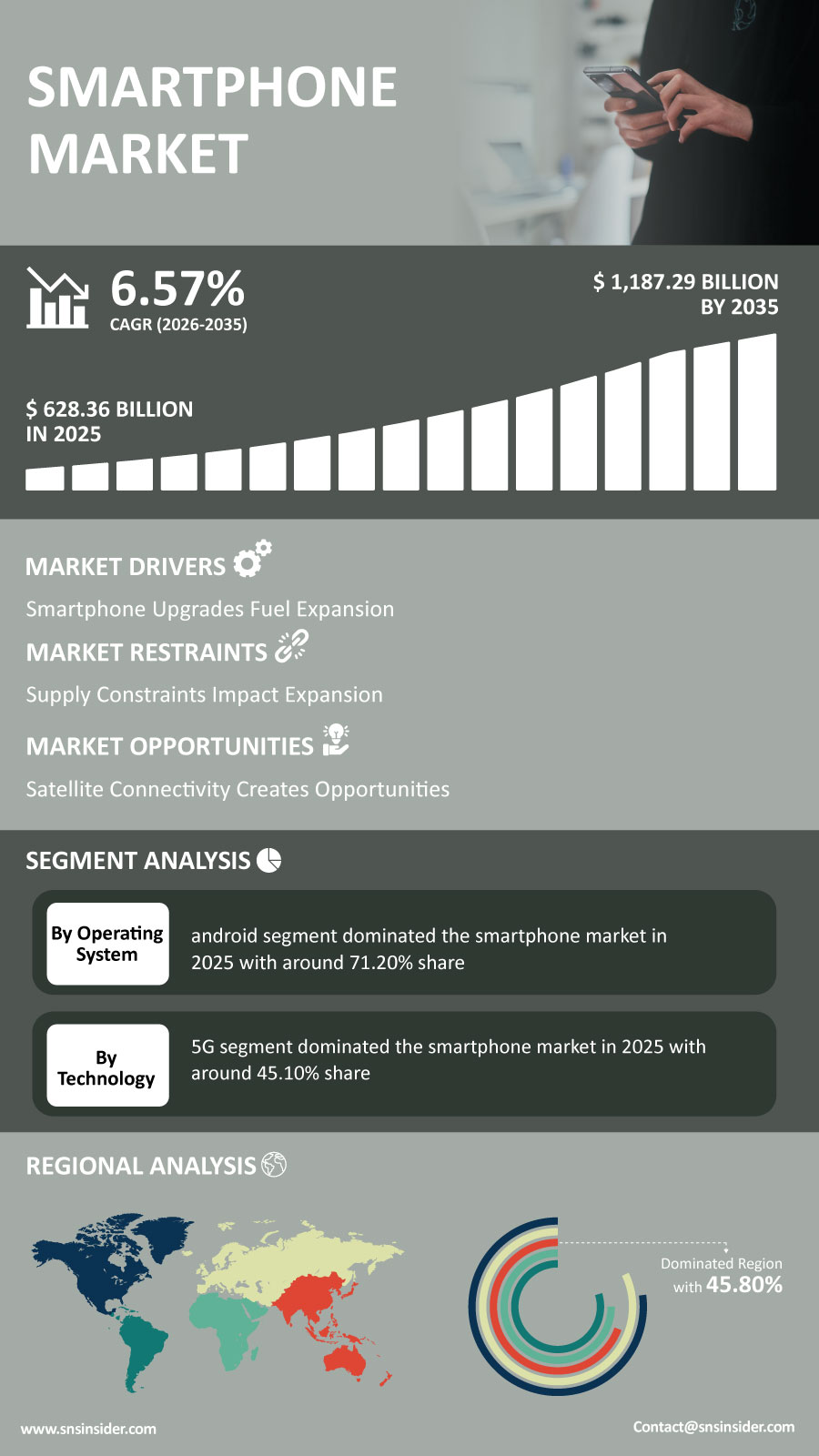
The global Smartphone Market is expected to maintain strong long-term growth as consumers increasingly rely on connected mobile technologies for communication, digital payments, entertainment, productivity, and artificial intelligence-powered experiences. According to a recent study by SNS Insider, the global Smartphone Market size valued at USD 628.36 billion in 2025, is anticipated to grow to USD 1,187.29 billion by 2035, registering a CAGR of 6.57% over the 2026–2035 forecast period.
The ongoing development of 5G technology coupled with rapid technological developments in mobile processing power, AI, and premium smartphones is prompting customers to upgrade their handsets. There are a number of features that smartphone makers are offering to enhance productivity, camera quality, battery life, and connectivity between different digital platforms.
The growing uptake of smartphones in developing nations is also helping fuel steady growth in the market. Better access to the internet, development of digital payments platforms, and efforts made by governments for digitalization are helping raise the level of smartphone penetration.
To Get Detailed Insights on the Smartphone Market – Request a Sample Report
AI Innovation and 5G Connectivity Continue to Unlock Growth Opportunities
AI has now become one of the most important factors impacting the evolution of smartphones. The manufacturers have been equipping their phones with cutting-edge AI technology that improves photography, languages translations, voice assistants, personalization, and the overall user experience without affecting data privacy.
On the other hand, the increased availability of 5G technology has created more prospects in the form of cloud gaming, video streaming, mobile enterprise solutions, AR applications, and IoT ecosystem. These trends are driving users to use advanced smartphones for demanding digital services.
Manufacturers are also investing heavily in foldable displays, energy-efficient chipsets, and satellite connectivity technologies to differentiate premium devices in a highly competitive global marketplace.
Key Market Insights Highlight Shifting Demand Patterns
By form factor, traditional bar and candy bar smartphones accounted for approximately 90.10% of global market revenue in 2025 due to their broad consumer acceptance across every price category. Foldable and flip smartphones are projected to register the fastest growth through 2035 at a CAGR of approximately 8.40%, driven by increasing demand for premium multitasking experiences and innovative device designs.
Based on operating system, Android held around 71.20% of market revenue in 2025 owing to its extensive global adoption and broad OEM ecosystem. iOS is forecast to witness the fastest growth at a CAGR of approximately 7.16% as premium smartphone demand and ecosystem loyalty continue to strengthen.
By distribution channel, e-commerce segment held approximately 38.20% of market revenue in 2025 while also emerging as the fastest-growing sales channel through 2035. Consumers increasingly prefer online purchasing because of competitive pricing, convenient financing options, exclusive product launches, and direct-to-consumer sales platforms.
In terms of technology, 5G smartphones accounted for 45.10% of market revenue in 2025 and remain the fastest-growing segment with a CAGR of approximately 7.09%, supported by continued global network expansion and rising demand for high-speed mobile connectivity.
Connected Digital Ecosystems Reshape Consumer Expectations
Today’s smartphones are transforming into focal points for a connected lifestyle as a result of their seamless integration with wearable devices, smart home systems, smart cars, and business solutions. Increasingly, users are expecting integrated digital experiences that can facilitate secure transactions, cloud-based collaboration, health tracking, and automated services from one device only.
Moreover, rising demand for artificial intelligence-based personal assistants, computational photography, and security features is reinforcing the propositions of today’s smartphones. It is anticipated that such developments will not only support replacement sales but also drive premium smartphones’ adoption in various geographies.
Asia Pacific Leads with 45.80% Market Share in 2025, While U.S. Accounts for 92.5% of North American Revenue
Asia Pacific is forecasted to maintain the status of the largest as well as fastest-growing region in terms of smartphone market during the forecast period. This is driven by robust manufacturing, higher internet penetration, disposable income growth, and higher use of digital banking solutions in China, India, Japan, and South Korea.
The North American region continues to be an important revenue generator due to strong consumer spending on high-end phones, 5G deployment, and increased use of smartphones for business mobility and cloud computing.
As digital economies continue expanding worldwide, smartphone adoption is expected to accelerate across both mature and developing markets.
Industry Participants Focus on AI, Design Innovation, and Premium Experiences
Competition across the smartphone industry remains intense as manufacturers invest in artificial intelligence, foldable technologies, camera innovation, battery efficiency, and next-generation semiconductor platforms. Companies are also strengthening ecosystem integration to deliver seamless experiences across smartphones, wearables, smart home devices, and connected services.
Top Smartphone Players operating in the global Market include Apple Inc., Samsung Electronics Co., Ltd., Xiaomi Corporation, OPPO, Vivo Communication Technology Co., Ltd., Huawei Technologies Co., Ltd., OnePlus Technology Co., Ltd., Google LLC, Sony Corporation, Motorola Mobility LLC, Honor Device Co., Ltd., Realme, Transsion Holdings, Nokia, LG Electronics Inc., ZTE Corporation, ASUSTeK Computer Inc., Micromax Informatics Ltd., TCL Technology, and Lava International Ltd.
An SNS Insider analyst Sushant Kadam commented, “Artificial intelligence, expanding 5G connectivity, and increasingly connected digital ecosystems are transforming smartphones into intelligent personal computing platforms. Companies that continue investing in AI-native experiences, premium hardware innovation, and seamless ecosystem integration will be well positioned to capitalize on the next phase of market growth.”
About the Author

Get in touch