
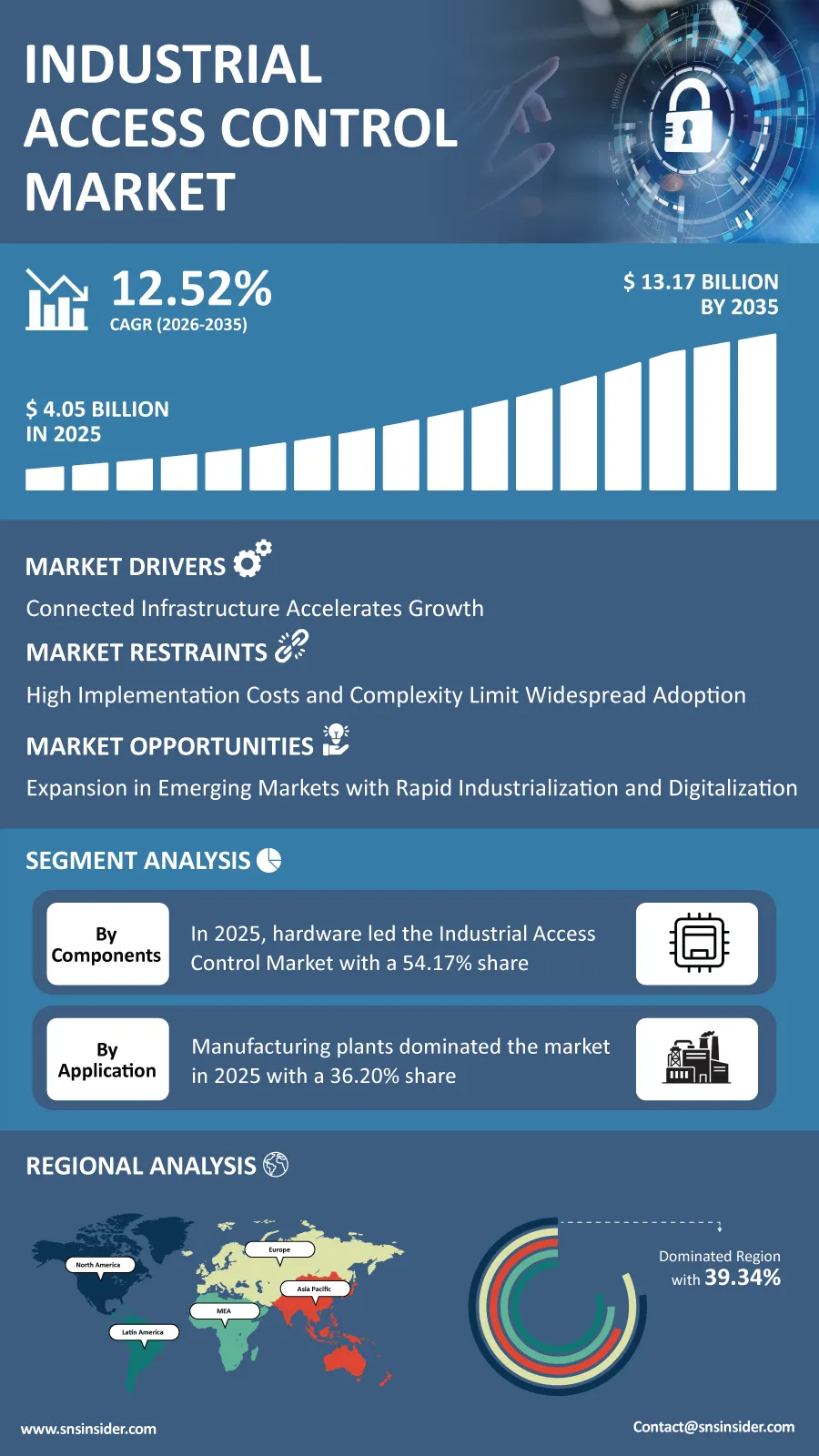
The global Industrial Access Control Market is expected to witness substantial expansion over the coming decade as manufacturers, utilities, and critical infrastructure operators strengthen physical and digital security across industrial facilities. According to a recent study by SNS Insider, the global Industrial Access Control Market size valued at USD 4.05 billion in 2025, is anticipated to grow to USD 13.17 billion by 2035, registering a CAGR of 12.52% over the 2026–2035 forecast period.
With the increase in industrial automation, smart factory installations, and digitalization of working environments, there is an increasing need for advanced access control systems. Companies are becoming more focused on securing their productive assets and workforce, as well as being compliant with safety laws.
As industrial facilities become increasingly connected through IoT devices, cloud platforms, and enterprise management systems, demand continues to rise for integrated access control technologies capable of delivering centralized monitoring, real-time authentication, and enhanced operational visibility.
To Get Detailed Insights on the Industrial Access Control Market – Request a Sample Report
Industrial Digitalization Creates Strong Growth Opportunities
Intelligent security solutions combining physical access control with digital ID management are becoming more popular among manufacturers and infrastructural facilities owners, who invest more in such platforms. Due to increased popularity of cloud-based solutions, many companies can now manage their operations on several industrial sites from central control centers, simplifying maintenance and ensuring scalability.
Furthermore, industrial enterprises have started using access control tools together with ERP, MES, and IoT-based platforms to monitor workplaces in order to improve workforce management and optimize security processes.
The increasing popularity of international standards of workplace safety pushes organizations to upgrade their security infrastructure by implementing certified access control systems, which are suitable for high-risk industrial sites.
Key Market Insights Highlight Shifting Demand Patterns
By component, hardware segment held 54.17% of global market revenue in 2025, reflecting continued demand for biometric readers, controllers, smart locks, and credential management devices across industrial facilities. Services are projected to register the fastest growth through 2035 as enterprises increasingly adopt managed security services, cloud integration, and lifecycle support solutions.
Based on application, manufacturing plants segment held around 36.20% of market revenue in 2025 due to growing investments in production security and workforce safety. Data centers are forecast to experience the fastest growth, driven by rising cybersecurity concerns, cloud infrastructure expansion, and stricter protection requirements for mission-critical facilities.
Based on type, physical access control represented with 45.32% of market revenue in 2025 as organizations continue securing entry points, restricted production zones, and critical assets. Electronic access control is projected to emerge as the fastest-growing segment owing to increasing deployment of IoT-enabled, cloud-managed, and software-driven security platforms.
On the basis of end user, the industrial sector held 42.65% of market revenue in 2025, supported by extensive deployment across manufacturing, utilities, and oil & gas operations. The commercial segment is expected to register the strongest growth through 2035 as businesses strengthen enterprise security infrastructure and adopt intelligent building management systems.
Connected Security Platforms Continue Transforming Industrial Operations
The current security trends in industrial sectors have shifted from the traditional concept of perimeter security towards creating a fully integrated ecosystem in which biometric identification, mobile credentials, artificial intelligence security cameras, and security management systems can be used.
Cloud-based access control systems are also contributing to remote management, preventive maintenance, and real-time analytics. This helps businesses mitigate risks and improve their incident response capabilities within the widely dispersed sites.
The growing convergence of cybersecurity and physical security is expected to remain a major factor influencing purchasing decisions throughout the forecast period.
Regional Markets Demonstrate Robust Investment Activity
North America is forecasted to hold 39.34% share of worldwide revenue in 2025, owing to high industrial infrastructure, safety policies within workplaces, and implementation of advanced security technology within industries including manufacturing, utility, defense, and oil & gas industry.
The Asia Pacific region will be the fastest growing market with a CAGR of 13.11% until 2035. The quick industrialization, smart manufacturing programs, increased investments in infrastructure, and government initiatives towards modernizing industries are driving the adoption of advanced access control solutions in this region.
Growing investments in Industry 4.0 technologies and digital transformation initiatives are expected to further strengthen regional demand over the next decade.
Industry Participants Focus on Intelligent Security Innovation
The competitive landscape remains dynamic as leading companies continue investing in AI-enabled security platforms, biometric authentication technologies, cloud-based access management, and integrated building automation solutions. Strategic acquisitions, product launches, and software innovations are helping manufacturers expand their industrial security portfolios while addressing evolving customer requirements.
Key companies operating in the global Industrial Access Control Market include Honeywell International Inc., Johnson Controls International plc, ASSA ABLOY AB, Bosch Security Systems, Siemens AG, Schneider Electric SE, dormakaba Holding AG, HID Global Corporation, NEC Corporation, Allegion plc, Tyco International, Stanley Black & Decker, Gunnebo Group, Axis Communications AB, Vanderbilt Industries, Identiv, Inc., Salto Systems, Kaba Group, LenelS2, and Gallagher Group.
An SNS Insider analyst Sushant Kadam commented, “Industrial security is becoming increasingly intelligent as organizations combine physical access management with cloud connectivity, automation, and real-time analytics. Companies delivering scalable, interoperable, and standards-compliant access control solutions will be well positioned to benefit from the accelerating digital transformation of industrial infrastructure.”
About the Author

Get in touch




