
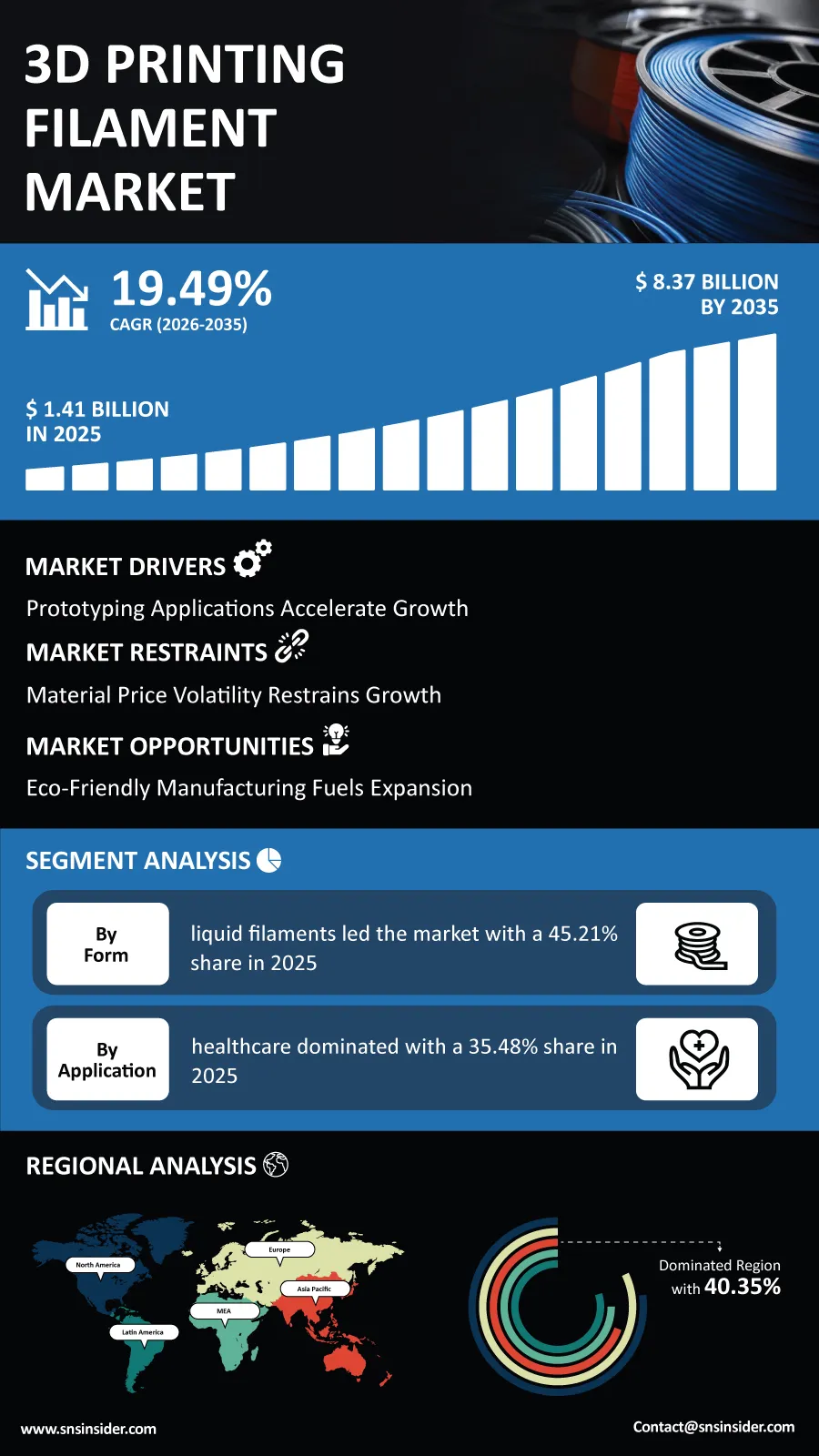
The global 3D Printing Filament Market is experiencing significant momentum as manufacturers across industries increasingly adopt additive manufacturing to improve production flexibility, reduce material waste, and accelerate product development. According to a recent study by SNS Insider, the global 3D Printing Filament Market size valued at USD 1.41 billion in 2025, is anticipated to grow to USD 8.37 billion by 2035, registering a CAGR of 19.49% over the 2026–2035 forecast period.
As there is an increasing inclination towards customized manufacturing and rapid prototyping, there is a greater need felt by companies to make further investment in high-end materials that can help in meeting the requirements of industrial-grade production. As there is a greater requirement for fast and efficient manufacturing processes, the demand for quality printing material keeps on increasing.
Innovation of materials is also transforming the dynamics of the market. Companies are developing polymers, composites, and green filament which offer enhanced mechanical properties while addressing more complex manufacturing needs.
To Get Detailed Insights on the 3D Printing Filament Market – Request a Sample Report
Additive Manufacturing Expansion Unlocks New Growth Opportunities
The ongoing digitization of manufacturing has been creating an environment that favors filament providers globally. Businesses have incorporated 3D printing within their operations in order to increase design freedom, reduce tooling expenses, and allow for on-demand manufacturing for specific uses.
The increasing uptake of automation, smart factories, and industry 4.0 concepts has also been enhancing the demand for sophisticated 3D printing filaments. Schools, research organizations, and industrial firms are also increasingly investing in additive manufacturing in order to innovate and develop expertise.
At the same time, rising interest in biodegradable and bio-based filament materials is opening new opportunities as manufacturers pursue sustainability goals while complying with evolving environmental regulations.
Key Market Insights Highlight Shifting Demand Patterns
By form, liquid filaments segment held around 45.21% of global market revenue in 2025, supported by their precision, superior layer deposition, and compatibility with advanced additive manufacturing systems. Powder filaments segment is expected to record the fastest growth through 2035 as industrial users increasingly adopt high-performance materials for complex manufacturing applications.
By application, healthcare held approximately 35.48% of market revenue in 2025 owing to growing use of additive manufacturing for medical devices, prosthetics, implants, and customized healthcare solutions. Aerospace and defense are forecasted to witness the strongest growth during the forecast period as lightweight, high-strength printed components gain wider acceptance.
In terms of material type, plastics segment dominated the market with 50.03% revenue share in 2025 due to their versatility, affordability, and broad compatibility across printing platforms. Metal filaments are projected to experience the fastest expansion as industrial manufacturers increasingly require durable, heat-resistant components for demanding production environments.
Based on filament size, 1.75mm filaments segment dominated with a 60.14% of market revenue in 2025, reflecting their widespread use across desktop and professional 3D printers. The 2.85mm segment is anticipated to register the fastest growth as industrial-scale manufacturing continues to expand.
Material Innovation Continues to Transform Manufacturing Applications
Advancements in materials technology have made additive manufacturing more powerful than ever before in many different industries. Additives, advanced plastics, reinforced composite materials, and engineering plastics are allowing companies to create more durable and accurate components.
The growing use of additive manufacturing in tooling, low volume productions, functional prototypes, and end-use parts has made it necessary to develop new filament technologies. As the quality of prints increases and production becomes more efficient, additive manufacturing becomes a viable alternative to traditional manufacturing techniques.
Regional Markets Demonstrate Strong Industrial Adoption
Asia Pacific is anticipated to have a share of 40.35% of the global market revenue in 2025, due to high levels of manufacturing, rising industrial automation, and the use of sophisticated manufacturing technologies. The region continues to reap from huge amounts of investments made in smart manufacturing and rapid prototyping.
North America will be the region that records the highest growth rate of 20.17% in the period between 2020 and 2035, owing to high-levels of R&D activities, usage of industrial additive manufacturing, and investments made in aerospace, health care, and defense sectors.
As governments and private enterprises continue supporting digital manufacturing initiatives, demand for advanced filament materials is expected to accelerate across global markets.
Industry Participants Focus on Advanced Materials and Sustainable Innovation
Competition within the 3D printing filament market remains dynamic as manufacturers invest in material development, production efficiency, and sustainable product portfolios. Companies are expanding offerings that include engineering-grade polymers, bio-based materials, composite filaments, and high-performance solutions designed for industrial manufacturing environments.
Key companies operating in the global 3D Printing Filament Market include Evonik Industries AG, Arkema, Huntsman International LLC, Materialise, Stratasys, Shenzhen Esun Industrial Co., Ltd., Syensqo, Ensinger, Zortrax, 3DXTECH, Spectrum Filaments, Nanoe, WOL3D, Serafin Gruppe, American Filament, ColorFabb, BASF 3D Printing Solutions, FormFutura, Raise3D, and Filamentum.
An SNS Insider analyst Sushant kadam commented, “Rapid advances in additive manufacturing technologies, combined with increasing demand for customized production and sustainable materials, are creating substantial opportunities across the filament industry. Companies that continue investing in material innovation, industrial-grade performance, and environmentally responsible solutions will be well positioned to capitalize on long-term market growth.”
About the Author

Get in touch




