
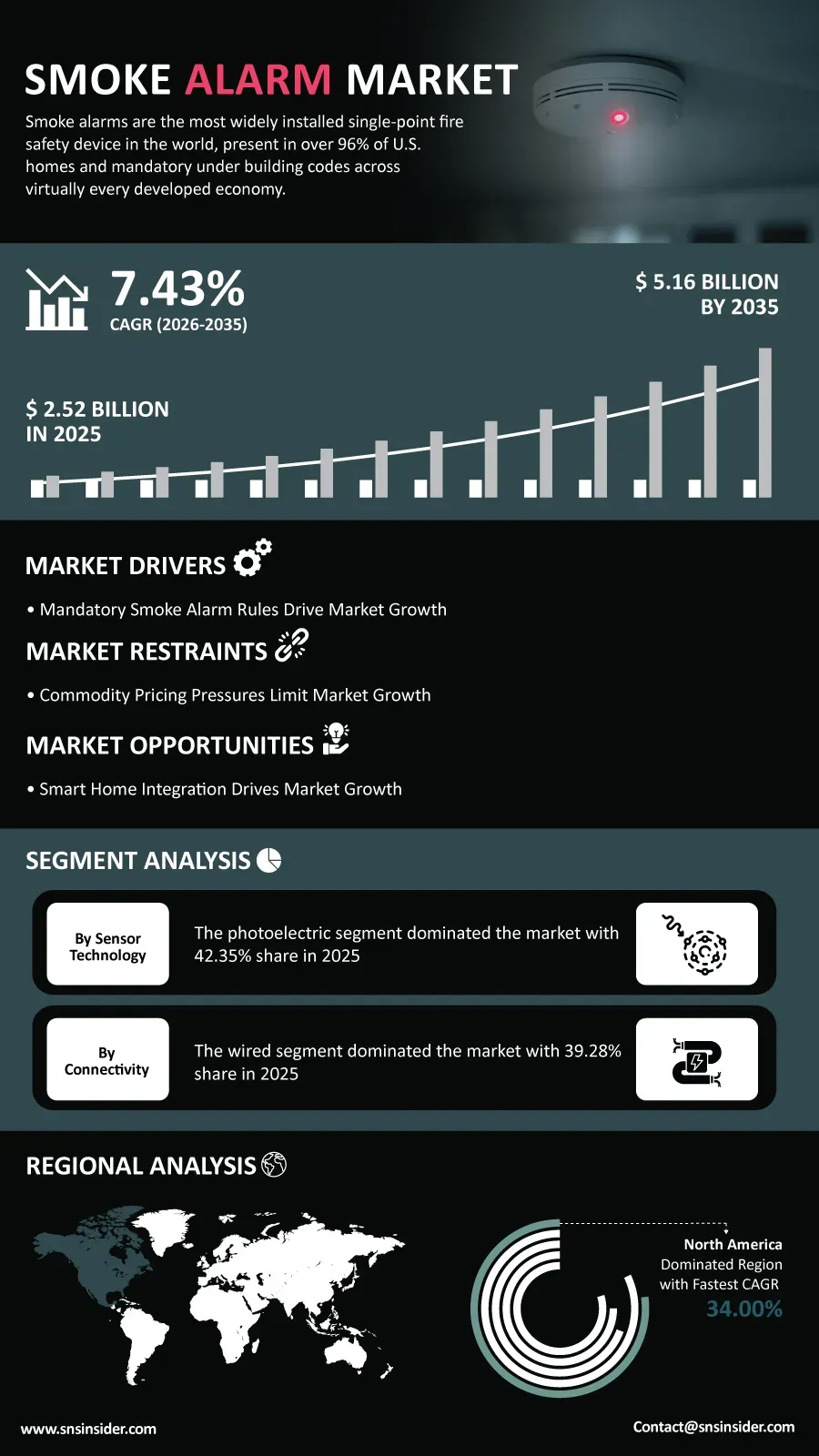
The worldwide Smoke Alarm Market is expected to remain strong as administrations, residential builders and homeowners demand stronger fire security features through high detection solutions and intense building standards. According to a recent study by SNS Insider, the global Smoke Alarm Market size valued at USD 2.52 billion in 2025, is anticipated to grow to USD 5.16 billion by 2035, registering a CAGR of 7.43% over the 2026–2035 forecast period.
Increase in awareness regarding residential and commercial fire hazards along with the growing urban construction activities is supporting demand for reliable fire detection systems worldwide. Fire safety policies tend to require installation of smoke alarms in mature and emerging economies respectively, the demand for replacements as aging devices reach their end-of-life continues unabated across commercial and residential markets.
Connected technologies are also rapidly advancing and transforming the industry. Companies have launched smart smoke alarms with built-in wifi feature along with cloud-based monitoring, voice alarm and integration with smart homes which allow users to receive real-time alerts and monitor your emergency from anywhere around the world.
To Get Detailed Insights on the Smoke Alarm Market – Request a Sample Report
Smart Fire Safety Solutions Continue to Expand Market Opportunities
This evolution of smart buildings and connected home is producing business opportunities for smoke alarm makers. With growing demand for integrated safety devices that can connect to home automation platforms, security systems and emergency monitoring services, connected smoke alarms are becoming an appealing step up from the traditional stand-alone units.
New standards in fire detection systems are being adopted by commercial property owners that provide better management of properties, compliance to regulation and enhanced safety for its occupants. Improvements and innovations in multi-sensor technology, AI, and wireless connectivity are helping lower false alarms while enhancing detecting capabilities within complex environments.
This is further bolstered by increasing adoption of ten-year sealed batteries technology and maintenance-free solutions, as they reduce servicing frequency while providing better long-term reliability for residential users.
Key Market Insights Highlight Shifting Demand Patterns
They can be detected using photoelectric sensors, which are predicted to have a market revenue share of about 42.35% globally in 2025 owing to their effectiveness in detecting slow-smoldering fires typically found within homes. Combination or dual-sensor alarms are estimated to be the fastest-growing segment through 2035 as consumers continue to prefer a single-device alarm with integrated fire detection capabilities.
Wired smoke alarms are likely to contribute around 39.28% of the market revenue during 2025 due to their widespread installation in both residential as well as commercial infrastructure which drives the growth of wired smoke alarms. Smart IoT-enabled smoke alarms are expected to be the fastest growing segment, mainly supported by increasing uptake of connected home devices and remote monitoring solutions.
By installation type, the ceiling-mounted smoke alarms are anticipated to account for 51.46% of market revenue in 2025 on account of their compatibility with standard or traditional buildings designs and fire safety codes. Wallbox configurations continue to meet particular architectural and retrofit needs.
On the basis of application, in 2025 residential segment will hold a share of revenue near to 46.51% of total demand, aided by compulsory installation laws and replacement demand from millions of existing households around the world. Based on end use, the commercial segment is projected to witness the highest growth through 2035 due to modernization of fire protection infrastructure across corporate offices, healthcare facilities, hospitality venues and retail establishments.
Connected Safety Technologies Transform Fire Protection Systems
The smoke alarm industry is quickly transitioning away from basic fire detection devices and towards intelligent safety ecosystems. Some of the modern solutions may implement smoke detection, carbon monoxide monitoring, mobile alerts, voice instructions and connection to smart assistants in one device allowing greater safety as well as ensuring convenience for users.
AI and advanced sensing technologies are enhancing performance by reducing annoying alarms due to cooking fumes, dust or steam while improving detection accuracy. These innovations are stimulating upgrades of obsolete fire detection infrastructure with advanced connected solutions (upgrades) among home and commercial property operators.
Regional Markets Demonstrate Strong Growth Potential
The North America region accounted for around 34.00% of global market revenue in 2025 and is expected to outpace Europe through comprehensive fire safety regulations, a mature replacement market, and the strong adoption of smart home technologies. Continuous need for regulatory compliance along with high consumer awareness, continues to strengthen the leadership position in market segments across regions.
By region, Asia Pacific will be the fastest growing market during the forecast period through 2035. Rapid urbanization, increase in residential and commercial construction, improved fire safety regulations followed by rising awareness regarding the protection of properties has led to significant demand across China, India, Southeast Asia and Australia.
With the continuous improvements in building safety regulations and promoting smart infrastructure, worldwide smoke detector market size is projected to rise at a faster pace over 2023–2032.
Industry Participants Focus on Connected Innovation
As manufacturers pour investments into intelligent sensing technology, wireless communication, artificial intelligence (AI), and smart home solutions, the competitive landscape is still changing. Companies are also diversifying their product portfolios focusing on connected alarms, combination smoke and carbon monoxide detectors, cloud-supported monitoring solutions aimed at improving user safety and meeting regulatory requirements.
Key companies operating in the global Smoke Alarm Market include Honeywell International Inc., Johnson Controls International PLC, Siemens AG, Robert Bosch GmbH, Kidde (Carrier Global Corporation), First Alert (Resideo Technologies Inc.), Google LLC (Nest Protect), Hochiki Corporation, Eaton Corporation PLC, Apollo Fire Detectors Ltd., ABB Ltd., FireAngel Safety Technology Group PLC, X-Sense Innovations Co. Ltd., Halma plc, Gentex Corporation, Ei Electronics Ltd., Universal Security Instruments Inc., NAPCO Security Technologies Inc., Schneider Electric SE, and Panasonic Corporation.
An SNS Insider analyst Sushant Kadam commented, “Growing adoption of connected home technologies, expanding fire safety regulations, and increasing demand for intelligent building infrastructure are reshaping the smoke alarm market. Manufacturers that focus on smart connectivity, reliable detection performance, and seamless integration with modern safety ecosystems will be well positioned to capture future growth opportunities.”
About the Author

Get in touch




