
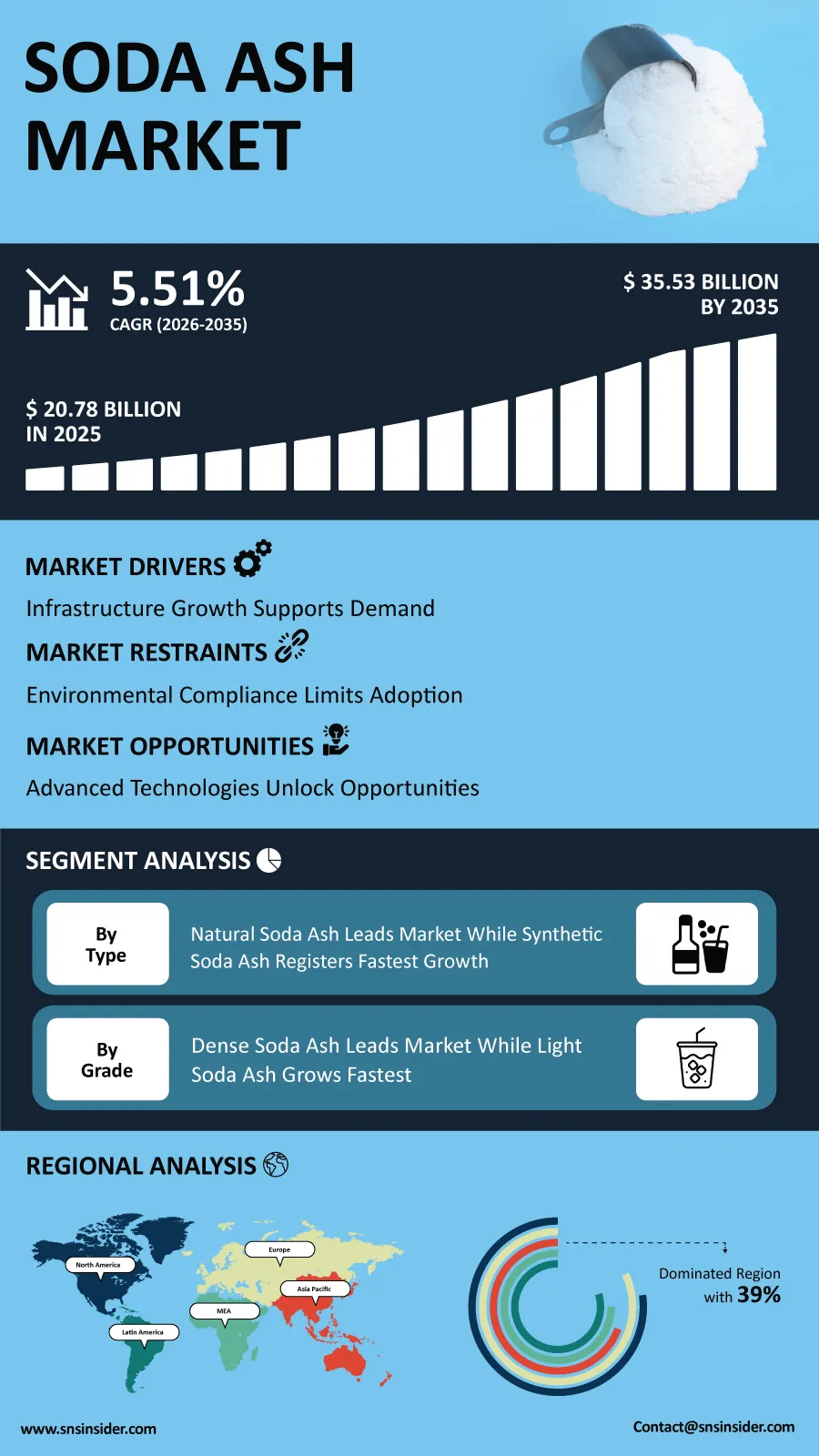
The global Soda Ash Market is poised to register a significant growth over forecast year due to increasing demand in glass manufacturing, chemicals, detergents, water treatment and battery materials. “According to a recent study by SNS Insider, the global Soda Ash Market size valued at USD 20.78 Billion in 2025, is anticipated to grow to USD 35.53 Billion by 2035, registering a CAGR of 5.51% over the 2026–2035 forecast period.”
Increasing industrialization along with the shift towards sustainable manufacturing is making soda ash increasingly strategic in all key consumer segments. Soda ash is a vital component in the manufacturing of glass, various chemicals, and industrial formulations as manufacturers aim to improve production efficiency and reduce environmental impact. Stable long-term demand across worldwide is also bolstered by strong investments in infrastructure development and renewable energy projects.
Increasing usage of flat glass for modern construction, solar panels, & automotive applications are further driving the market. Additional demand from detergent and cleaning product manufacturers is supported by increasing urbanization, expansion of consumer goods manufacturing and improving hygiene awareness. Producers are also beginning to invest in cleaner production technologies and operational upgrades for the sake of sustainability and to make their supply chains more resilient.
To Get Detailed Insights on the Soda Ash Market – Request a Sample Report
Sustainable Manufacturing and Battery Supply Chains Create Long-Term Growth Opportunities
The global race to decarbonization has opened up new opportunities for soda ash producers. You are familiar with clean chemical processing and energy efficiency manufacturing facilities expanding existing operations even as growth investments in green chemistry. With governments implementing stringent environmental regulations, low-emission production technologies are gaining tremendous importance.
The other key growth opportunity is the explosive electric vehicle ecosystem. Soda ash is used more and more in processing Litte lithium carbonate, aiding the production of battery material including for electric vehicle and energy storage markets. With recruitment capacity for battery manufacturing rise where we live, demand for reliable chemical feedstocks on manufacture will only accelerate through the decade.
Natural mineral extraction, carbon reduction initiatives, and process automation are examples of technological advancements in production efficiency that enable manufacturers to reduce operating costs while improving environmental performance.
Key Market Insights Highlight Shifting Demand Patterns
Natural Soda Ash represented a global revenue share of over 63.0% in 2025, owing its economic viability to near-surface deposits of trona and comparatively lower capital and operational costs with several environmental benefits. By 2035, growth in Synthetic Soda Ash is expected to be the fastest growing because manufacturers are modernizing their production processes for increased efficiency and sustainability.
Dense Soda Ash accounted for almost 39% of revenue in the market, in terms of volume in 2025. On the other hand, Light Soda Ash is expected to grow at a quick pace due to growing consumption in detergent production and chemical processing sector.
By application, in 2025 Glass Industry accounted for nearly 49% of total market revenue, signalling high consumption in constructions, automotive wind-vise and packaging (especially bottle caps), besides solar-panel glass manufacturing. Detergents and Soaps segment likely to be the fastest-growing category globally since cleaning product demand is on the rise.
Process Innovation and Cleaner Production Technologies Support Market Evolution
To enhance productivity and lower emissions, manufacturers are increasingly adopting automation solutions such as digital manufacturing system management, advanced process controls, and energy-efficient production technologies. Improved extraction technologies and more efficient refining processes allow companies to improve the quality of their products while reducing environmental footprints.
Circular economy efforts, recycling initiatives and carbon management technologies are creating even more revolutionised industry operations. These developments assist producers in remaining competitive across global markets while continuing to meet changing sustainability objectives.
Asia Pacific Leads with 39% Share in 2025, While North America Emerges as the Fastest-Growing Regional Market Through 2035
Asia Pacific held for a share of around 39% of global revenue in 2025, aided by the regional bulk-scale glass manufacturing, rising detergent production and high chemical processing capacity. The Beijinger's integrated industrial base, massive capital goods and infrastructure investments, and the fact that it is the largest producer of manufactured goods in the world for most regions of China continue to drive regional market leadership.
North America, on the other hand, is likely to be the fastest-growing regional market until 2035 owing to large natural trona reserves in countries such as the U.S. and Canada, technological advancements for mining from deep surface and high quality/availability of mining resources along with growing global export demand. America fortify its competitive edge by utilizing efficient extraction processes, sustainable production practices, and long-standing global supply chains.
Increasing adoption of sustainable manufacturing technologies, circular economy initiatives and energy-efficient industrial processes enables consistent market expansion in Europe. On the other hand, Latin America and Middle East & Africa are expanding gradually owing to industrial development, increased construction activities and chemical manufacturing in emerging economies.
Industry Participants Focus on Sustainable Production and Capacity Expansion
Rising competition in the worldwide soda ash market furthermore encourages new investments for cleaner generation innovations, operational modernization and additional basic limit extension. Organizations now regard automation, energy efficiency, and sustainable resource utilization as necessary tools to fortify their competitive advantage in response to rising worldwide demand through multiple industrial applications.
Key companies operating in the global Soda Ash Market include WE Soda, Ciner Resources Corporation, Solvay, Şişecam Group, Tata Chemicals Ltd., Nirma Ltd., DCW Ltd., Genesis Alkali, OCI Company Ltd., GHCL Ltd., Shandong Haihua Group, Kazan Soda Elektrik, Eti Soda, United Soda Ash, ArChemCo, STPP Group, Fondland Chemicals Co., Ltd., Weifang Haizhiyuan Chemistry, Shouguang Dinghao Trading, and Shandong Pulisi Chemical.
An SNS Insider analyst Himanshu Sharma commented, "Growing demand for sustainable industrial materials, expanding glass manufacturing capacity, and increasing battery material production are creating long-term opportunities for the global soda ash industry. Companies investing in cleaner production technologies, resource-efficient operations, and strategic capacity expansion will be well positioned to capitalize on evolving market requirements over the coming decade."
About the Author

Get in touch




