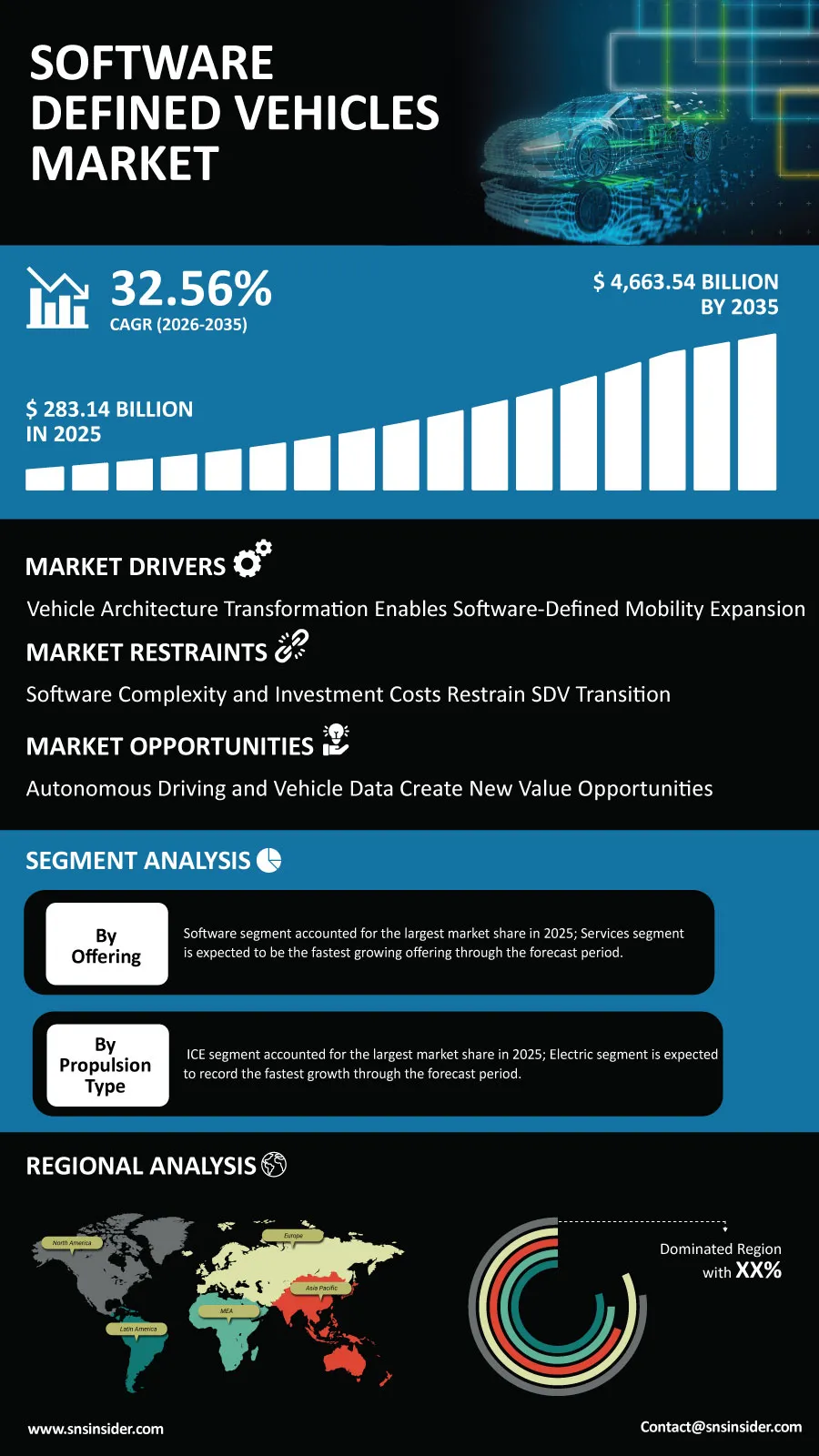
The global Software Defined Vehicles Market is entering a new phase of expansion as automakers transition from hardware-centric engineering to software-driven vehicle platforms capable of continuous upgrades and intelligent functionality. “According to a recent study by SNS Insider, the global Software Defined Vehicles Market size valued at USD 283.14 billion in 2025, is anticipated to grow to USD 4,663.54 billion by 2035, registering a CAGR of 32.56% over the 2026–2035 forecast period.”
Greater adoption of artificial intelligence, connectivity, cloud, and advanced driver assistance solutions is revolutionizing the design, operation, and maintenance of cars. Car manufacturers have started to emphasize the development of software that enhances the efficiency of cars, provides cybersecurity, and offers tailored digital experiences for car owners.
Moreover, automotive manufacturers are shifting towards centralized computing platforms in order to make the electronics of cars easier and faster software delivery. Software upgrades, intelligent diagnostic, and digital service ecosystems have become competitive advantages for automotive manufacturers through which they can earn money after selling the cars.
To Get Detailed Insights on the Software Defined Vehicles Market – Request a Sample Report
Connected Mobility and Digital Vehicle Platforms Create Strong Long-Term Growth Opportunities
Automakers and technology companies are increasingly developing and deploying intelligent mobility ecosystems, where connectivity through the cloud, edge computing, and advanced software play an integral part. Increasingly, cars are becoming digital devices capable of being upgraded with new features and capabilities remotely.
Increasing consumer desire to have a more tailored in-car experience is another driver of rapid software development. Digital dashboards, voice assistants, predictive navigation and subscriptions create new chances for automakers to enhance customer engagement and revenue model based on recurring payments.
The development of powerful automotive processors and AI-driven computing technologies is contributing to making decision-making processes faster in vehicles. Such technologies enable complex safety functions, intelligent powertrain management, and communication between various car subsystems.
Key Market Insights Highlight Evolving Industry Priorities
Based on offering, the software segment accounted for the largest share of market revenue in 2025 due to increasing investments in vehicle operating systems, connectivity platforms, and embedded automotive applications. The services segment is expected to witness the fastest growth through 2035 as demand rises for software integration, cybersecurity management, cloud services, and lifecycle support.
By propulsion type, internal combustion engine (ICE) vehicles maintained the leading market position during 2025 as connected software capabilities expanded across existing vehicle portfolios. Electric vehicles are projected to record the highest growth over the forecast period as manufacturers develop software-first vehicle architectures optimized for intelligent mobility.
In terms of application, advanced driver assistance systems (ADAS) represented the largest revenue contribution in 2025 owing to increasing adoption of safety technologies worldwide. Autonomous driving applications are anticipated to expand at the fastest pace through 2035 as AI capabilities and automated mobility solutions continue advancing.
AI, Cloud Computing, and Centralized Vehicle Architecture Transform Automotive Development
The software-defined vehicle ecosystem keeps progressing at an accelerating pace as car makers deploy artificial intelligence technology right into the heart of the computing system. AI analytics allow for preventive maintenance, better driver assistance systems, optimized batteries and custom user experience at lower operational complexity levels.
Cloud-native technologies and over-the-air software deployment allow auto makers to speed up innovation in their business by introducing novel features into their cars, improving performance and cybersecurity of the vehicles without the need for physical servicing.
The convergence of software engineering, semiconductor development, and digital technology is allowing vehicles to be evolving platforms and not static mechanical products, which is changing the methods of automotive product development.
North America Led the Software Defined Vehicles Market in 2025; Asia Pacific Expected to Deliver the Fastest Growth Through 2035
The North American region continued to lead in the global automotive technology market in 2025 due to robust investments in connected vehicles technology, autonomous driving technology, innovative semiconductors, and cooperation between auto-makers and technology providers. The U.S. continues to be an active participant in developing software platforms and intelligent mobility solutions.
The Asia Pacific region is set to record the highest growth through 2035 due to growing production of electric vehicles, massive investments in smart mobility systems and connected automotive technology in China, Japan, South Korea, and India. This region's robust manufacturing environment is rapidly advancing the next generation of vehicle platforms.
The European region is also experiencing high momentum due to massive investments in vehicle software platforms, digital mobility systems, and strict automotive safety regulations which encourage the adoption of intelligent driving technologies.
Industry Participants Strengthen Investments in Software Innovation
Competition across the Software Defined Vehicles Market continues to intensify as automotive manufacturers, semiconductor companies, and technology providers expand investments in AI computing, vehicle operating systems, cloud connectivity, and cybersecurity capabilities. Strategic collaborations between automakers and software developers are accelerating deployment of scalable digital vehicle platforms designed to support connected mobility and autonomous driving.
Key companies operating in the global Software Defined Vehicles Market include Tesla, Inc., NVIDIA Corporation, Qualcomm Incorporated, Intel Corporation (Mobileye), Robert Bosch GmbH, Continental AG, Aptiv PLC, Volkswagen AG (CARIAD), General Motors Company, Ford Motor Company, Toyota Motor Corporation, Mercedes-Benz Group AG, BMW Group, Stellantis N.V., Waymo LLC (Alphabet Inc.), Baidu, Inc., Huawei Technologies Co., Ltd., BYD Co., Ltd., NIO Inc., and Harman International (Samsung Electronics).
An SNS Insider analyst Sakshi Kale commented, "Software is becoming the defining factor of next-generation mobility as connected services, artificial intelligence, and centralized computing architectures reshape vehicle capabilities. Companies investing in scalable software ecosystems, cybersecurity, and intelligent mobility platforms are expected to capture significant long-term growth opportunities across the global automotive industry."
About the Author

Get in touch