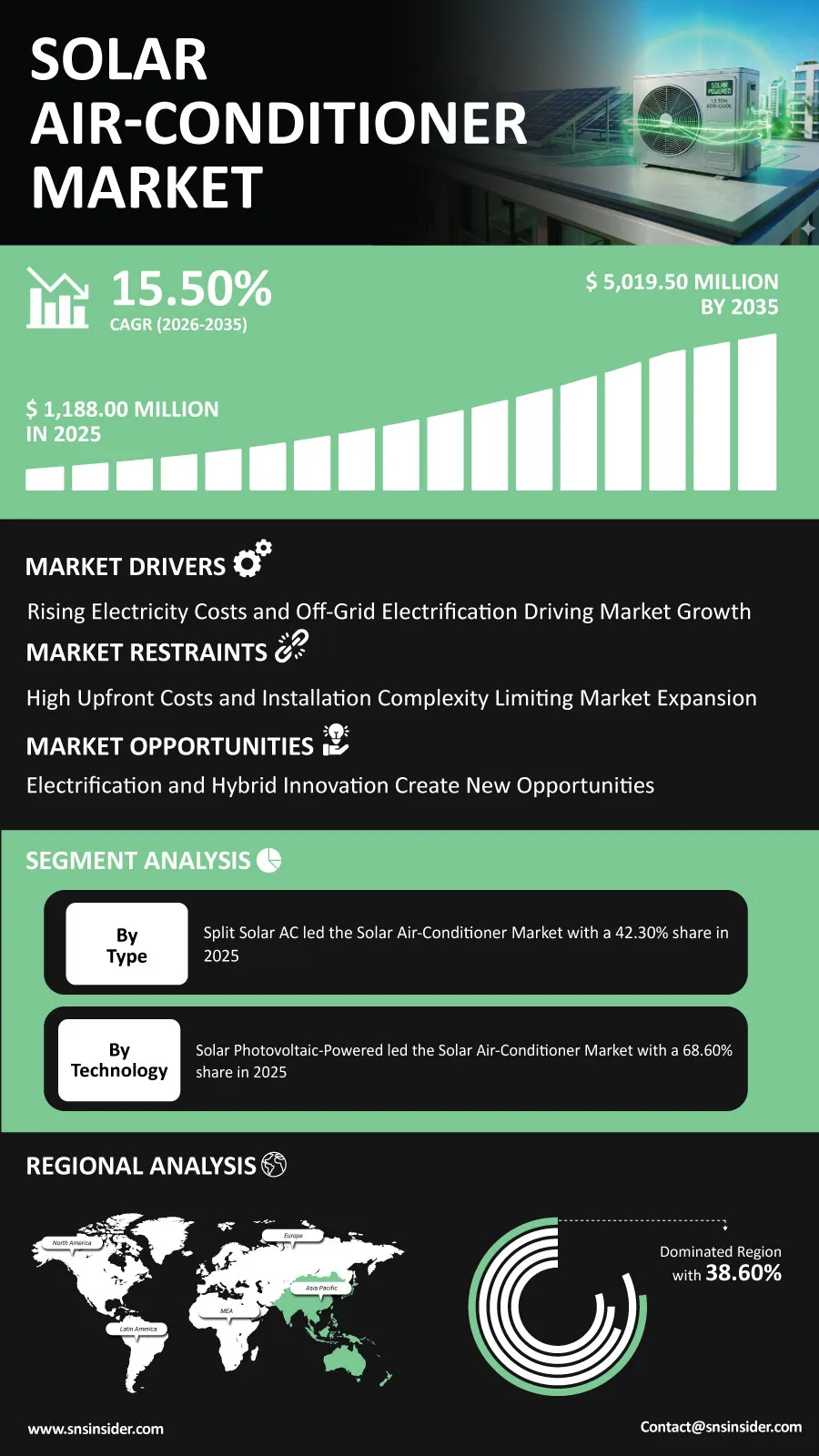
The global Solar Air-Conditioner Market is set for significant expansion as consumers and businesses worldwide continue transitioning toward sustainable, cost-effective cooling solutions. "According to a recent study by SNS Insider, the global Solar Air-Conditioner Market size valued at USD 1,188.00 million in 2025, is anticipated to grow to USD 5,019.50 million by 2035, registering a CAGR of 15.50% over the 2025-2035 forecast period."
There have been tremendous changes within solar air conditioning technology over time due to which many manufacturers who aim at improving cooling efficiency can take advantage of this trend. This includes the need for more reliable, hybrid-powered systems that will provide consumers with the ability to reduce electricity costs while maintaining consistent cooling performance. This applies in situations where solar air conditioners are used across residential, commercial, and industrial applications.
Manufacturers are constantly working hard to ensure that their solar cooling systems perform better than before in order to meet various needs of energy-conscious consumers and businesses.
To Get Detailed Insights on the Solar Air-Conditioner Market – Request a Sample Report
Sustainable Cooling Ecosystems Create New Demand
The development of solar air conditioner technology has moved beyond the initial photovoltaic air conditioning to much more sophisticated forms such as hybrid air conditioning and the usage of DC air conditioning. This requires the innovation of better and more reliable air conditioning system due to the increased investment in the hybrid inverterless systems, integration of WiFi control and compressor technologies among others.
The new designs of solar air conditioners offer greater energy savings, decreased dependence on grid electricity and reliable weather independent air conditioning system. This enables consumers to manage their energy expenses and environmental stewardship better.
Solar cooling manufacturers, renewable energy companies, and government agencies are increasingly cooperating thanks to the growing interest in developing future solutions for sustainable cooling access.
Key Market Findings Highlight High-Growth Segments
The split solar AC segment dominated all categories in the solar air-conditioner market share with a market revenue share of 42.30% in 2025 due to its flexibility and widespread residential adoption.
The fastest growing category is expected to be cassette solar AC which will grow at a CAGR of 17.20% through 2035. This will be possible owing to the increasing need for discreet, ceiling-mounted commercial cooling solutions.
By technology, solar photovoltaic-powered systems held the largest share of total market revenue of 68.60% in 2025 due to broader commercial availability and scalability. The hybrid segment will see the fastest growth in revenue generation at a CAGR of 18.60%.
Based on application, residential generated a share of 58.60% of market revenue in 2025 thanks to growing homeowner adoption of solar-powered cooling. On the other hand, commercial applications will be the segment recording the fastest revenue growth at a CAGR of 17.80%.
Distributive trends are changing as well. Traditional residential applications remain substantial, but commercial applications will turn out to be the fastest-growing segment through 2035, on the back of corporate sustainability commitments, net-zero pledges, and increased demand from incentive-driven building owners.
Efficiency, Reliability, and Sustainability Gain Importance
In this regard, consumers have been looking at cooling systems that would make their energy costs lower and require less grid dependency and be more sustainable.
Innovation in hybrid AC/DC technology, smart control integration, and compressor efficiency has been making it possible for companies to come up with products that can operate effectively across demanding climate conditions. In addition to that, increasing emphasis on off-grid reliability and carbon footprint reduction is also making it possible for companies to find solutions that optimize solar cooling performance.
Such trends are likely to become even more prominent in the future.
Asia Pacific Emerges as the Largest Market with 38.60% Revenue Share Amid Rising Urbanization
The Asia Pacific region represented 38.60% share of global market revenue in 2025 and was the largest regional market, owing to rapid urbanization and strong solar irradiance across China, India, and Southeast Asia. In addition, the Middle East & Africa region is expected to be the fastest-growing market during the forecast period, propelled by exceptionally high solar irradiance and applications across the region's fast-growing cooling demand industries.
On the other hand, North America represented a significant share of global market revenue in 2025, aided by growing demand for energy-efficient HVAC solutions and favorable government incentives.
Leading Companies Drive Innovation and Competition
The environment continues to stay very dynamic since players continue innovating on products and technologies as well as forming partnerships in order to enhance their position in the industry.
Some of the major companies that operate in the global solar air-conditioner market are Gree Electric Appliances Inc., Midea Group Co. Ltd., Daikin Industries Ltd., Haier Group Corporation, Lennox International Inc., Carrier Global Corporation, Panasonic Corporation, Chigo Air Conditioning Co. Ltd., HotSpot Energy Inc., and Solair World International Pte Ltd.
An SNS Insider Analyst Sakshi Kale commented, "The rapid commercialization of hybrid solar cooling technology is creating unprecedented demand for high-performance, energy-efficient air conditioning systems. Manufacturers that successfully combine reliability, energy savings, smart connectivity, and advanced engineering capabilities will be best positioned to capitalize on emerging opportunities across residential, commercial, and off-grid applications."About the Author

Get in touch