
The global e-waste management market is poised for a time of rapid growth owing to higher consumer electronics usage, shorter life cycles of products, and tighter recycling laws. The need for recovering precious metals, EV batteries, and secure IT asset destruction is motivating manufacturers, recyclers, and technology vendors to establish sophisticated processing facilities.
According to SNS Insider, the global e-waste management market was valued at USD 83.46 billion in 2025, is estimated to reach USD 92.12 billion in 2026, and is projected to expand to USD 224.07 billion by 2035, registering a CAGR of 10.38% during 2026–2035.
The industry is moving away from traditional dismantling and disposal processes towards formal recovery systems that are based on automated sorting, metal extraction, refurbishing, and digital tracking of materials. Extended producer responsibility laws are driving formal recycling processes forward, while increasing focus on circular manufacturing is opening business prospects for specialty recyclers.
To Get Detailed Insights on the E-Waste Management Market – Request a Sample Report
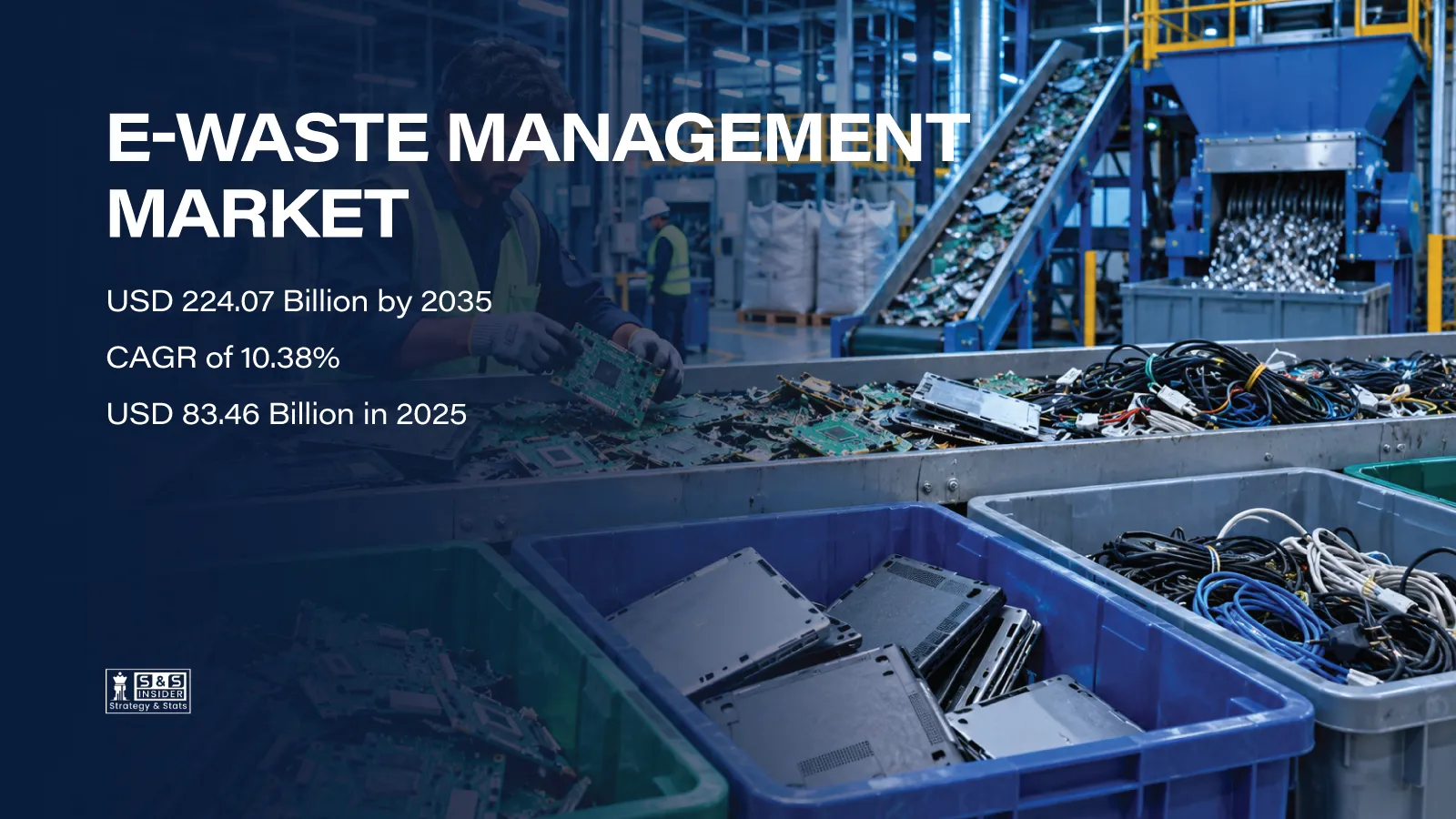
Asia-Pacific region will lead in terms of demand and growth driven by electronics manufacturing, increasing use of electric vehicles, and investments in official recycling facilities.
Market Size and Forecast
|
Market Indicator |
Value |
|---|---|
|
Market Size, 2025 |
USD 83.46 Billion |
|
Market Size, 2026 |
USD 92.12 Billion |
|
Market Forecast, 2035 |
USD 224.07 Billion |
|
CAGR, 2026–2035 |
10.38% |
|
Leading Region |
Asia-Pacific |
|
Fastest-Growing Region |
Asia-Pacific |
|
Leading Material |
Metals |
|
Fastest-Growing Source |
EV Batteries |
Demand Drivers and Constraints
Primary Demand Drivers
-
Increasing electronic waste generation: Rising consumption of smartphones, computers, household appliances, and connected devices is expanding the volume of discarded electronic equipment requiring proper treatment.
-
Stricter recycling regulations: Extended producer responsibility policies and restrictions on hazardous waste disposal are encouraging manufacturers to establish collection and recycling partnerships.
-
Growing critical metal demand: Recovery of copper, gold, silver, lithium, cobalt, and other materials is becoming strategically important for electronics manufacturing and energy technologies.
-
Expansion of electric vehicle batteries: Increasing volumes of battery manufacturing scrap and retired battery packs are creating opportunities for specialized recovery facilities.
-
Corporate sustainability commitments: Electronics manufacturers and enterprises are prioritizing certified recycling, equipment refurbishment, and documented waste management practices.
-
Technological advancements: Automated dismantling, AI-enabled sorting, and hydrometallurgical processing are helping recyclers improve material separation and recovery efficiency.
Potential Growth Constraints
-
High transportation, processing, and regulatory compliance costs.
-
Competition from informal recycling networks.
-
Fluctuating prices of recovered metals and secondary materials.
-
Safety risks associated with lithium-ion batteries and hazardous components.
-
Limited collection infrastructure in developing economies.
Demand Structure by Material
Metals (2025 Market Share: 56.96%)
Metals form the largest portion of the materials, contributing about 56.96% of the revenue generated through e-waste management by 2025. Old circuit boards, electronic connectors, wiring, batteries, and electronic equipment enclosures hold recoverable metals that can be used in a wide range of applications. The monetary value of metals such as copper, aluminum, gold, silver, and important battery minerals is what encourages investment in specialized processing plants.
Manufacturers are also evaluating recycled metal resources in order to lessen their dependence on mining and improve their material supply chain resilience. Modern technology is enhancing the feasibility of extracting valuable materials from electronics.
Current trend: Increasing commercialization of high-value metal recovery and urban mining operations.
Major trends: Precious metal extraction, critical mineral recovery, automated separation, and recycled metal supply agreements.
Plastics (Forecast CAGR: 11.62%)
Plastic is expected to witness rapid growth, recording a CAGR of around 11.62% in the period from 2026 to 2035. Engineering plastics that are used in casings, parts, and protective covers in electronic equipment make up a number of these plastics. Increased demand for recyclable materials is driving recyclers to enhance polymer identification and segregation.
Advanced sorting systems could enable the identification of re-usable plastics from those that contain additives which are limited. Companies in electronics sector looking to increase their recycled content would drive increased demand for secondary polymers.
Current trend: Expansion of specialized plastic recovery and higher-purity recycled polymer production.
Major trends: AI-assisted plastic sorting, recycled content integration, polymer purification, and circular product design.
Demand Structure by Source
Consumer Electronics (2025 Market Share: 37.75%)
The share of consumer electronics was around 37.75% in the global market in 2025; thus, it represents the most sizable source category. The regular replacement of smartphones, laptops, tablets, TV sets, and other electronic gadgets leads to the creation of large amounts of discarded products. The efforts of retailers, manufacturers, and trade-ins contribute to the transition of the used products to refurbishment and proper recycling.
The rising necessity of data destruction is also fueling demand for processing facilities for such products as computers and all kinds of connected devices. By 2035, consumer electronics will continue to represent an important source of metals and plastics.
Current trend: Expansion of organized device collection and refurbishment networks.
Major trends: Electronics take-back programs, secure data destruction, reusable component recovery, and automated dismantling.
EV Batteries (Forecast CAGR: 13.88%)
The batteries in EVs will see the fastest growth among source segments, as per the expected CAGR of 13.88%. Rising numbers of EV installations and battery production operations will lead to the requirement of customized collection, transportation, disassembly, and recycling services. The lithium-ion batteries feature materials such as lithium, nickel, cobalt, and copper that could be recycled and then used in the production process again.
The automobile companies and battery manufacturers will form recycling arrangements in order to ensure raw materials availability in the future. Hydrometallurgy and batteries disassembly equipment will become increasingly vital as the retired batteries volumes increase.
Current trend: Rapid development of dedicated battery recovery infrastructure.
Major trends: Battery material recovery, automated dismantling, hydrometallurgical processing, and closed-loop supply chains.
Regional Market Dynamics
Asia-Pacific (2025 Share: 45.92%; Forecast CAGR: 11.03%)
Asia-Pacific region holds the largest share in the world e-waste management market by contributing around 45.92% of revenue in 2025 and is anticipated to maintain its market CAGR growth of 11.03% till 2035. The key countries that hold market share include China, India, Japan, and South Korea owing to the production of electronic goods and recycling infrastructure in place. Producer responsibility laws will increase the formalization process of waste treatment and disposal. There is increasing battery recycling from electric vehicles and investments in recovering metals.
Direction: Market leadership supported by electronics manufacturing, regulatory development, and battery recycling investment.
Europe (2025 Market Share: 23.48%)
In 2025, Europe was expected to constitute about 23.48% of global market revenue. Some of the advantages enjoyed in Europe include existing waste electrical and electronic equipment (WEEE) regulations, well-organized systems of collections, and advanced materials recovery facilities.
Germany is a major player in the processing industry; Belgium and Sweden have recycling facilities for metals among other European nations. Recycling technology has been boosted by battery regulations and repair programs, as well as policies on circular economy.
Direction: Continued expansion supported by established recycling regulations and circular manufacturing initiatives.
North America (2025 Market Share: 21.36%)
The North American e-waste management market accounted for around 21.36% of the global market in 2025. The US is one of the key players in this region, with its market estimated at USD 13.98 billion in 2025 and expected to grow at a CAGR of 9.86% from 2026 to 2035. The growth drivers of this industry include corporate technology upgrades, data center equipment replacement, and certified IT asset disposition. Construction of local battery processing and recovery plants is opening up new possibilities.
Direction: Growth supported by enterprise electronics recycling and domestic material recovery capacity.
Middle East & Africa (2025 Market Share: 4.87%)
The Middle East and Africa contributed roughly 4.87% to the world’s market revenue in 2025. The UAE and Saudi Arabia have been creating organized systems for electronics recycling as part of efforts to improve resource efficiency. In Africa, increased usage of electronic equipment has created the need for electronics recycling in Africa.
Direction: Emerging opportunities supported by recycling infrastructure development and regulatory modernization.
Latin America (2025 Market Share: 4.37%)
Latin America comprised about 4.37% of the total market share in 2025. Brazil stands out among all countries as the leader in reverse logistics in the region, while Mexico, Chile, and Colombia are setting up electronic recycling programs. Growing demands for proper electronic waste management and collection infrastructure will drive future growth.
Direction: Progressive growth through formal recycling networks and producer responsibility initiatives.
Competitive Landscape
The global e-waste management industry includes specialized electronics recyclers, metal refining companies, environmental service providers, and IT asset disposition operators. Prominent companies covered in the SNS Insider report include Aurubis AG, Boliden AB, Electronic Recyclers International, Mitsubishi Materials Corporation, Sims Lifecycle Services, Stena Metall AB, Umicore, and Veolia Environnement.
Industry competition is increasingly influenced by access to electronic scrap, collection network coverage, recovery efficiency, processing certifications, and technological capabilities. Companies are expanding battery recycling operations, developing advanced material recovery systems, and establishing partnerships with electronics manufacturers to secure long-term waste supplies.
Market Outlook (2026–2035)
The worldwide market for e-waste management will amount to $224.07 billion by 2035 owing to rising electronic waste production, rising regulations related to recycling, and increased demand for reclaimed materials. Electric vehicle batteries and electronic plastics are anticipated to give lucrative growth prospects, whereas metals will continue to form the largest materials category.
Increased automation and artificial intelligence, along with improved chemical recycling, can increase the efficiency of the process and resource use. But the cost of collection, informal recycling, and fluctuating prices of recycled materials will pose major challenges. In summary, there are ample growth prospects in the e-waste management market over the coming years until 2035; competitiveness in the future will depend on collection efficiency and material recycling technology.
About the Author

Get in touch




