The global clinical alarm management market is witnessing significant growth due to the increasing focus on patient safety, streamlining of clinical workflows, and smart connectivity of medical devices. Alarm fatigue among health care professionals, high adoption rate of connected patient monitors, and increasing adoption of smart hospital systems are changing the way medical alarms are created, ranked, and transmitted.
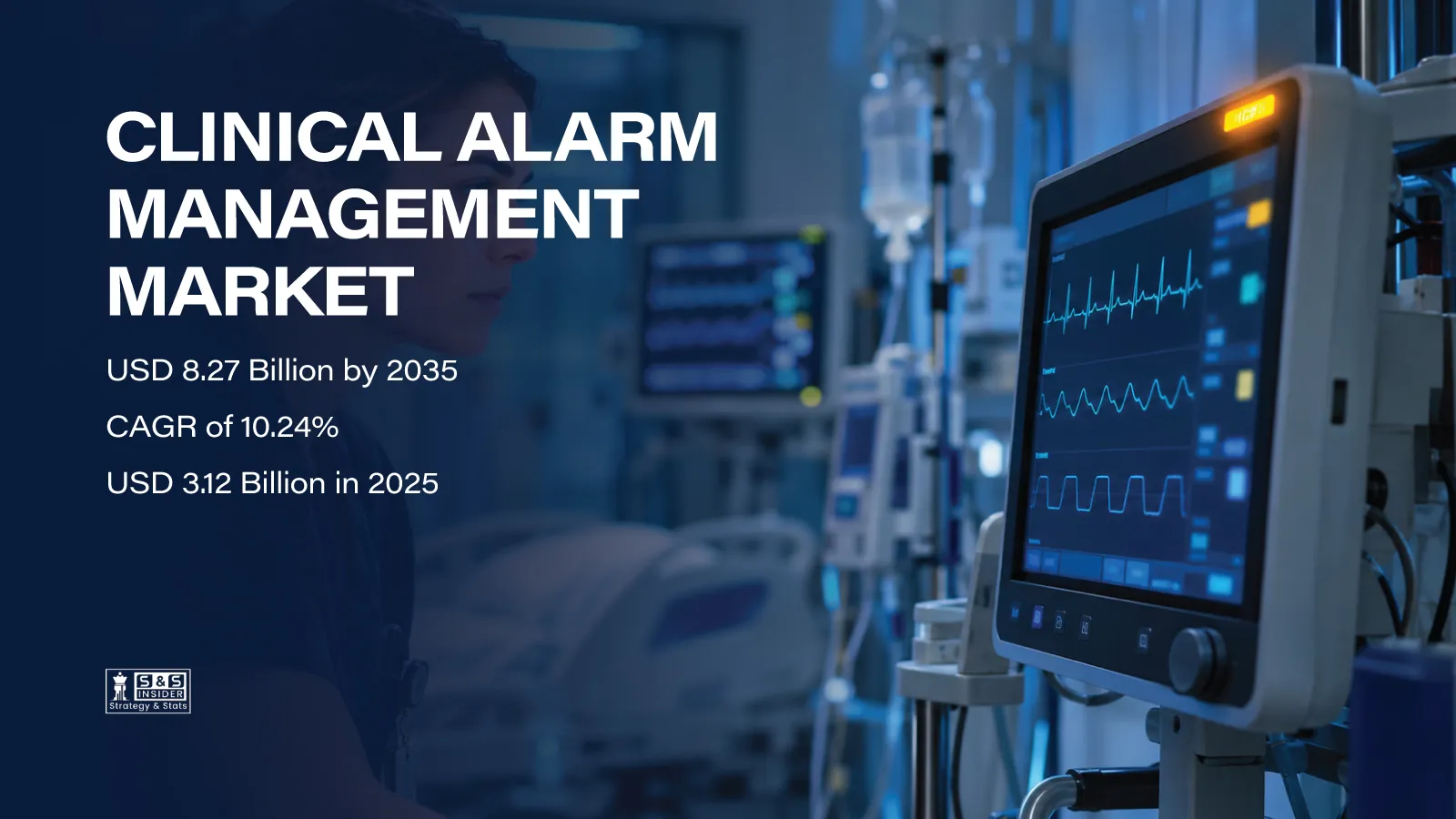
According to SNS Insider, the global clinical alarm management market was valued at USD 3.12 Billion in 2025 and is projected to reach USD 3.44 Billion in 2026 and USD 8.27 Billion by 2035, expanding at a CAGR of 10.24% over the forecast period.
Increasingly, hospitals are beginning to invest in advanced alarm management systems that have the capacity to filter out non-actionable alarms, provide accurate notifications, and disseminate important information to relevant medical practitioners. The application of artificial intelligence, wireless communication technology, and mobile applications is now crucial in clinical alarms management.
To Get Detailed Insights on the Clinical Alarm Management Market – Request a Sample Report
North America remains the largest regional market, while Asia-Pacific offers the fastest growth opportunities as healthcare facilities expand smart hospital capabilities and connected patient monitoring systems.
Market Size and Forecast
|
Market Indicator |
Value |
|
Market Size, 2025 |
USD 3.12 Billion |
|
Market Size, 2026 |
USD 3.44 Billion |
|
Market Forecast, 2035 |
USD 8.27 Billion |
|
CAGR, 2026–2035 |
10.24% |
|
Leading Region |
North America (40.73% Share) |
|
Fastest-Growing Region |
Asia-Pacific (11.19% CAGR) |
|
Leading Component |
Solutions (66.27% Share) |
|
Leading Technology |
Wireless Alarm Management Systems (44.62% Share) |
Demand Drivers and Constraints
Primary Demand Drivers
-
Increasing alarm fatigue: Excessive non-actionable medical alerts create distractions for healthcare professionals, encouraging hospitals to implement intelligent alarm prioritization solutions.
-
Expansion of connected medical devices: Growing installations of patient monitors, ventilators, infusion pumps, and nurse call systems increase demand for centralized alert management.
-
Smart hospital infrastructure development: Healthcare digitalization initiatives are accelerating adoption of integrated alarm management technologies.
-
AI-enabled alarm filtering: Machine learning and predictive analytics help healthcare organizations identify unnecessary notifications and improve clinical alert workflows.
-
Healthcare workforce shortages: Rising clinical workloads are encouraging hospitals to deploy mobile notification systems that reduce avoidable interruptions.
-
Electronic health record integration: Connecting alarm systems with clinical records supports contextual notifications and better coordination among caregivers.
Potential Growth Constraints
-
High installation costs and complex integration with existing hospital infrastructure.
-
Limited interoperability between medical devices from different manufacturers.
-
Cybersecurity concerns associated with connected clinical communication networks.
-
Staff training requirements and resistance to changes in established alarm procedures.
-
Budget limitations affecting technology adoption among smaller healthcare facilities.
Demand Structure by Component
Solutions (2025 Market Share: 66.27%)
In 2025, solutions were leading in the market share in the domain of clinical alarm management with a share of around 66.27% of revenue worldwide. With the rise in the number of alarms produced by different clinical systems, hospitals are adopting solutions such as integrated software platforms, alarm middleware, notification devices, and analytical dashboards.
The centralized approach helps healthcare providers differentiate between critical alarms and less critical ones, facilitating more effective operations of monitoring patients. The increasing capitalization in interoperability and clinical communications within hospitals will continue driving the market demand for a full-featured alarm management system.
Current trend: Increasing adoption of centralized alarm management platforms across hospital networks.
Major trends: Intelligent alert prioritization, clinical communication integration, wireless connectivity, and real-time alarm analytics.
Services (Forecast CAGR: 10.96%)
The services segment is projected to register a CAGR of 10.96% during 2026–2035. Demand is increasing for system integration, technical consulting, implementation support, clinical workflow assessment, and ongoing platform maintenance.
Healthcare institutions usually need specific support in linking alarm management software to patient monitoring tools and the electronic health records systems. Optimization services are growing more important as healthcare providers are constantly assessing alarms’ effectiveness and adjusting their notification systems.
Current trend: Growing demand for managed clinical alarm optimization and integration services.
Demand Structure by Technology
Wireless Alarm Management Systems (2025 Market Share: 44.62%)
Wireless alarms management systems had an approximate market share of 44.62% in 2025. Such technologies make it possible for the clinical alarms to traverse the hospital networks without the need for health care personnel to be located in specific monitoring locations.
Their integration with wireless patient monitors, nurse call system, and hand-held communication devices ensures constant communication in intensive care units, emergency departments, and general hospital wards. Their compatibility with existing hospital wireless infrastructure encourages adoption among facilities modernizing clinical communication workflows.
Current trend: Expanding use of wireless alert routing across connected hospital environments.
Major trends: Real-time notifications, network-enabled monitoring, device interoperability, and automated escalation.
Mobile Application-Based Alarm Management (Forecast CAGR: 12.84%)
Alarm management system utilizing mobile applications is currently the fastest growing technology area, which is likely to experience a CAGR of 12.84% from 2026 to 2035. Healthcare providers are making increased use of secure smartphones and wearables for communication in order to get patient alerts while shifting departments.
The mobile platform provides options for notifications, caregivers’ assignments, escalation of alarms, and patient data access. Increased deployment of digital nursing practices and virtual care services will lead to increased demand for mobile-centric clinical communications solutions.
Current trend: Accelerating adoption of smartphone-enabled clinical alarm management.
Major trends: Secure mobile notifications, wearable communication devices, remote monitoring integration, and automated response tracking.
Demand Structure by Application
Patient Monitoring (2025 Market Share: 45.92%)
Monitoring of patients contributed around 45.92% to the total global revenue from clinical alarm management in 2025. Intensive care units, emergency rooms, and telemetry units produce large numbers of physiological monitoring alarms.
Intelligent alarm management solutions have been implemented by healthcare providers in an effort to minimize unwanted alarms while ensuring clinically relevant events stay visible. Bedside monitoring devices and clinical dashboards support alarm management throughout hospitals' departments.
Current trend: Increased investment in intelligent physiological monitoring and alarm prioritization.
Alarm Notification and Communication (Forecast CAGR: 11.72%)
The alarm notification and communication segment is expected to witness a CAGR of 11.72% during 2026-2035. Healthcare organizations are increasingly consolidating alarms generated by nurse call systems, infusion pumps, ventilators, patient monitors, and other medical devices.
Unified communication solutions aid in distributing the alarms based on clinical roles, patient requirements, and alarm escalation policies. An increasing trend toward virtual nursing and communication among caregivers is also adding to the growth.
Current trend: Transition toward unified clinical notification and communication platforms.
Demand Structure by End User
Hospitals (2025 Market Share: 52.41%)
In 2025, hospitals contributed to about 52.41% of the worldwide clinical alarm management market. Hospitals have large networks of monitored beds and devices that need to be connected, leading to the need for centralizing alerts.
Safety patient programs, clinical workflows, and digital hospital technologies still play key roles in supporting the adoption. Health care systems prefer enterprise platforms that connect different units of health care facilities.
Current trend: Enterprise-wide adoption of intelligent alarm management technologies.
Long-Term Care and Home Healthcare (Forecast CAGR: 12.09%)
The long-term care and home healthcare market is expected to grow at a CAGR of 12.09% until 2035. The growth of an aging population and the adoption of remote patient monitoring technologies are contributing towards opportunities that exist outside hospitals.
Wearable devices, fall detection devices, and home monitoring devices trigger alarms that require appropriate evaluation. Alarm management systems based on cloud technology provide a scalable solution to healthcare organizations dealing with dispersed patients.
Current trend: Expansion of clinical alarm management into home-based and long-term care settings.
Regional Market Dynamics
North America (2025 Market Share: 40.73%)
North America occupied the highest market share at 40.73% in 2025. The region is supported by healthcare infrastructure development, numerous installations of patient monitoring equipment, and clinical safety.
The U.S. contributed about 89.74% of revenue generated in North America in 2025. There has been increased investments in hospitals in terms of hospital technology. Increased use of electronic health record and wireless communication system contributes to future demand.
Direction: Sustained market leadership supported by connected healthcare modernization.
Europe — Established Healthcare Technology Market
Europe is the second-largest regional market due to well-established hospitals and growing usage of digital healthcare solutions. The market leader in Europe is Germany, which constitutes 24.37% of the regional revenue in 2025.
Medical institutions in Germany, the UK, France, and Nordic countries have been investing in patient monitoring and clinical communication solutions. The drivers behind the growth include the compliance with medical devices, cybersecurity, and healthcare data protection standards.
Direction: Steady expansion supported by hospital digitalization and interoperability initiatives.
Asia-Pacific (Forecast CAGR: 11.19%)
Asia-Pacific is expected to be the fastest-growing regional clinical alarm management market, registering a CAGR of 11.19% during 2026–2035. China accounted for 31.84% of regional revenue in 2025.
Increasing hospital construction, critical care capacity expansion, and adoption of smart hospital technologies are strengthening market demand. India, Japan, and South Korea are also important markets as healthcare providers invest in connected monitoring systems and modern nursing communication infrastructure.
Direction: Rapid expansion driven by healthcare infrastructure investment and digital transformation.
Latin America
Latin America represented approximately 5.41% of the global market in 2025, with Brazil accounting for 44.19% of regional revenue. Growing investment in private healthcare facilities, intensive care modernization, and patient safety initiatives supports demand. However, financial constraints and integration costs continue to influence adoption.
Direction: Gradual growth supported by hospital modernization and connected monitoring.
Middle East & Africa
The Middle East and Africa accounted for approximately 5.22% of global revenue in 2025. Saudi Arabia represented 34.27% of the regional market, supported by healthcare infrastructure development and hospital technology investment. The United Arab Emirates, Qatar, and South Africa also offer opportunities for clinical communication and patient monitoring solutions.
Direction: Emerging opportunities driven by healthcare modernization and smart hospital investment.
Competitive Landscape
The global clinical alarm management market includes medical technology manufacturers, patient monitoring providers, and specialized clinical communication companies.
Major participants include Koninklijke Philips N.V., GE HealthCare, Stryker Corporation, Ascom Holding AG, Spok Holdings Inc., Masimo Corporation, Medtronic plc, Baxter International Inc., Drägerwerk AG & Co. KGaA, Nihon Kohden Corporation, Mindray Medical International Limited, TigerConnect Inc., Connexall USA, and AirStrip Technologies Inc.
Competitive differentiation increasingly depends on platform interoperability, intelligent alarm filtering, secure communication capabilities, and integration with hospital information systems.
Technology providers are expanding mobile notification functionality, advanced analytics, and clinical workflow integration to meet changing healthcare requirements.
Market Outlook (2026–2035)
The worldwide market for clinical alarms management is anticipated to grow and reach USD 8.27 Billion by 2035 due to rising need for patient safety technologies and advanced hospital infrastructures.
The future growth is likely to depend on factors such as AI and predictive analysis, the use of mobile clinical communication and patient monitoring technologies. Hospitals will be the leading customer segment, whereas home healthcare and long-term care may become areas for expansion.
North America is likely to preserve its current market leadership position, while Asia-Pacific is going to offer better growth potential due to advanced healthcare infrastructure and technology utilization. Interoperability issues, cybersecurity, and high costs of implementation are among the factors which influence purchasing decisions.
As a result, the market for clinical alarms management has good growth potential until 2035, with intelligent notification technologies and prevention of alarm fatigue gaining importance in clinical settings. Hospitals will remain the largest customer category, while long-term care and home healthcare are expected to provide important expansion opportunities.
About the Author

Get in touch