The global portable medical devices market is expected to enter a phase of significant growth as more and more healthcare providers are using small diagnostic machines, connected patient monitoring systems, and wearable medical devices. Increase in chronic diseases, an aging population, and the use of home healthcare services have altered the pattern of equipment usage.
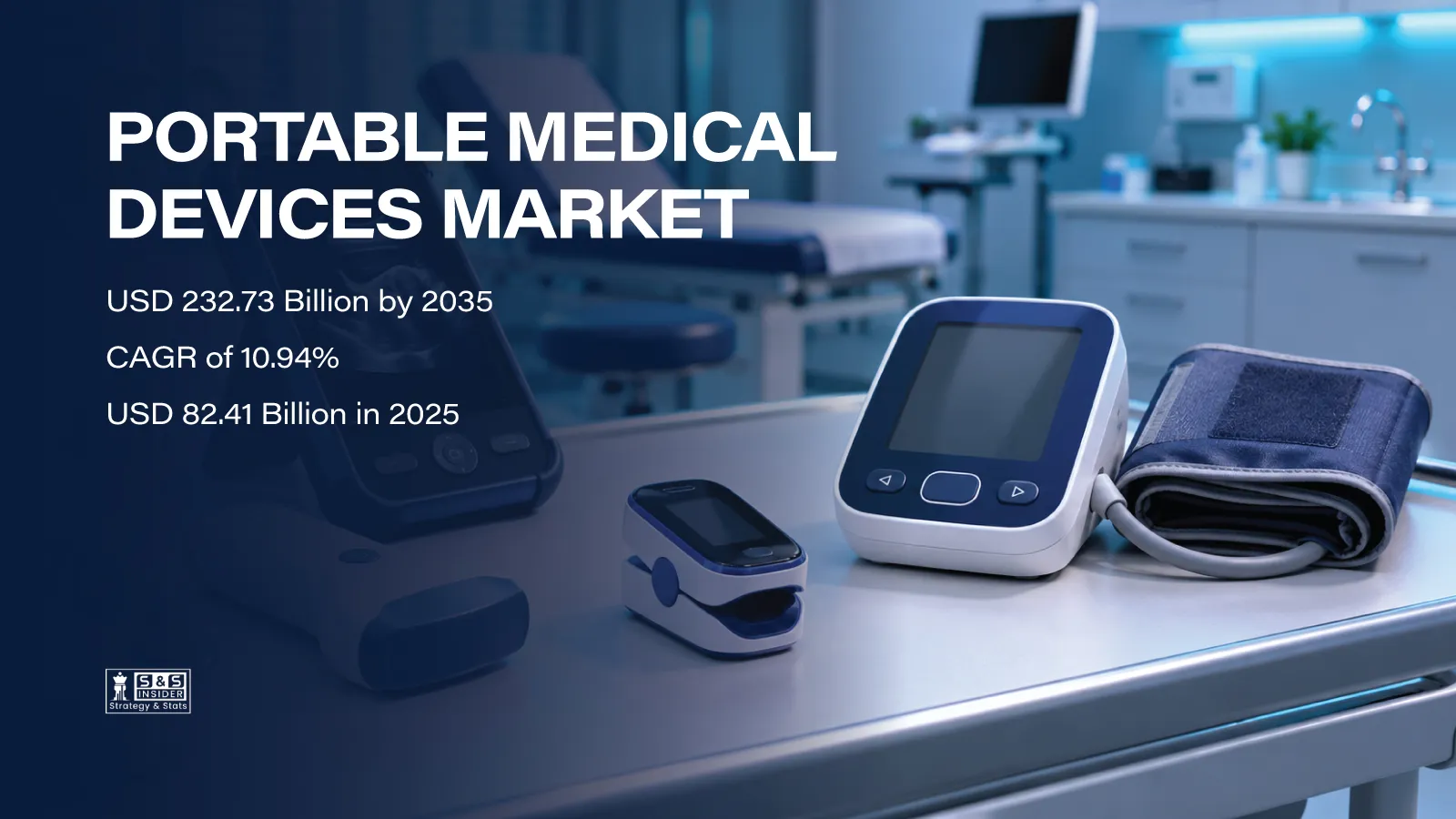
According to SNS Insider's Portable Medical Devices Market report, the market was valued at USD 82.41 billion in 2025, is estimated to reach USD 91.43 billion in 2026, and is projected to expand to USD 232.73 billion by 2035, registering a CAGR of 10.94% during 2026–2035.
Portable electrocardiograms, continuous glucose monitoring, handheld ultrasounds, and wireless vital signs monitors are becoming increasingly common in the healthcare delivery process for patients.
The emergence of artificial intelligence, wireless technology, and smaller sensors is revolutionizing the ability of devices to monitor patient conditions. Device manufacturers are creating smaller devices which have the ability to collect and transmit physiological data to clinicians.
To Get Detailed Insights on the Portable Medical Devices Market – Request a Sample Report
North America continues to dominate as the largest market region, whereas Asia-Pacific is projected to have the highest growth over the next two decades. Growth will be especially high in the areas of wearable medical devices, home health monitoring, and decentralized diagnostics.
Market Size and Forecast
|
Market Indicator |
Value |
|
Market Size, 2025 |
USD 82.41 Billion |
|
Market Size, 2026 |
USD 91.43 Billion |
|
Market Forecast, 2035 |
USD 232.73 Billion |
|
CAGR, 2026–2035 |
10.94% |
|
Leading Region, 2025 |
North America (39.62%) |
|
Fastest-Growing Region |
Asia-Pacific (12.47% CAGR) |
|
Leading Product Segment |
Monitoring Devices (47.26%) |
|
Fastest-Growing Product Segment |
Smart Wearable Medical Devices (17.88% CAGR) |
Demand Drivers and Constraints
Primary Demand Drivers
-
Increasing chronic disease prevalence: Cardiovascular disorders, diabetes, hypertension, and respiratory diseases are increasing demand for continuous monitoring and portable diagnostic equipment.
-
Expansion of home healthcare: Healthcare providers are adopting remote patient monitoring systems and home-based treatment models to reduce unnecessary hospital visits and support long-term disease management.
-
Advancement in wearable technologies: Improvements in sensor accuracy, battery efficiency, wireless communication, and device miniaturization are supporting the development of sophisticated wearable medical equipment.
-
Growing adoption of artificial intelligence: AI-enabled diagnostic support, automated alerts, and physiological data analysis are improving the functionality of portable monitoring platforms.
-
Aging global population: Increasing healthcare requirements among older adults are strengthening demand for accessible, easy-to-operate monitoring and therapeutic devices.
-
Increasing investment in decentralized healthcare: Government healthcare modernization programs and expanding outpatient services are creating additional opportunities for portable medical equipment manufacturers.
Potential Growth Constraints
-
High acquisition costs for advanced portable imaging and continuous monitoring technologies.
-
Inconsistent reimbursement policies across healthcare markets.
-
Data privacy and cybersecurity risks associated with connected medical equipment.
-
Complex product approval and clinical validation requirements.
-
Limited digital infrastructure and device maintenance capabilities in developing regions.
Demand Structure by Product
Monitoring Devices (2025 Market Share: 47.26%)
Monitoring devices comprise the most significant product type and contribute around 47.26% of revenue generated in the industry during 2025. The demand is driven by applications of blood pressure monitors, glucose monitoring systems, heart rate monitors, and pulse oximeters in hospitals and non-hospital healthcare settings.
Increasing prevalence of chronic diseases necessitates constant physiologic testing of patients, resulting in the demand for medical devices that can monitor health parameters without regular hospital visits.
Manufacturers are increasingly incorporating wireless communication and smartphone compatibility into monitoring equipment, allowing healthcare professionals to assess patient information remotely.
Current trend: Increasing deployment of connected monitoring devices across clinical and homecare environments.
Major trends: Continuous physiological monitoring, wireless data transmission, automated alerts, and remote chronic disease management.
Smart Wearable Medical Devices (Forecast CAGR: 17.88%)
Intelligent wearable medical devices are estimated to witness the highest growth among the products, growing at a CAGR of around 17.88% between 2026 and 2035. Wearable heart monitors, continuous glucose sensors, medical patches, and connected health tracking wearables have become increasingly popular as healthcare systems shift towards continuous patient monitoring.
Advancements in sensor miniaturization and better battery performance have enabled the use of more comfortable monitoring for extended durations. Additionally, connectivity with digital health solutions helps doctors track physiological changes between visits.
Current trend: Growing adoption of clinically oriented wearables for continuous monitoring.
Major trends: AI-assisted health analytics, miniaturized biosensors, extended device wear time, and integrated digital health platforms.
Demand Structure by Application
Cardiology (2025 Market Share: 28.47%)
Cardiology is the largest application segment, accounting for about 28.47% of total market revenue in 2025. Portatile ECGs, wearable heart devices, blood pressure monitors, and miniaturized ultrasounds assist in cardiovascular diagnostics and chronic illness management.
The rising prevalence of heart diseases and the need for early detection of heart arrhythmias are encouraging healthcare professionals to use portable cardiac technology in their practice. Remote monitoring helps assess specific patients following hospitalization.
Current trend: Increasing use of portable cardiac diagnostics and continuous heart rhythm monitoring.
Gynecology (Forecast CAGR: 13.21%)
Gynecology is expected to grow at the fastest rate with a CAGR of about 13.21% up till 2035. Portable ultrasound devices, fetal monitors, and connected maternal health devices will be driving the prenatal screening process in outpatient settings and community health care settings. The demand is especially pertinent in areas where maternal health programs are being developed.
Current trend: Expanding use of compact ultrasound and portable maternal monitoring technologies.
Demand Structure by End User
Hospitals (2025 Market Share: 38.64%)
Hospitals continue to be the largest end-user segment, generating approximately 38.64% of worldwide revenue in 2025. Portable ultrasound systems, defibrillators, multi-parameter monitors, and emergency diagnostic devices are some of the most important equipment used in ICU, ER, and ambulatory services. Hospitals have an increasing preference for portable equipment that can be moved from one department to another while still remaining functional. The considerations that influence procurement include diagnostic accuracy and life-cycle costs.
Current trend: Modernization of hospital equipment through compact and connected medical technologies.
Homecare Settings (Forecast CAGR: 12.58%)
The homecare settings segment is forecasted to grow at a CAGR of around 12.58% for the period 2026-2035. Diabetic patients, hypertensive patients, respiratory disease patients, and cardiovascular disease patients are increasingly resorting to wearable monitoring devices out of hospital care centers. Remote patient monitoring programs allow clinicians to review selected health indicators while patients remain at home. The expansion of telehealth services and home-based recovery programs is further increasing equipment demand.
Current trend: Greater adoption of connected medical devices for home-based patient management.
Demand Structure by Portability
Hand-held devices are expected to make up nearly 43.17% of the market revenue by 2025. These portable devices, such as pulse oximeters, glucose monitors, thermometers, and pocket ultrasound machines still find relevance due to their portability and simplicity of usage.
As far as wearables are concerned, they are expected to generate a CAGR of about 16.43% till 2035. With continuous acquisition of physiological data, the scope of remote monitoring and post-discharge observation increases. The shift from periodic acquisition to continuous acquisition of data is proving to be a vital competitive advantage.
Regional Market Dynamics
North America (2025 Market Share: 39.62%)
North America holds the top spot in the worldwide market for portable medical devices by taking up an estimated 39.62% share of revenues in 2025. This is owing to the presence of developed healthcare infrastructure, presence of existing medical device makers, and adoption of remote monitoring technologies. In the U.S. market, the market value stood at USD 29.18 billion in 2025, and is expected to grow at a CAGR of 11.06% from 2026 to 2035. Hospitals are adopting tele-monitoring systems for delivering better clinical assessment.
Direction: Continued leadership supported by healthcare digitization and demand for remote monitoring.
Europe — Established Healthcare Technology Market
Europe comes next in the list of regional markets owing to its aged population, healthcare system, and adoption of digital health solutions. Germany, the U.K., France, and Italy represent some key markets in terms of portables for diagnosis and monitoring. There are many chances being provided by increasing adoption of virtual care solutions and home-based monitoring of patients. Compliance with regulatory standards and validation are some key concerns for manufacturers.
Direction: Stable expansion driven by healthcare modernization and outpatient monitoring.
Asia-Pacific (Forecast CAGR: 12.47%)
The Asia-Pacific region is estimated to emerge as the fastest-growing regional market, exhibiting a CAGR of around 12.47% from 2026-2035. An increase in healthcare spending, higher prevalence of chronic diseases, and availability of diagnostic services is driving the demand.
China stands out as a key regional market, whereas India, Japan, South Korea, and Southeast Asian countries hold potential in various product types. Portable medical devices have special significance in rural hospitals and community clinics due to the unsuitability of larger systems in such locations.
Direction: Accelerated growth supported by healthcare accessibility and medical technology adoption.
Latin America and Middle East & Africa
Latin America and Middle East & Africa are markets for portable technology in healthcare that are still developing. Brazil and Mexico are major markets in Latin America due to the development of healthcare facilities and increasing need for health monitoring of chronic diseases. The healthcare sector in Saudi Arabia and the United Arab Emirates is being modernized, which opens up new possibilities for the implementation of diagnostic and monitoring devices.
Direction: Gradual expansion supported by healthcare investment and improved device accessibility.
Competitive Landscape
The portable medical devices market includes established medical technology manufacturers and specialized companies developing connected monitoring and diagnostic solutions. Major participants identified in the SNS Insider report include Abbott, Medtronic, Philips, Dexcom, Omron Healthcare, Masimo, ZOLL Medical, FUJIFILM Sonosite, Mindray, and Siemens Healthineers.
Competition increasingly focuses on sensor performance, clinical accuracy, wireless connectivity, device usability, and integration with digital healthcare systems. Manufacturers are investing in continuous glucose monitoring, compact ultrasound technologies, wearable cardiac monitoring, and AI-enabled diagnostic capabilities. Product innovation and partnerships with healthcare providers are expected to remain important competitive strategies.
Market Outlook (2026–2035)
By 2035, the global market for portable medical devices is forecast to grow to USD 232.73 billion, owing to the emergence of structural changes within healthcare and developments in the connected medical technologies. An increasing number of remote patient monitoring systems, wearable medical sensors, and portable diagnostic systems are likely to drive the market demand from hospitals, ambulatory care centers, and residences. Innovations associated with artificial intelligence and wireless connectivity are expected to continue being the key areas of interest for manufacturers.
The homecare applications and smart wearable devices will present some of the best growth prospects, with monitoring devices continuing to maintain their market share. North America will remain one of the well-established markets for portable medical devices, whereas Asia-Pacific, which is the most rapidly expanding region. Generally speaking, the market for portable medical devices is expected to see its steady growth until 2035, with market success defined by accuracy, affordability, connectivity, and capacity of medical devices to provide healthcare beyond hospital setting.
About the Author

Get in touch