The market for technical textiles across the globe is expected to witness constant growth till 2035 owing to increased demand for such fabrics for applications in the health care sector, automotive industry, construction industry, aerospace industry, and the industries related to manufacturing. Technical textiles have become commercially significant owing to the demand for superior mechanical strength, thermal stability, filtration capability, and lightweight nature of such textiles.
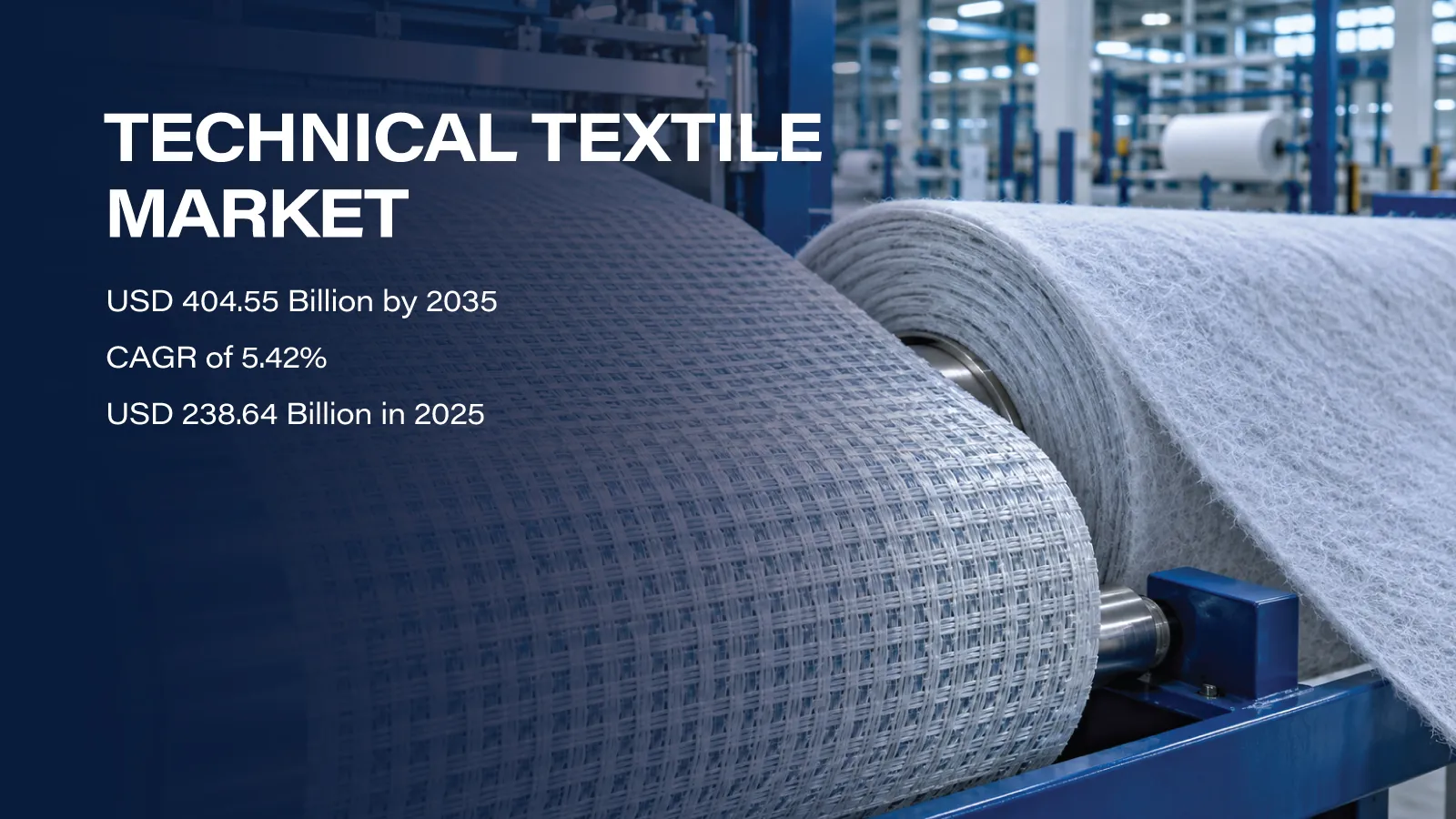
According to SNS Insider, the global technical textile market was valued at USD 238.64 Billion in 2025, reached an estimated USD 251.57 Billion in 2026, and is projected to attain USD 404.55 Billion by 2035, expanding at a CAGR of 5.42% during 2026–2035.
This is due to the incorporation of specialty textiles in medical devices, electric vehicles, infrastructure strengthening, industrial filtration, and protective clothing. Manufacturers are also focusing on developing advanced fibers, recyclable fibers, and textile processing machinery.
To Get Detailed Insights on the Technical Textile Market – Request a Sample Report
Asia-Pacific continues to be the leading manufacturing and consuming region, owing to its strong textile manufacturing base, industrial development, and increasing demand in the healthcare sector. Asia-Pacific is expected to have the highest CAGR from 2021 to 2035.
The industry’s future outlook points toward growing prospects for manufacturers in high-performance fibers, medical nonwovens, reinforcements, and sustainable textile fibers.
Technical Textile Market Size and Forecast
|
Market Indicator |
Value |
|---|---|
|
Market Size, 2025 |
USD 238.64 Billion |
|
Market Size, 2026 |
USD 251.57 Billion |
|
Market Forecast, 2035 |
USD 404.55 Billion |
|
CAGR, 2026–2035 |
5.42% |
|
Largest Regional Market |
Asia-Pacific |
|
Asia-Pacific Share, 2025 |
41.38% |
|
Fastest-Growing Region |
Asia-Pacific |
|
Asia-Pacific CAGR |
6.31% |
|
Leading Material |
Synthetic Fibers |
|
Leading Application |
Mobiltech |
Demand Drivers and Constraints
Primary Demand Drivers
-
Expanding medical and hygiene applications: Increasing consumption of surgical gowns, wound dressings, protective equipment, filtration materials, and disposable hygiene products supports demand for medical-grade technical textiles.
-
Automotive lightweighting: Vehicle manufacturers are incorporating advanced fabrics, composite reinforcements, insulation, and thermal protection materials to improve efficiency, safety, and vehicle performance.
-
Infrastructure modernization: Investments in roads, railways, drainage networks, and erosion protection are expanding the adoption of geotextiles and geosynthetic reinforcement materials.
-
Industrial safety requirements: Growing demand for flame-resistant clothing, ballistic protection, cut-resistant equipment, and specialized industrial fabrics is encouraging high-performance fiber adoption.
-
Sustainable material development: Recycled polyester, bio-based fibers, and alternative chemical finishes are creating opportunities for manufacturers serving environmentally conscious industries.
-
Manufacturing expansion in Asia: Growing production capacity, government initiatives, and export-oriented textile manufacturing are supporting regional market development.
Potential Growth Constraints
-
Volatile polyester, polypropylene, nylon, and energy prices affecting manufacturing costs.
-
High capital requirements for advanced nonwoven, composite, and specialized fiber production.
-
Increasing restrictions on certain chemical treatments and textile finishing substances.
-
Price competition from established low-cost manufacturing regions.
-
Complex certification requirements for medical, aerospace, and protective textile applications.
Demand Structure by Material
Synthetic Fibers (2025 Market Share: 52.37%)
Synthetic fibers is one of the biggest material segments, with 52.37% share in technical textiles market in 2025. The use of polyester, polypropylene, and nylon fibers is common due to properties such as strength, processability, tensile strength, and relatively low cost of production. Such materials can be used for purposes, such as industrial filtration, car interiors, hygiene items, packing, and geotextiles.
Existing facilities for fiber production along with regular supply of raw materials help in securing the economic standing of synthetic fibers. The manufacturers are also considering recycling of polymers in order to meet sustainability concerns without sacrificing their properties.
Current trend: Continued demand for cost-effective synthetic fabrics with improved recyclability and functional performance.
High-Performance Fibers (Forecast CAGR: 7.59%)
High-performance fibers have been expected to witness the fastest growth among all the materials in the forecast period, growing at the rate of about 7.59% CAGR between 2026 and 2035. There are aramid, carbon, glass, and ultra-high molecular weight polyethylene fibers that provide some special characteristics which are necessary for various applications. Increasing demand for lightweight structures, advanced thermal protection, and high-strength reinforcement materials is encouraging investment in specialty fiber development.
Current trend: Accelerating adoption of advanced reinforcement fibers across aerospace, defense, and electric mobility applications.
Demand Structure by Process
Woven Fabrics (2025 Market Share: 42.18%)
Woven fabrics dominate the process category, accounting for approximately 42.18% of the market in 2025 due to their inherent properties of stability, strength, and already established production processes that are fit for making airbags, conveyors, industrial tarps, car reinforcements, and protective suits. Engineered Woven Fabrics can be designed to exhibit certain durability and stability properties. The presence of readily available weaving machinery and the established industrial supply chain network makes this division even more viable.
Current trend: Sustained demand for engineered woven materials in automotive, industrial, and protective applications.
Composite and Braided Structures (Forecast CAGR: 7.82%)
Textiles with composite and braided constructions are forecast to witness growth at a rate of 7.82% CAGR by 2035. These textiles are increasingly being used as reinforcements in aerospace structures, wind turbines, pressure vessels, and light-weight automotive applications. Advanced braiding, three-dimensional weaving, and automated composite production processes help in fabricating complicated structural components and optimize material usage.
Current trend: Growing adoption of lightweight composite reinforcements and automated manufacturing technologies.
Demand Structure by Application
Mobiltech (2025 Market Share: 25.31%)
The Mobiltech application segment constitutes the largest end-user industry and accounts for around 25.31% of the global sales of technical textiles by 2025. The use of technical textiles in automobiles, railways, aircrafts, and ships include seat covers, airbags, seat belts, insulators, filters, and structural reinforcements. The growth in production of electric cars will lead to a higher demand for thermal shields, batteries insulation, and lightweight composites. The need for safety standards and durability in vehicles will ensure continuous demand.
Current trend: Increasing textile content in vehicles, particularly for lightweight construction and thermal management.
Meditech (Forecast CAGR: 7.12%)
Meditech is estimated to be the most rapidly growing segment at a CAGR of around 7.12% during 2026-2035. Increasing healthcare needs, aging population, and increasing usage of disposable medical equipment fuel demand in the market. Technical textiles include surgical gowns, wound dressings, implants, medical filtration, and protective garments. Various manufacturers have started developing breathable, antimicrobial, and other specialty barrier textiles to satisfy evolving needs in healthcare.
Current trend: Expanding adoption of advanced medical nonwovens and specialized healthcare textiles.
Regional Market Dynamics
Asia-Pacific (2025 Market Share: 41.38%)
In Asia-Pacific region, which dominates the global technical textiles market, revenues account for about 41.38% share of the market in 2025 and are forecast to record fastest regional CAGR of 6.31% over the 2035 period. China has abundant capacities for fibers, fabrics, and non-wovens, while India is expanding technical textile manufacturing capacity through industrial development programs. Japan and South Korea supply high-tech fibers and composite materials. The demand is backed by vehicle manufacturing, hygiene consumption, infrastructure development, and growing health care needs.
Direction: Continued regional leadership supported by manufacturing scale, industrial investment, and increasing domestic consumption.
Europe — High-Performance Textile Innovation
Europe forms the second-largest regional market for technical textiles, backed by a developed auto industry, aerospace industry, and others. The countries, such as Germany, France, Italy, and many more in Europe have well-developed capacities for producing fabrics, filtration media, and composite materials. Environmental regulations are forcing companies to produce materials that are recyclable and require less chemicals for finishing and better traceability. On the downside, energy costs are high and industrial demand is low.
Direction: Growth concentrated in specialized, certified, and environmentally responsible textile technologies.
North America — Aerospace, Medical and Protective Applications
North America comes third in terms of consumption with consumption dominated by aerospace, military, healthcare, manufacturing in the automotive industry, and industrial filtration. In terms of the U.S. technical textiles market size, the U.S. technical textiles market reached an estimated value of around USD 45.75 Billion in 2025 and is expected to grow at a CAGR of 4.96% during 2035. Advanced manufacturing capabilities, medical supply requirements, and demand for specialized protective fabrics support market expansion.
Direction: Continued investment in high-value industrial textiles, medical materials, and advanced composite applications.
Latin America and Middle East & Africa
Latin America and the Middle East & Africa have been identified as developing markets for technical textiles. Brazil and Mexico have created market demands by using technical textiles in their automotive production, agriculture, mining, and development projects.
Meanwhile, there is an increased demand for geotextiles, industrial textiles, and special building materials as a result of infrastructure development in Saudi Arabia and UAE. Healthcare modernization and agricultural development offer additional opportunities across both regions.
Direction: Gradual expansion supported by construction activity, healthcare demand, and industrial diversification.
Competitive Landscape
The technical textile market remains fragmented, with multinational manufacturers competing alongside specialized regional producers. Key companies include Freudenberg Performance Materials, Toray Industries, Magnera, Ahlstrom, Teijin Frontier, Asahi Kasei, DuPont, Owens Corning, Hexcel, Garware Technical Fibres, SRF Limited, Alkegen, and Avgol.
Competition increasingly focuses on material performance, production efficiency, certifications, recycling capabilities, and customer-specific product development. Manufacturers are pursuing advanced composite technologies, medical textile specialization, and sustainable material innovation to strengthen their commercial positions. Strategic acquisitions and manufacturing portfolio restructuring are also influencing competition across specialized nonwovens, high-performance fibers, and industrial textile applications.
Market Outlook (2026–2035)
The forecasted growth of the global technical textiles market during the period from 2026 to 2035 is estimated to be around 5.42%, going from USD 251.57 Billion in 2026 to USD 404.55 Billion by 2035. The major factors contributing to market growth are increased usage of medical textiles, car light-weighting, infrastructure improvement, and adoption of special purpose industrial materials. High-performance fibers and composite materials should provide interesting opportunities as manufacturers strive to increase strength and reduce weight and thermal properties of products.
At the same time, sustainability demands would impact the development of new products, driving recyclable fiber technology and eco-friendly finishing processes. Asia-Pacific region will remain the leader in technical textiles owing to vast manufacturing capabilities and rising demand in industrial applications. Overall, the technical textile market is positioned for steady expansion through 2035, with competitive advantage increasingly determined by material innovation, manufacturing efficiency, regulatory compliance, and the ability to meet specialized end-use performance requirements.
About the Author

Get in touch