
The latest SNS Insider Passive and Interconnecting Electronic Components Market report states that demand for reliable electronic components is rising due to artificial intelligence infrastructure, automotive electrification, industrial automation, and high-speed communication networks, and the global market is entering a major expansion phase.
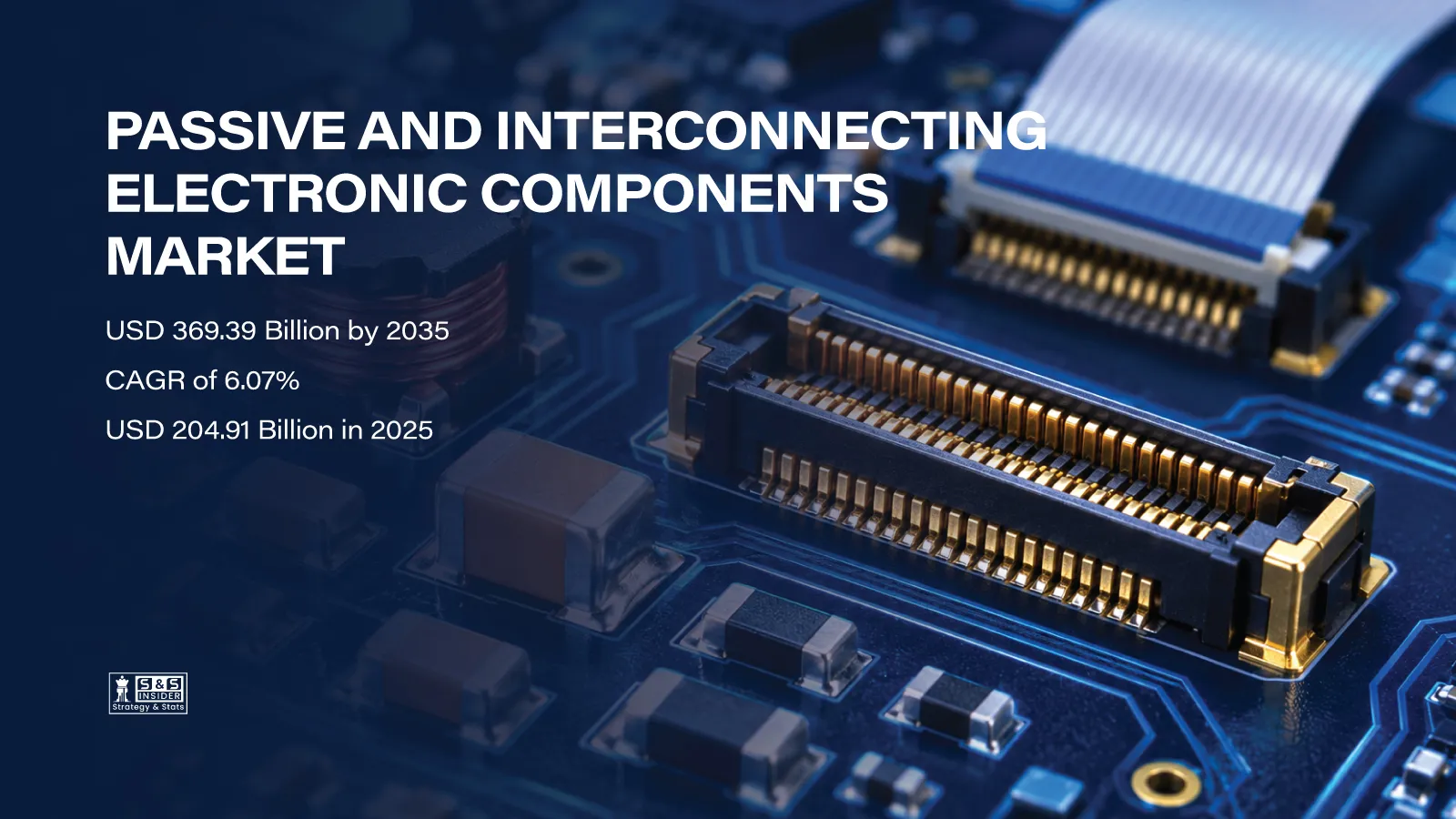
The global passive and interconnecting electronic components market was valued at USD 204.91 billion in 2025 and is projected to reach USD 217.35 billion in 2026. Revenue is expected to reach USD 369.39 billion by 2035, growing at a CAGR of 6.07% during 2026-2035.
The industry is undergoing a structural transition to smaller, higher capacity and more robust components that are able to support ever more complex electronic systems. Power management, electrical stability and signal transmission require capacitors, resistors, inductors, connectors and printed circuit boards.
AI servers, electric vehicles and 5G infrastructure are also driving demand for high-performance components. Manufacturers are ramping up production capacity and improving material technologies.
To Get Detailed Insights on the Passive and Interconnecting Electronic Components Market – Request a Sample Report
Asia-Pacific leads in global revenue and is predicted to grow fastest regionally, fueled by the established manufacturing ecosystems in China, Japan, South Korea and Taiwan.
Competitive positioning will increasingly be driven by manufacturing precision, high-reliability product development and diversified supply chains by 2035.
Market Size and Forecast
| Market Indicator | Value |
|---|---|
| Market Size, 2025 | USD 204.91 Billion |
| Market Size, 2026 | USD 217.35 Billion |
| Market Forecast, 2035 | USD 369.39 Billion |
| CAGR, 2026–2035 | 6.07% |
| Leading Region, 2025 | Asia-Pacific (44.37%) |
| Fastest-Growing Region | Asia-Pacific (6.79% CAGR) |
Demand Drivers and Constraints
Primary Demand Drivers
-
AI data center expansion: Increasing deployment of high-performance servers creates demand for advanced capacitors, inductors, and high-speed connectors.
-
Electric vehicle adoption: Battery management systems, traction inverters, and charging infrastructure require reliable passive and interconnecting components.
-
Electronics miniaturization: Compact smartphones, wearables, and computing devices support demand for smaller, higher-capacitance components.
-
5G network development: High-frequency telecommunications equipment requires precision connectors and advanced filtering components.
-
Industrial automation: Smart factories, robotics, and industrial controllers increase demand for durable electronic components.
-
Renewable energy infrastructure: Solar inverters, energy storage systems, and power conversion equipment support demand for high-voltage components.
Potential Growth Constraints
-
Raw material price fluctuations and semiconductor supply chain disruptions.
-
High capital investment requirements for advanced manufacturing facilities.
-
Increasing technical complexity and component qualification requirements.
-
Environmental compliance obligations and restrictions on hazardous materials.
-
Pricing pressure within standardized, high-volume component categories.
Demand Structure by Component
Passive Components (2025 Market Share: 58.94%)
The major segment is passive components and it covers approximately 58.94% of the total revenue worldwide in 2025. Capacitors, resistors, inductors and transformers are essential for voltage stabilization, current control, energy storage and electromagnetic interference suppression. Steady demand is driven by their wide use in consumer electronics, industrial equipment, automotive systems and telecommunications infrastructure.
Growing demand for high capacitance and temperature resistance with increased adoption of AI computing hardware and electric vehicles is driving this trend. In an effort to satisfy the requirements of increasingly dense circuit architectures, manufacturers are concentrating on smaller designs and improved electrical performance.
Current trend: Rising demand for compact, high-performance passive components.
Major trends: Multilayer ceramic capacitor innovation, high-voltage component development, miniaturization, and improved thermal stability.
Interconnecting Components (Forecast CAGR: 6.64%)
Interconnection components will see the fastest growth at the component level, with a CAGR of 6.64% from 2026 to 2035.
The demand for high speed data transmission, electric vehicle wiring systems and industrial communication equipment is driving the market for connectors, sockets, printed circuit boards and cable assemblies. Reliability at scale is crucial for interconnections in AI data centers needing high bandwidth and efficient power distribution.
Automakers are also moving to more complex electrical architectures, which boosts the demand for connectors in battery systems, advanced driver assistance and electronic control units.
Current trend: Accelerating adoption of high-speed and high-reliability interconnect solutions.
Major trends: High-density connectors, automotive wiring architectures, low-loss signal transmission, and advanced PCB integration.
Demand Structure by Product Type
Capacitors (2025 Market Share: 23.28%; Forecast CAGR: 7.37%)
Capacitors dominate the product category with a 23.28% revenue share in 2025, and are also expected to register the fastest growth, at 7.37% CAGR through 2035.
They are important in power filtering, voltage stabilizing and energy storage, thus they are widely used in electronic applications. Increasing demand for multilayer ceramic capacitors used in smartphones, servers and automotive electronics.
Electric vehicle power systems need components that can operate in extreme electrical and thermal environments. AI servers also need dense power-delivery networks, which are forcing manufacturers to make smaller, more reliable, higher-capacitance capacitors.
Current trend: Increasing investment in high-capacitance ceramic capacitor manufacturing.
Major trends: Miniature MLCCs, automotive-grade capacitors, advanced dielectric materials, and high-voltage power applications.
Demand Structure by Application
Consumer Electronics (2025 Market Share: 32.64%)
The largest application share is of consumer electronics, with a revenue share of approximately 32.64% in 2025.
Smartphones, laptops, tablets, televisions, wearables and connected household appliances all require huge quantities of passive components and interconnects. Higher component integration is supported by device functionality, compact designs and faster charging technologies.
The growth of on-device artificial intelligence and connected consumer ecosystems are also pushing manufacturers to adopt advanced component technologies.
Replacement demand and technology upgrades will continue to support purchasing across all major electronics manufacturing markets through 2035.
Current trend: Strong demand for miniature components supporting multifunctional electronics.
Major trends: Smart device integration, compact circuit designs, faster charging, and high-density electronic assemblies.
Automotive (Forecast CAGR: 7.74%)
The automotive sector is anticipated to grow at the quickest pace, with an expected CAGR of 7.74% in the period 2026–2035.
The electrification of the vehicle, the advanced driver assistance systems and the digital cockpit technologies are increasing the electronic components requirements per vehicle. Capacitors, inductors and high current interconnects are key elements in electric powertrains and battery management systems.
This opens doors for suppliers with qualified high reliability products as automotive manufacturers require durability, temperature resistance and long term component availability.
Current trend: Increasing electronic component integration across electric and software-defined vehicles.
Major trends: Automotive-grade MLCCs, high-voltage connectors, battery management components, and advanced vehicle electrical architectures.
Demand Structure by End User
Original Equipment Manufacturers (2025 Market Share: 69.18%)
End-user demand is dominated by original equipment manufacturers, which account for around 69.18% of market revenue in 2025.
Component specifications are built directly into product design and manufacturing processes . OEMs have large purchasing volumes . Manufacturers in the automotive, industrial, healthcare and telecommunications fields depend on qualified suppliers to ensure consistent electrical performance and product reliability.
Long-term purchase contracts and supplier qualification requirements reinforce existing commercial relationships.
Current trend: Growing emphasis on supply reliability and direct component procurement.
Major trends: Long-term sourcing agreements, supplier diversification, component standardization, and advanced quality assurance.
Electronic Contract Manufacturers (Forecast CAGR: 6.95%)
Electronic contract manufacturers are projected to grow at a CAGR of 6.95% through 2035.
Global electronics brands are increasingly outsourcing assembly operations to specialized manufacturers capable of managing complex component procurement and high-volume production.
Expansion of manufacturing operations in India, Vietnam, Mexico, and Eastern Europe is supporting additional demand for passive components, connectors, and printed circuit boards.
Current trend: Increasing reliance on outsourced electronics manufacturing.
Major trends: Regional production diversification, integrated procurement, high-volume PCB assembly, and flexible manufacturing networks.
Regional Market Dynamics
Asia-Pacific (2025 Market Share: 44.37%; Forecast CAGR: 6.79%)
The Asia-Pacific region will have the highest share of revenue of 44.37% in 2025 in the global market and is expected to witness the fastest growth rate with a CAGR of 6.79%.
China, Japan, South Korea and Taiwan have mature electronics manufacturing ecosystems and high-end component manufacturing capabilities. China accounts for about 58.73% of regional revenue.
Demand is regional, with growing electric vehicle and smartphone production as well as investment in AI infrastructure and industrial automation. India and Southeast Asian economies are increasing their electronics manufacturing capacity, opening more opportunities for suppliers.
Direction: Continued market leadership supported by electronics manufacturing expansion and advanced component innovation.
North America — Second-Largest Regional Market
North America is the second largest regional market supported by AI computing infrastructure, aerospace and defense electronics, automotive development and industrial automation.
The United States held a share of approximately 90.37% of the regional revenue in 2025, and the market was valued at USD 46.72 billion. The U.S. market is expected to grow at a CAGR of 5.68% from 2026 to 2035.
Growing construction of data centers and demand for high-reliability electronic systems provide opportunities for specialized manufacturers.
Canada contributes telecommunications, industrial equipment and transportation electronics.
Direction: Stable expansion driven by data center investment, defense applications, and advanced manufacturing.
Europe — Third-Largest Regional Market
Europe is the third largest market with a share of about 27.64% in 2025. Germany is the largest contributor in the region.
Germany, France, the United Kingdom and Italy are important markets for automotive electronics, industrial automation, transportation systems and equipment for renewable energy.
European manufacturers are concerned with reliability of components, energy efficiency and adherence to regulations regarding environment.
The increasing use of electric mobility and industrial digitalization is driving demand for advanced capacitors, connectors and power management components.
Direction: Sustained growth supported by automotive electrification and industrial technology modernization.
Latin America — Emerging Electronics Manufacturing Market
Electronics production and automotive supply chains are being diversified to Latin America by manufacturers.
Brazil is the biggest regional demand, contributing to about 36.74% of Latin American revenue in 2025. Another important manufacturing location is Mexico, especially for automotive electronics and assembly for export.
“Increasing industrial investment, the development of telecommunications infrastructure and regional sourcing strategies are supporting component demand.
Direction: Gradual expansion driven by automotive manufacturing, industrial investment, and supply chain diversification.
Middle East & Africa — Developing Industrial Electronics Market
The Middle East and Africa market is supported by industrial infrastructure development, telecommunications investment, and renewable energy projects.
Saudi Arabia represents approximately 31.47% of regional revenue in 2025. The UAE, Qatar, and South Africa also offer opportunities linked to industrial automation, energy infrastructure, and electronic equipment deployment.
Increasing investment in data centers and smart infrastructure is expected to support future component consumption.
Direction: Emerging growth supported by industrial diversification and digital infrastructure expansion.
Key Market Participants
The competitive landscape includes manufacturers specializing in passive components, electronic connectors, and advanced interconnection technologies.
Representative participants include Murata, TDK, Samsung Electro-Mechanics, Yageo (including KEMET), Vishay Intertechnology, KYOCERA AVX, Taiyo Yuden, Panasonic Industry, TE Connectivity, Amphenol, Molex, Hirose Electric, Bourns, Würth Elektronik, Samtec, Phoenix Contact, and HARTING.
Competitive strategies increasingly emphasize product miniaturization, advanced materials, manufacturing capacity expansion, and acquisitions that strengthen high-speed connectivity portfolios.
Market Outlook (2026–2035)
The SNS Insider estimates that the global market for revenue will reach USD 369.39 billion by 2035, with a CAGR of 6.07%.
The major demand drivers will be AI computing infrastructure, vehicle electrification, industrial automation and telecommunications modernization.
Capacitors are set for relatively strong growth as manufacturers bring out smaller, higher-capacitance products. There will be big opportunities in the automotive space too as vehicle electrical architectures become more advanced.
Asia Pacific is expected to remain the leader and the regional diversification in manufacturing will affect procurement and investment decisions globally.
Competitive differentiators will increasingly include supply chain resilience, component reliability and manufacturing precision.
Overall, the passive and interconnecting electronic components market is positioned for sustained expansion through 2035, with growth increasingly determined by advanced electronics integration, high-performance component development, and the global expansion of intelligent digital infrastructure.
About the Author

Get in touch




