The global pharmaceutical gelatin market is anticipated to grow steadily over the next two decades through 2035 owing to increased pharmaceutical output and increasing demands for oral dosage drugs. The reason for the popularity of gelatin in the pharmaceutical sector is due to its film-forming abilities, compatibility, stabilization, and usage in capsule manufacture.
According to SNS Insider, the Pharmaceutical Gelatin Market was valued at USD 1.33 Billion in 2025 and is projected to increase to USD 1.41 Billion in 2026, reaching USD 2.32 Billion by 2035, registering a CAGR of 5.74% during 2026–2035.
Growth is becoming more related to generic drug production, pharmaceutical outsourcing, production of nutraceuticals, and gelatin use in absorbable hemostatic agents and advanced drug formulations. Companies are improving their production processes by making traceability of the ingredients better, production more consistent and regulation-compliant.
To Get Detailed Insights on the Pharmaceutical Gelatin Market – Request a Sample Report
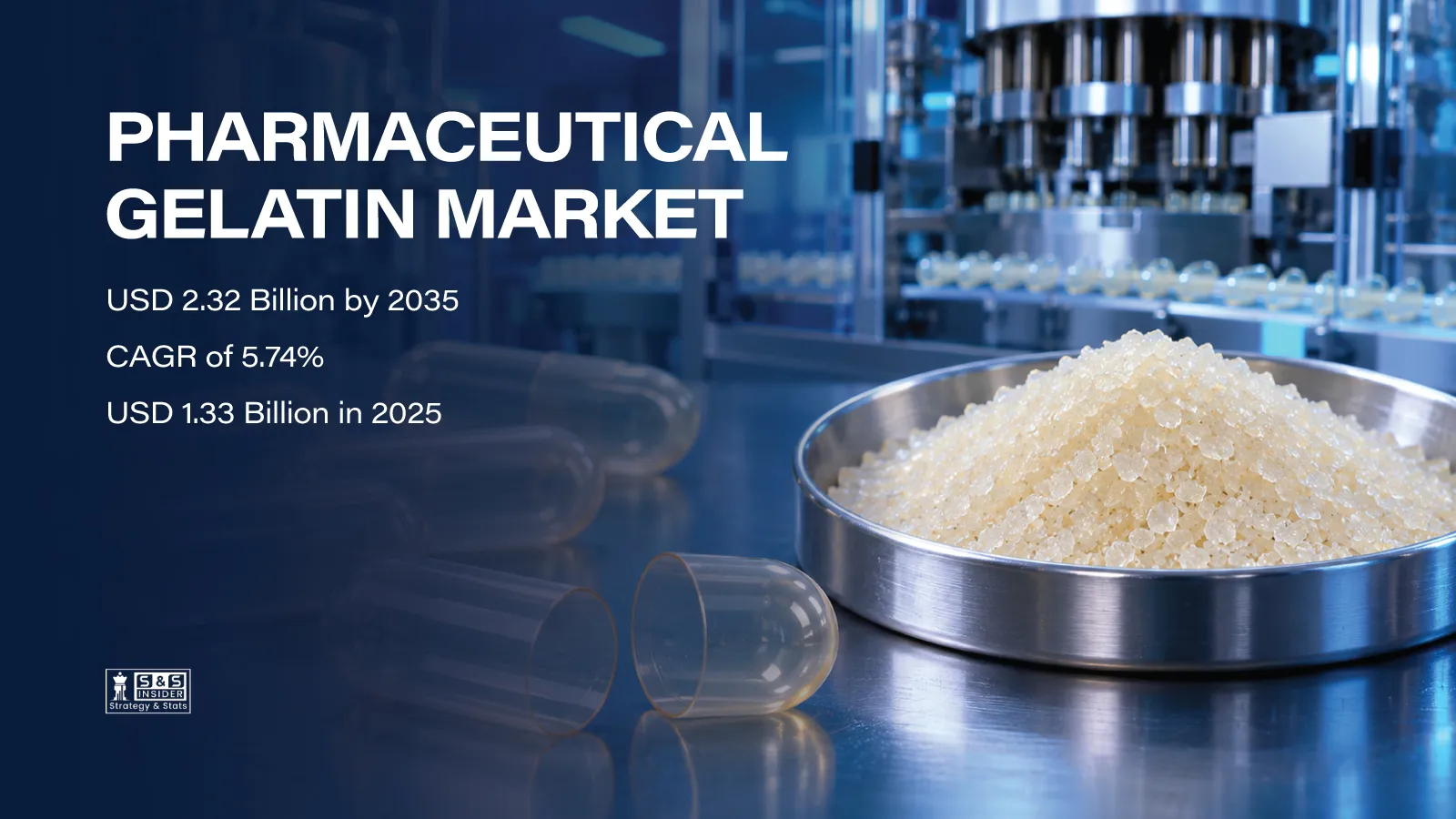
North America had the largest market share of 39.20% in 2025, while Asia Pacific will have the highest growth rate of 6.48% CAGR. In spite of growing competition for capsule material from plant-based sources, pharmaceutical gelatin still enjoys well-established manufacturing facilities and good compatibility in many drug formulations.
Market Size and Forecast
|
Market Indicator |
Value |
|
Market Size, 2025 |
USD 1.33 Billion |
|
Market Size, 2026 |
USD 1.41 Billion |
|
Market Forecast, 2035 |
USD 2.32 Billion |
|
CAGR, 2026–2035 |
5.74% |
|
Leading Region |
North America (39.20%) |
|
Fastest-Growing Region |
Asia Pacific (6.48% CAGR) |
|
Leading Application |
Hard Capsules (40.12%) |
Demand Drivers and Constraints
Primary Demand Drivers
-
Expansion of capsule manufacturing: Increasing pharmaceutical production is supporting demand for gelatin-based hard capsules and softgel formulations used in prescription and over-the-counter medicines.
-
Growing nutraceutical consumption: Vitamins, omega-3 supplements, and other health products continue to create demand for gelatin-based delivery systems.
-
Rising generic medicine production: Pharmaceutical manufacturing expansion across India, China, and other emerging economies is increasing requirements for reliable excipient supplies.
-
Advancements in drug delivery: Gelatin's formulation flexibility supports applications involving lipid-based medicines, controlled-release systems, and specialized pharmaceutical preparations.
-
Increasing pharmaceutical outsourcing: Contract manufacturers require consistent gelatin quality, technical support, and dependable regional supply chains.
-
Improving manufacturing capabilities: Investments in purification technologies and processing infrastructure support pharmaceutical-grade gelatin availability.
Potential Growth Constraints
-
Growing competition from plant-based capsule materials, including HPMC and pullulan.
-
Raw material price fluctuations linked to livestock processing and international supply chains.
-
Religious and dietary restrictions affecting acceptance of certain animal-derived ingredients.
-
Strict pharmaceutical quality, traceability, and regulatory compliance requirements.
-
Increasing production costs associated with purification, testing, and certification.
Demand Structure by Source
Bovine Gelatin (2025 Market Share: 41.83%)
Bovine gelatin holds the largest share among segments, with 41.83% contribution to the worldwide pharmaceutical gelatin market revenue in 2025. Availability, reliable gelling properties, and usage in pharmaceutical production have helped bovine gelatin gain market dominance. It finds application in hard capsules, softgel shells, tablets, and certain medical products. The manufacturers of these products can take advantage of well-established supply chains and tested production techniques. However, documentation on the source and safety standards is required by the pharmaceutical industry buyers.
Current trend: Continued preference for established bovine gelatin grades with verified sourcing and pharmaceutical quality documentation.
Marine Gelatin (Forecast CAGR: 7.46%)
Marine gelatin is estimated to register the highest growth among segments, growing at a CAGR of about 7.46% from 2026 to 2035. Gelatin derived from fish holds a lot of attention among manufacturers looking for non-mammalian raw material options because of its feasibility in meeting specific dietary or religious demands. Functional properties, cost, and certification standards will be major factors determining its acceptance.
Current trend: Increasing development of specialty fish-derived gelatin formulations for differentiated pharmaceutical applications.
Demand Structure by Function
Stabilizing Agents (2025 Market Share: 42.17%)
The share of stabilizing agents was 42.17% in the gelatin market for pharmaceutical applications in 2025. Gelatin maintains the stability and structure of certain capsules, tablets, and pharmaceutical formulations. The role of gelatin lies in the protection of ingredients in the formulation process. Demand is expected to remain significant as pharmaceutical manufacturers emphasize product quality and formulation reliability.
Current trend: Sustained demand for multifunctional pharmaceutical excipients with established performance characteristics.
Thickening Agents (Forecast CAGR: 6.34%)
Thickening agents are projected to grow at approximately 6.34% CAGR through 2035. Increasing development of semi-solid medications, pharmaceutical gels, suspensions, and specialized drug delivery products supports demand for ingredients capable of controlling viscosity and texture. Gelatin's rheological characteristics make it relevant to formulations requiring defined consistency and controlled processing behavior.
Current trend: Growing utilization in pharmaceutical gels and specialty oral formulations.
Demand Structure by Application
Hard Capsules (2025 Market Share: 40.12%)
Capsules formed the leading application segment and held an approximate share of 40.12% of the overall global market value in 2025. Capsule shells based on gelatin continue to be preferred because of compatibility with existing filling machinery, reliable properties, and applicability for various formulations in the pharmaceutical industry. Production by generic medicine manufacturers and nutraceutical firms can be counted among the significant drivers of demand. The present manufacturing base further facilitates the use of gelatin as compared to other capsule types.
Current trend: Stable demand from established capsule manufacturing operations and expanding generic medicine production.
Softgel Capsules (Forecast CAGR: 6.71%)
Softgel capsules are expected to register the fastest application growth, with a CAGR of approximately 6.71% during 2026–2035. Softgels are important for liquid and lipid-based formulations, including certain vitamins, nutritional oils, and poorly water-soluble active ingredients. Gelatin provides elasticity and sealing characteristics required for efficient softgel production. Continued investment in encapsulation technologies is expected to support demand.
Current trend: Growing adoption of softgel delivery for specialized pharmaceutical and nutritional formulations.
Demand Structure by End User
Pharmaceutical and Biopharmaceutical Companies (2025 Market Share: 64.35%)
In 2025, pharmaceutical and biopharmaceutical firms have contributed 64.35% to market revenue. Such entities need pharmaceutical grade gelatin in the production of medicines, excipients, and other medicinal purposes. Long-term procurement agreements, supplier qualification procedures, and comprehensive quality documentation support relationships with established gelatin producers.
Current trend: Increasing emphasis on traceable pharmaceutical ingredients and reliable supply contracts.
Biotechnology Companies (Forecast CAGR: 6.58%)
The biotechnology companies are anticipated to grow at around 6.58% CAGR between 2026 and 2035. Gelatin-based solutions are under scrutiny for potential uses in biologic stabilization, research frameworks, and drug delivery. Although biotechnology applications can require relatively small material volumes, they often demand stringent purity standards and specialized technical support.
Current trend: Growing research interest in high-purity gelatin for advanced therapeutic development.
Regional Market Dynamics
North America (2025 Market Share: 39.20%)
North America captured the largest share of the global gelatin for pharmaceuticals market with a 39.20% market share in 2025. The region has been driven by pharmaceutical manufacturing activities, dietary supplements production, and quality demands. The largest regional market includes the U.S., which had a valuation of about USD 0.44 Billion in 2025. Demand was driven by pharmaceutical capsules production and excipients purchase.
Direction: Continued market leadership supported by pharmaceutical manufacturing and supply chain modernization.
Europe — Established Manufacturing and Quality Standards
The European region is the second largest regional pharmaceutical gelatin market. The pharmaceutical industry and the manufacturing expertise in the production of gelatin make Germany an important country in the market. France, Italy, Belgium, and the Netherlands also contribute to regional demand. Strict quality standards, documented sourcing requirements, and specialized processing capabilities influence supplier competitiveness.
Direction: Steady demand supported by pharmaceutical quality requirements and established production networks.
Asia Pacific (Forecast CAGR: 6.48%)
Asia Pacific is expected to be the fastest-growing regional market, expanding at approximately 6.48% CAGR through 2035. In terms of regional shares of countries, China has the highest share, while India presents growth opportunities due to increasing exports of generics and capability of capsule manufacturing.
Japan and South Korea also add their share of demand due to the presence of well-developed pharmaceutical and nutraceutical industries in these countries. Increasing regional manufacturing capacity and specialized capsule production are expected to strengthen gelatin consumption.
Direction: Accelerating demand supported by pharmaceutical production expansion and investment in regional supply chains.
Latin America and Middle East & Africa
Latin America represented approximately 4.12% of global market revenue in 2025, with Brazil accounting for an important share of regional demand. Brazil's livestock-related raw material availability and pharmaceutical manufacturing base support the regional gelatin industry. The Middle East and Africa accounted for approximately 3.85% of global revenue. Saudi Arabia is a major regional market, where pharmaceutical localization initiatives and demand for certified gelatin support opportunities.
Direction: Gradual expansion supported by local pharmaceutical manufacturing, distribution development, and specialized certification requirements.
Competitive Landscape
The pharmaceutical gelatin market includes established international producers and regional manufacturers supplying pharmaceutical-grade gelatin and related materials. Key participants include GELITA AG, Darling Ingredients Inc., Tessenderlo Group, Nitta Gelatin Inc., Weishardt Group, Lapi Gelatine S.p.A., ITALGEL S.r.l., Trobas Gelatine B.V., Gelnex, and India Gelatine & Chemicals Ltd.
Competition increasingly focuses on raw material traceability, gel strength consistency, production capacity, regulatory compliance, and technical formulation support. Manufacturers are also evaluating marine-derived products, sustainability improvements, and regional production investments to strengthen their positioning.
Market Outlook (2026–2035)
The forecast value of the global pharmaceutical gelatin market is expected to reach USD 2.32 billion in 2035 on the basis of proven demand for capsules and increasing pharmaceutical manufacturing operations. Hard capsules are estimated to continue being the dominant source of consumption, and the softgel segment provides further options for unique formulations. Gelatin derived from marine sources presents growth opportunity in selected high-end applications, but the costs and performance of such products may restrict their use.
The North American region is predicted to dominate the market, whereas the Asia Pacific region will take advantage of pharmaceutical manufacturing growth and supply chain developments. Competition from plant-derived materials will prompt companies to enhance product quality and technical uniqueness. Generally speaking, the pharmaceutical gelatin market is expected to stay robust until 2035 with the growing influence of capsule manufacturing capacities, advanced drug delivery applications, compliance issues, and availability of pharmaceutical-grade materials.
About the Author

Get in touch